Over 40 Years in BusinessISO 27001 compliantPublic sector: GSA contract holder
LA 562-298-5000 · Chicagoland 312-432-5300 · Phoenix 602-733-6807 · Client Support

East Valley
Cybersecurity services in the East Valley from BTI's Phoenix office and data center: 24/7 NOC/SOC monitoring, MDR, incident response and a free assessment.
Call the Phoenix IT team: 480-272-8728
Phoenix office hours: open 24/7. Emergency support is available 24/7. Call 800-435-7284.
Free cybersecurity assessment
No cost, no obligation. Business inquiries only. Already a BTI client? Use the dedicated support number assigned to your organization.
Managed cybersecurity for Chandler, Tempe, Mesa, Gilbert and Scottsdale organizations, run from BTI Communications Group's Phoenix office and data center inside the Iron Mountain facility on North 48th Street. A 24/7 NOC/SOC watches your environment, and for managed security clients, BTI's own Phoenix staff come on site across the East Valley when an incident calls for it, as defined in your service agreement.
BTI delivers managed cybersecurity, MDR, incident response, vCISO, compliance support and security testing for organizations in Chandler, Tempe, Mesa, Gilbert, Scottsdale and Queen Creek, from our Phoenix office inside the Iron Mountain AZP-1 facility, about 8 to 25 miles from most sites in the East Valley. Call the Phoenix IT team at 480-272-8728.
BTI's own policies and controls are ISO 27001 compliant and independently reviewed through the Technology Assurance Group (TAG) ISO 27001 Compliance Program.
Picture a Tempe engineering firm with a Chandler lab. An employee approves an MFA prompt they did not start, and within the hour a forwarding rule appears in their mailbox. This is a planning scenario, not a claimed BTI project.
With managed detection and response in place, the 24/7 NOC/SOC sees the impossible travel sign in and the new rule, disables the session, resets credentials and blocks the forwarding address. The incident response plan names who calls the client contact and the cyber carrier. If a laptop needs to be rebuilt or evidence preserved, BTI staff drive from the Phoenix office to Tempe or Chandler. Afterward, the vCISO review adds number matching to MFA prompts and a conditional access rule for the lab.
Next step: Get a free cybersecurity assessment
BTI provides on site incident response in the East Valley for managed security clients, as defined in your service agreement. BTI's own Phoenix staff come on site in the East Valley when an incident calls for on site work: isolating affected systems, preserving log evidence, rebuilding devices and supporting recovery under the incident response plan BTI writes for you.
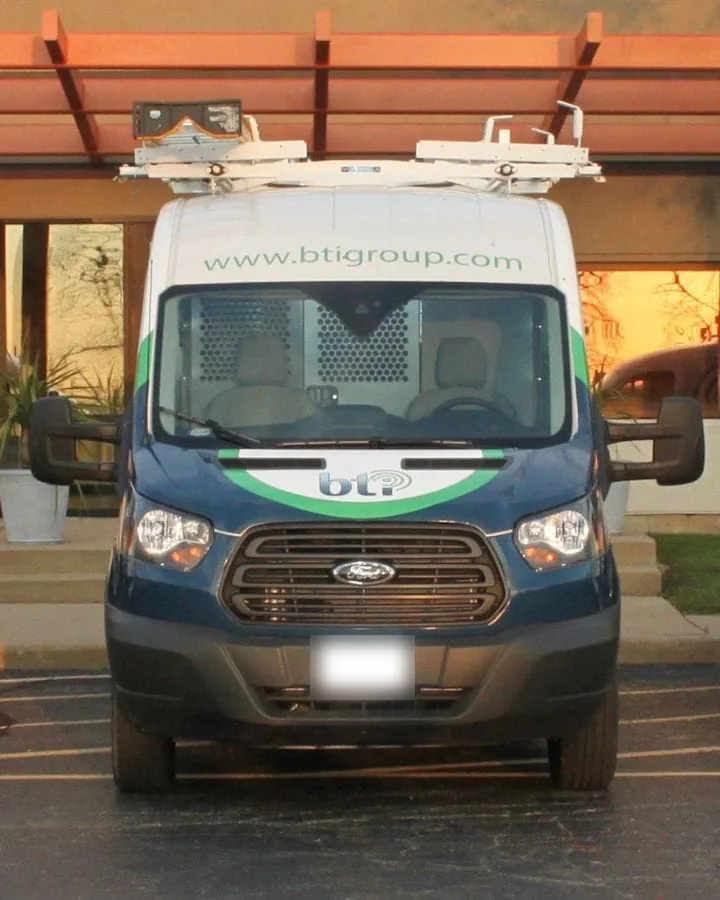
Details: 24/7 MDR and incident response.
Next step: Get a free cybersecurity assessment
BTI organizes cybersecurity for East Valley organizations into six outcomes, each itemized.
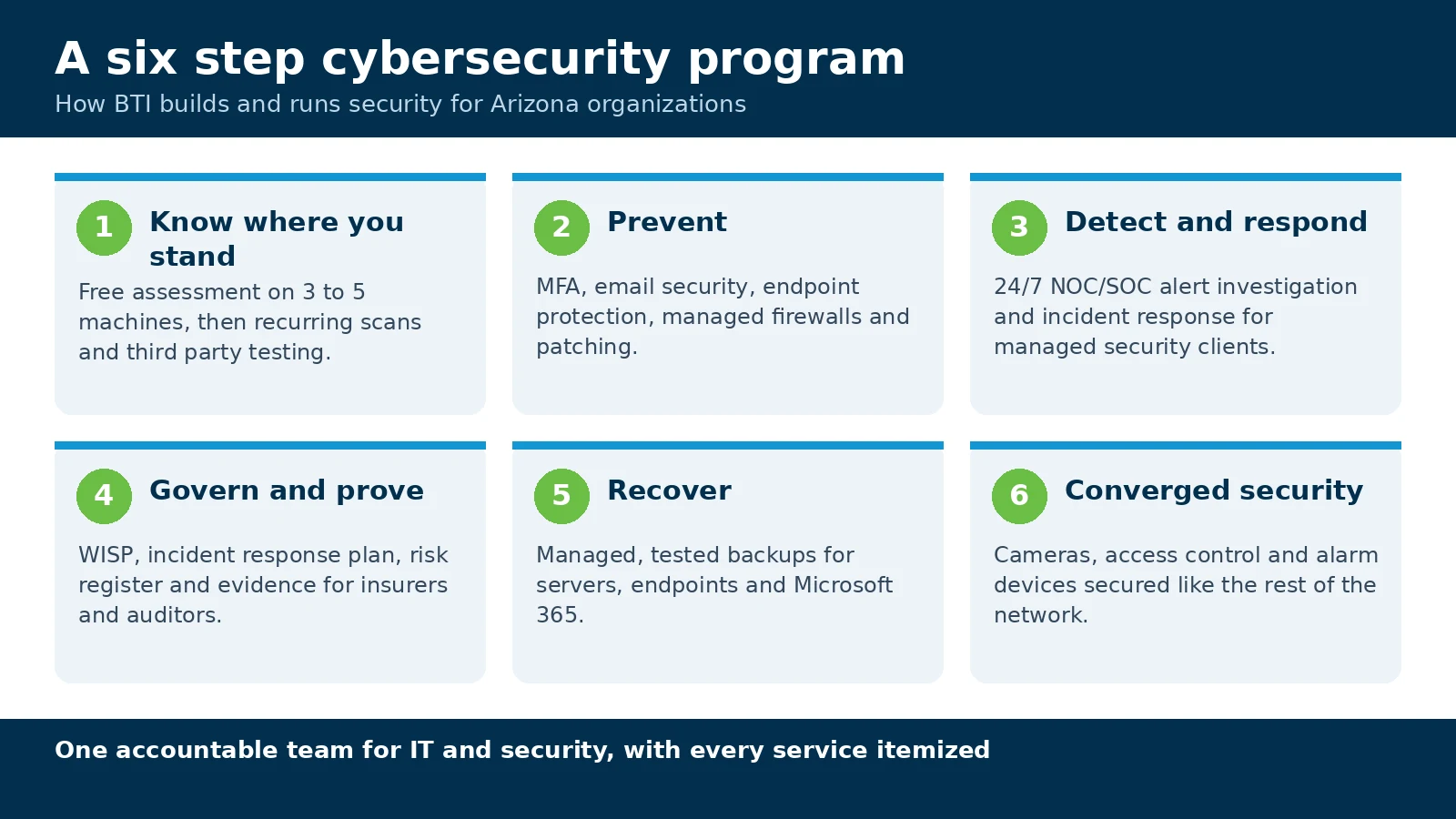
A credential free test on 3 to 5 machines with a written report and readout, then recurring vulnerability scans and third party penetration tests.
MFA and conditional access, dedicated email filtering and training, managed endpoint protection or EDR, managed firewalls or SASE, and patching under a written agreement.
The 24/7 NOC/SOC investigates alerts and, for managed security clients, incident response is included as defined in the service agreement.
A named security leader keeps the WISP, incident response plan, risk register and evidence current.
Managed and tested backups for servers, endpoints and Microsoft 365, with failover to BTI's Phoenix data center for critical systems.
Cameras, access control and alarm devices secured like the rest of the network, with firmware updates, MFA on remote access and logs forwarded to the SIEM.
Know where you stand: Free Cybersecurity Assessment and Pen Test. Govern: vCISO and Cybersecurity Consulting. Recover: Backup and Disaster Recovery.
Next step: Get a free cybersecurity assessment
BTI sells, installs, supports, upgrades and renews the cybersecurity your organization depends on in the East Valley, from one Phoenix team. Each answer below is the short version; ask for a written quote for the details.
BTI sells and supports the security stack East Valley organizations need: endpoint protection and EDR, email security, firewalls and SASE, Microsoft 365 security, SIEM logging and backup. One team runs them together and watches the alerts.
BTI installs and configures firewalls, endpoint agents, email filtering and MFA for East Valley organizations, then documents every setting so the next audit has evidence. New sites get the same security baseline as existing ones.
BTI's 24/7 NOC/SOC monitors and investigates alerts for East Valley organizations around the clock. For managed security clients, incident response is included in BTI managed security, as defined in your service agreement.
BTI replaces end of life firewalls, moves antivirus to managed EDR, adds SASE for remote staff and hardens Microsoft 365 for East Valley organizations, with a staged plan that avoids downtime.
BTI sells and renews endpoint, email security, firewall and backup licenses for East Valley organizations and lines up renewal dates, so protection never lapses because a subscription expired.
BTI itemizes every cybersecurity service for East Valley organizations, so you can see each line and add or drop pieces. Cost depends on users, devices and sites, the detection level you choose, testing frequency and your compliance and insurance requirements.
BTI is a security reseller and managed security provider. It sells the tools, installs them and runs them through the 24/7 NOC/SOC, so East Valley buyers are not left with licenses and no one watching the console.
BTI sells, supplies, deploys and supports security products for East Valley organizations, so you get the tools and the ongoing operation from one team.
If you searched for cybersecurity services near me in Chandler, Tempe, Mesa, Gilbert, Scottsdale and Queen Creek, BTI's Phoenix office and data center is about 8 to 25 miles away, with the 24/7 NOC/SOC behind it.
Next step: Get a free cybersecurity assessment
BTI supports the industries that make up the East Valley's business base, with controls and support matched to how each one works.
Chandler and Mesa suppliers often face customer security reviews and, for defense work, CMMC expectations. CMMC and other compliance work is completed and contracted by BTI and its partners, including top industry professionals in each category.
Scottsdale and Tempe firms are frequent targets for email impersonation and payment fraud. Identity protection, email filtering and phishing training come first.
Gilbert, Mesa and Chandler practices need protected patient data, tested backups and documented incident response. BTI supports HIPAA security work alongside your compliance adviser.
East Valley districts, charter schools and agencies need written security programs and evidence for insurers and auditors, and some can buy through BTI's GSA contract (47QTCA21D00BA).
Next step: Talk with an engineer about your industry
BTI provides cybersecurity for the building types common in the East Valley, each with its own network and support needs.
Office suites and tech campuses along Loop 101 and Loop 202 need fast Wi-Fi, conference room systems and a clean Microsoft 365 setup for hybrid staff. BTI secures these buildings in the East Valley with monitored endpoints, firewalls and logging.
Manufacturing and lab buildings in Chandler and Mesa need production networks kept separate from office IT, with change control that respects shift schedules. BTI secures these buildings in the East Valley with monitored endpoints, firewalls and logging.
Medical and dental offices in Gilbert, Mesa and Scottsdale need reliable workstations, imaging connectivity and tested backups. BTI secures these buildings in the East Valley with monitored endpoints, firewalls and logging.
Next step: Get a free cybersecurity assessment
BTI helps organizations in the East Valley meet the technical side of the requirements they face. BTI describes how it helps; your assessor, carrier or counsel confirms compliance.
For healthcare and dental groups in the East Valley, BTI supports HIPAA security work: access controls, MFA, logging, encryption, tested backups and a documented incident response plan, alongside your compliance adviser.
Organizations in the East Valley that take card payments need segmented payment networks, patched systems and logging. BTI helps meet PCI DSS technical requirements by separating payment devices, managing firewalls and keeping evidence for your assessor.
Cyber insurance carriers now ask East Valley organizations about MFA, EDR, backups and incident plans before they renew. BTI puts those controls in place and documents them so renewal questionnaires have honest answers. BTI does not sell insurance or give coverage advice.
Defense and aerospace suppliers in the East Valley that handle controlled unclassified information need CMMC aligned controls and evidence. CMMC and other compliance work is completed and contracted by BTI and its partners, including top industry professionals in each category.
Arizona requires notice to affected individuals within 45 days after determining that a security system breach occurred (A.R.S. 18-552). BTI's incident runbook supports that timeline with detection, investigation support and documentation. This is general information, not legal advice.
Next step: Ask about a compliance gap review
BTI is a GSA contract holder (47QTCA21D00BA), which helps public agencies and contractors in the East Valley buy through an established federal vehicle. See government cybersecurity.
Next step: Get a free cybersecurity assessment
BTI secures cameras, access control and alarm systems in the East Valley as part of the same program, under Arizona BTR Alarm Business license 22913-0 and Arizona ROC license 331189, C-67 Low Voltage. Related pages: Brivo access control in the East Valley, Commercial security cameras in the East Valley, Access control systems in East Valley.
Next step: Get a free cybersecurity assessment
BTI runs IT and security fully, or works alongside your internal IT team in a co-managed model with a written split of who does what. See managed IT in the East Valley and co-managed IT support. For defined upgrades, see IT projects in Phoenix, and for governed automation, see Managed AI automation in East Valley.
Next step: Get a free cybersecurity assessment
BTI also serves Queen Creek from the same Phoenix team.
See every service on the BTI East Valley hub page.
615 N 48th St, Suite 1048
Phoenix, AZ 85008 (inside the Iron Mountain data center)
IT team: 480-272-8728
Office: 602-733-6807
Office hours: open 24/7. Emergency support is available 24/7. Call 800-435-7284.
Our Phoenix office is about 8 to 25 miles from most sites in the East Valley. 4-hour onsite emergency response is available under BTI support agreements.
East Valley organizations tend to reach the cybersecurity question at a specific moment: a new office or warehouse opens, a carrier sends a tougher renewal form, a public agency or prime contractor asks for security documentation, or a neighbor business gets hit with ransomware. Whatever the trigger, the decisions are the same. This guide lays out the six steps of a complete program, the realistic options at each step, what each option involves and where it falls short, written from the perspective of a provider that runs IT and security from an office inside a Phoenix data center.
Jump to a step:
When you test matters almost as much as how. A baseline taken at the right time turns into a plan; one taken at the wrong time turns into a report nobody reads.
| Trigger | What to test | Why it matters |
|---|---|---|
| Before a cyber insurance renewal | MFA coverage, endpoint protection on every device, backup separation, remote access exposure. | Lets you answer the application with facts and fix gaps before the carrier finds them. |
| Before an acquisition, merger or new location | External exposure, inherited accounts, unmanaged devices and old firewalls. | Attackers like the seams between two networks being joined. |
| After a scare or an incident nearby | Email impersonation, credential reuse, admin rights and what an attacker on one PC could reach. | Turns worry into a ranked list of fixes. |
| On a schedule | Monthly vulnerability scans and quarterly penetration tests by a third party. | Builds the trendline insurers, auditors and boards want to see. |
Testing approaches also differ by who runs them. Internal IT running its own scanner is fast but grades its own homework. A one-time penetration test from a consulting firm is independent but ages quickly. Recurring third-party testing costs more over a year but shows whether risk is going down. BTI's starting point is the free cybersecurity assessment, a credential-free test on 3 to 5 machines with a written report and readout; ongoing independent testing comes through Recurring Security Testing.
With a limited budget, put prevention dollars where attacks actually start. In BTI's experience, identity and email come first, because so many intrusions begin with a stolen password or a convincing message rather than an exotic exploit.
| Priority | Do it yourself | Managed option | What BTI uses |
|---|---|---|---|
| 1. Identity and MFA | Turn on MFA in your Microsoft 365 or Google admin console. | Conditional access, managed devices and just-in-time admin rights, reviewed regularly. | Microsoft Entra ID and Intune |
| 2. Email | Rely on built-in spam filtering. | Dedicated filtering plus domain protection (SPF, DKIM, DMARC) and phishing simulation. | Dedicated email filtering and managed training |
| 3. Endpoints | Free or consumer antivirus. | Managed antivirus, or EDR watched around the clock. | Bitdefender baseline or SentinelOne with the 24/7 NOC/SOC |
| 4. Network and remote access | Consumer-grade routers and open remote desktop ports. | Managed firewalls per site, or SASE for staff who work from anywhere. | Cisco Meraki and two SASE paths |
| 5. Patching | Auto-update and hope. | Patching under a written agreement with verified closure. | Patch & Vulnerability Management |
| 6. Website and DNS | Leave the domain and site to the registrar and web developer. | Protective DNS filtering, registrar lock, website hardening and change monitoring. | Website & DNS Security |
The do-it-yourself column is not wrong for a very small office. It stops working once you have more people than one person can watch, more than one site, or a contract or carrier that expects proof.
For response, the biggest difference between providers is not the tool brand. It is what happens after an alert is confirmed. There are three common ways Arizona organizations arrange incident response:
BTI's view: most mid-sized organizations need the third model plus cooperation with the second. With 24/7 MDR & Incident Response, the 24/7 NOC/SOC investigates alerts from SentinelOne, Microsoft 365, identity and network devices, and a managed SIEM keeps optional one-year log retention for investigations. For managed security clients, incident response is included in BTI managed security, as defined in your service agreement. In the East Valley, BTI's own Phoenix staff come on site when an incident calls for it, and remote response starts right away.
Arizona requires a person that owns or licenses the computerized data, within 45 days after a determination that a security system breach has occurred, to notify affected individuals. A.R.S. 18-551 defines a security system breach and related terms. BTI's incident runbook and the governance work in this step are built to support that timeline with detection, investigation support and documentation. This is general information, not legal advice. Confirm your obligations with your counsel.
Arizona public agencies, school districts and the contractors who serve them often need a written security program, and private-sector carriers and customers ask for the same evidence. You have three realistic paths:
| Path | What it involves | Who it fits | Weak spot |
|---|---|---|---|
| Answer as asked | Fill in each questionnaire or security addendum when it arrives. | Organizations with very few outside requests. | Answers drift apart over time and nobody owns them. |
| Hire a consultant for a policy set | A one-time project that produces policies and a risk assessment. | Organizations with internal staff to maintain the documents afterward. | Documents age the moment the project ends. |
| Ongoing program with a vCISO | A named security leader keeps the WISP, incident response plan, risk register and evidence current, and runs tabletop exercises with leadership. | Organizations facing repeated audits, insurance renewals or contract reviews. | Requires a compliance champion on your side to answer questions and complete training. |
BTI delivers the third path. Every managed security client gets a written WISP and incident response plan built from BTI's standardized framework based on ISO 27001, tailored to your organization as defined in your service agreement, with Cyber Liability Essentials as the evidence locker. Public buyers can purchase through BTI's GSA contract (47QTCA21D00BA). For insurance, BTI works with your carrier and builds its requirements into your program: Cyber Insurance Readiness. Governance leadership: vCISO & Cybersecurity Consulting.
Recovery planning in Arizona is not only about ransomware. Summer storms and power events can take a server room offline too, and the same plan should cover both. Questions that separate a real recovery plan from a backup subscription:
BTI manages and monitors backup for servers, endpoints, Microsoft 365 and Google Workspace, and tests restores: Backup & Disaster Recovery. Critical systems can also fail over to BTI's Phoenix data center, where BTI's Phoenix office is located. For systems that cannot wait for a restore, see hot standby disaster recovery for Azure, VMware and data center environments.
East Valley offices, warehouses and campuses often add cameras and access control in phases, from different installers, and those devices end up on the business network without anyone owning their security. The two common approaches are a separate physical security integrator with IT segmenting their devices, or one partner for both. One partner means one set of rules for firmware updates, remote access with MFA and device logs forwarded to the SIEM, so a door forced open and a strange login at the same hour can be seen together.
BTI installs and supports cameras, access control and alarm systems in the East Valley under its Arizona BTR Alarm Business license and Arizona ROC C-67 Low Voltage license. See Converged Cyber + Physical Security and IoT & OT Security.
Security specialists are hard to hire and keep, and even a strong single hire cannot cover nights, weekends and vacations. Most organizations land on one of three models:
The IT side of that decision is covered on Managed IT in the East Valley, outsourced IT in Phoenix and Co-Managed IT Support.
BTI's answers: a Phoenix office colocated with BTI's data center inside the Iron Mountain data center at 615 N 48th St, BTI staff who come on site in the East Valley, a 24/7 NOC/SOC, ISO 27001 compliant policies and controls, over 40 years in business technology and itemized proposals.
The remote access tools an IT provider uses to manage your computers can reach every device across your East Valley locations at once. Ask these five questions before you hand anyone that access:
Not sure how your current provider would answer? A free cybersecurity assessment shows where you stand, including how remote access into your environment is protected. For more detail, read 5 questions to ask your IT provider about its remote access tools.
A two-page checklist that walks your team through the six steps, with yes or no checks and the options to consider at each step. Print it, share it with leadership, or bring it to your consultation.
Bring your latest renewal form, contract security addendum or audit request, and leave with a ranked list of what to do first.
Phoenix IT team: 480-272-8728
BTI supports endpoint protection and EDR, email security, firewalls and SASE, Microsoft 365 security, SIEM logging and backup for organizations in the East Valley.
Yes. BTI installs and configures firewalls, endpoint protection, email security and MFA for organizations in the East Valley, then monitors them through the 24/7 NOC/SOC.
BTI’s 24/7 NOC/SOC investigates alerts around the clock and escalates to your contacts under the incident response plan. Emergency support is available 24/7. Call 800-435-7284.
Yes. BTI plans firewall replacements, EDR migrations and SASE rollouts with a staged cutover, then manages the new tools.
Yes. BTI sells and renews endpoint, email security, firewall and backup subscriptions and tracks renewal dates for you.
Cost depends on how many users, devices and sites you have, whether you need managed EDR monitored 24/7, how often you test, and your compliance and insurance requirements. BTI itemizes every service.
Both. BTI sells security tools, installs them and runs them as a managed service through its 24/7 NOC/SOC.
Yes. BTI sells, supplies, deploys and supports the tools as a managed security provider, so you get the products and the operation from one team.
Yes. BTI’s Phoenix office and data center at 615 N 48th St is about 8 to 25 miles from most sites in the East Valley, and BTI staff come on site under your incident response plan.
Yes. Chandler and Mesa suppliers often face customer security reviews and, for defense work, CMMC expectations. CMMC and other compliance work is completed and contracted by BTI and its partners, including top industry professionals in each category.
Yes. Scottsdale and Tempe firms are frequent targets for email impersonation and payment fraud. Identity protection, email filtering and phishing training come first.
Yes. Gilbert, Mesa and Chandler practices need protected patient data, tested backups and documented incident response. BTI supports HIPAA security work alongside your compliance adviser.
Yes. East Valley districts, charter schools and agencies need written security programs and evidence for insurers and auditors, and some can buy through BTI’s GSA contract (47QTCA21D00BA).
Office suites and tech campuses along Loop 101 and Loop 202 need fast Wi-Fi, conference room systems and a clean Microsoft 365 setup for hybrid staff. BTI provides cybersecurity for these buildings from its Phoenix office.
Manufacturing and lab buildings in Chandler and Mesa need production networks kept separate from office IT, with change control that respects shift schedules. BTI provides cybersecurity for these buildings from its Phoenix office.
Medical and dental offices in Gilbert, Mesa and Scottsdale need reliable workstations, imaging connectivity and tested backups. BTI provides cybersecurity for these buildings from its Phoenix office.
Yes, for healthcare clients. BTI supports HIPAA security work, including access controls, logging, encryption, backups and documented incident response, alongside your compliance adviser.
Yes. BTI helps with the technical side of PCI DSS: network segmentation for payment devices, firewall management, patching and logging evidence. Your assessor or acquirer confirms compliance.
Yes. BTI implements the controls carriers ask about, such as MFA, EDR, tested backups and an incident response plan, and documents them for your renewal. BTI does not sell insurance or give coverage advice.
Yes. CMMC and other compliance work is completed and contracted by BTI and its partners, including top industry professionals in each category. BTI implements the technical controls and keeps the evidence your assessment needs.
Arizona requires notice to affected individuals within 45 days after determining that a security system breach occurred (A.R.S. 18-552). This is general information, not legal advice. Confirm your obligations with your counsel.
The free assessment takes a few days to run and report. Core controls such as MFA, email security and managed EDR are usually rolled out over the following weeks, in priority order.
Yes. BTI plans the transition so monitoring overlaps during cutover, collects existing logs and documentation, and times the change around your current contract.
The 24/7 NOC/SOC monitors and investigates alerts, a named contact owns your account, and regular reviews cover risks, testing results and the roadmap.
Yes. BTI’s Phoenix team supports organizations across the East Valley, including Chandler, Tempe, Mesa, Gilbert, Scottsdale and Queen Creek. Most help desk work is remote, and engineers schedule on site visits from our Phoenix office, about 8 to 25 miles from most East Valley sites.
Remote help desk work starts right away. Planned on site work is scheduled with you, and BTI support agreements can include 4-hour onsite emergency response. Exact terms are written into your agreement.
BTI Communications Group’s Phoenix office is inside the Iron Mountain data center at 615 N 48th St, Suite 1048, Phoenix, AZ 85008. The office is open 24/7. Call the IT team at 480-272-8728. Emergency support is available 24/7. Call 800-435-7284.
4-hour onsite emergency response is available under BTI support agreements. The terms for your sites are written into the agreement.
Use this Buyer’s Guide to plan a cybersecurity program in the East Valley. Start with identity, email, endpoints, logging and backups, and confirm who monitors alerts after hours before you buy more tools. BTI designs, monitors and supports the program from our Phoenix office, then leaves you with a written plan and the evidence your insurer and auditors ask for.
Client stories
Providing managed cybersecurity, monitoring and incident support in Chandler, Gilbert and Queen Creek and nearby East Valley communities, from our Phoenix office.
Providing managed cybersecurity, monitoring and incident support in Tempe and the ASU area and nearby East Valley communities, from our Phoenix office.
Providing managed cybersecurity, monitoring and incident support in Mesa, Gilbert and Apache Junction and nearby East Valley communities, from our Phoenix office.
Providing managed cybersecurity, monitoring and incident support in Scottsdale and Paradise Valley and nearby East Valley communities, from our Phoenix office.
BTI is the cybersecurity partner for the East Valley that pairs a local Phoenix office with a 24/7 NOC/SOC and written service commitments. Here is what that means in practice.
BTI Communications Group has over 40 years in business technology and runs IT and security from one team.
Alerts are investigated around the clock, and for managed security clients, incident response is included as defined in your service agreement.
For the East Valley, BTI's own Phoenix staff respond on site under the terms written into your agreement.
615 N 48th St, Suite 1048, inside the Iron Mountain data center. Call the IT team at 480-272-8728 or see reviews on BTI Phoenix on Google Maps.
BTI's own policies and controls are ISO 27001 compliant through the TAG ISO 27001 Compliance Program, and BTI is an ISNetworld member.
Arizona ROC license 331189 (C-67 Low Voltage) and Arizona BTR Alarm Business license 22913-0, so cameras and door controllers are secured in the same program.
Talk with BTI's Phoenix team about your sites, users and goals. You get a written, itemized recommendation.
Emergency support is available 24/7. Call 800-435-7284.
Talk with BTI's Phoenix team about your sites, users and goals. You get a written, itemized recommendation.
Emergency support is available 24/7. Call 800-435-7284.