Cisco Meraki Security Cameras | Pros, Cons, & Overview
Cisco Meraki Security Cameras | Pros, Cons, & Overview Security is more than just locking the doors at closing time. Nowadays,…
Read guide →40 Years in BusinessISO 27001 compliantPublic sector: GSA · CMAS & TESMA (CA)
LA 562-298-5000 · Chicagoland 312-432-5300 · Phoenix 602-733-6807 · Client Support
ARIZONA · CALIFORNIA · CHICAGO
Reliable Cisco Meraki Camera Support From the Network to the Camera
Get one experienced team for Cisco Meraki MV camera support, troubleshooting, installation, licensing, and network infrastructure so you spend less time coordinating vendors and more time knowing your surveillance system is working as intended.
Meraki deployments delivered
Cloud network monitoring
Engineer response, no call center
See your camera
plan in 3 questions.
Tell us where you are and a Meraki engineer will get in touch, no cost, no obligation.
● A Meraki engineer replies within 1 business day · Non-residential only.
3
Regional offices · CA · IL · AZ
24/7
Proactive monitoring
Certified Engineers
on staff
Client stories
The Full Meraki Stack
Deploy the right cameras in the right locations with the cabling, PoE, switching, and network infrastructure needed for reliable operation.
Keep licensing aligned with your current environment and future expansion without managing renewals and changes on your own.
Standardize cameras, documentation, and infrastructure across locations for easier management and more consistent performance.
Fix the network issues behind camera problems with one team that understands switching, vLANs, connectivity, cabling, and security systems.
Get end-to-end support for your whole Cisco Meraki environment.
The BTI Difference
Buying the right cameras is only one part of a successful deployment. BTI supports the cabling, PoE, switching, network configuration, cybersecurity, and ongoing service behind your system, helping identify problems faster and reduce the gaps that come from relying on multiple vendors.
BTI works across commercial cameras, structured cabling, switching, networking, cybersecurity, and managed technology services. That allows us to address problems that may extend beyond the camera itself.
Already using Meraki MV? BTI can evaluate the existing environment, document what is deployed, identify infrastructure or configuration concerns, and help develop a practical remediation or expansion plan.
BTI’s security operating model specifically supports multi-site deployments, standardized documentation, subcontractor coordination, project quality control, and lifecycle support.
Camera environments change as facilities grow. BTI can support additional cameras, new locations, infrastructure upgrades, licensing changes, firmware management, and other lifecycle requirements instead of disappearing after installation.
Modern IP cameras are network devices. BTI’s Security Division coordinates with its IT team on network configurations, vLANs, switch-port assignments, firewall requirements, cybersecurity hardening, and other infrastructure dependencies supporting security systems.
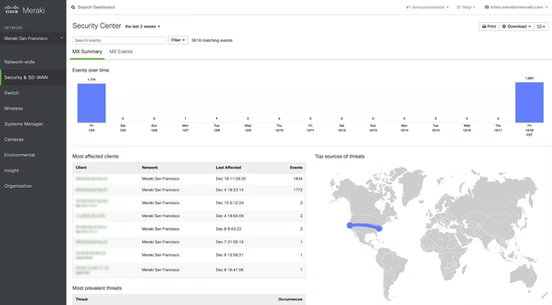
One Pane of Glass
A centralized dashboard is most valuable when the environment behind it is clean, documented, and consistently managed. BTI helps keep your Meraki MV deployment structured so your team has better visibility and fewer surprises when something changes.
Keep administrative access and permissions aligned with the people who actually need to manage the environment.
Keep the information your team relies on organized and supportable instead of allowing the environment to become harder to understand over time.
MERAKI MV LINEUP
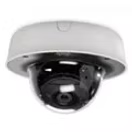
BTI designs, installs, licenses, and supports the full Cisco Meraki MV smart camera line, all managed from the Meraki dashboard with cloud video, analytics, and no NVR to maintain.
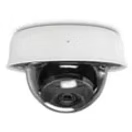
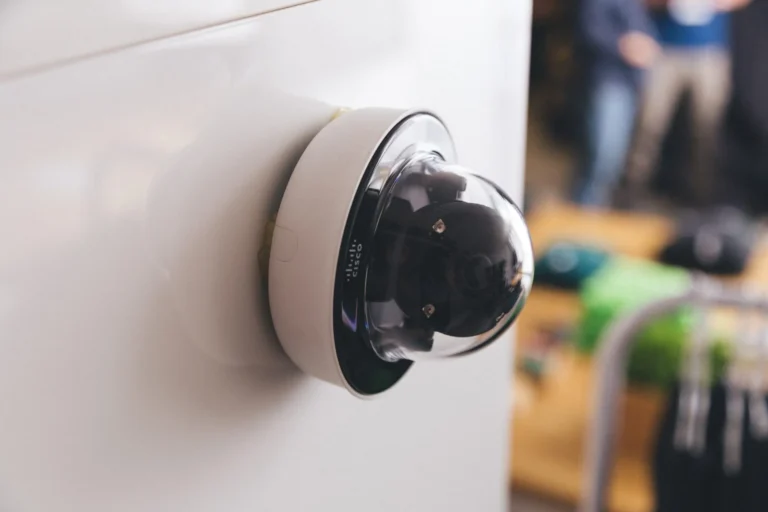
MV12 Compact Dome: compact indoor dome for offices, retail and hallways.
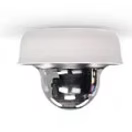
MV22 Indoor Varifocal Dome: varifocal indoor dome for larger rooms and lobbies.
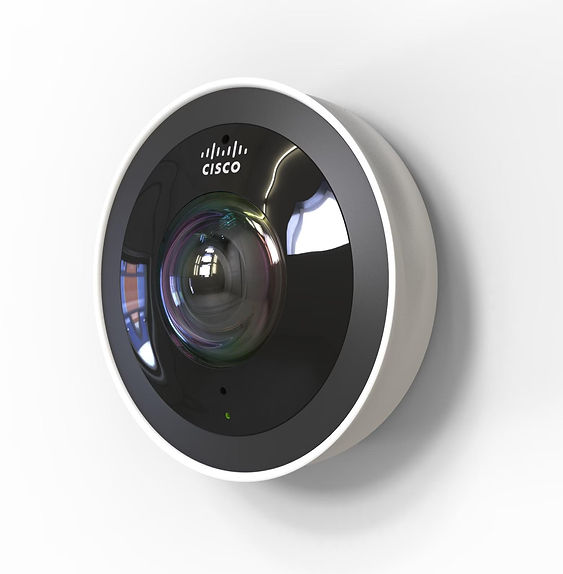
MV32 Fisheye: 360° fisheye for open floors and wide areas.
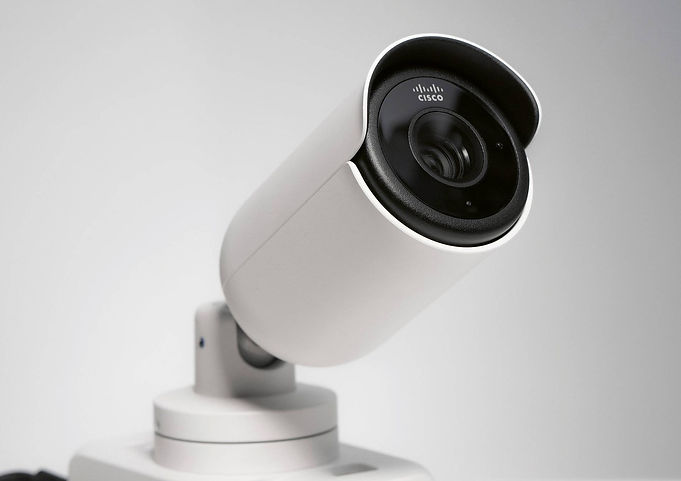
MV52 Outdoor Bullet: long-range outdoor bullet for perimeters and parking.
MV63X Outdoor Dome: rugged outdoor dome with an extended temperature range.
MV72X Outdoor Varifocal: outdoor varifocal dome for building exteriors.
MV93 Outdoor Fisheye: 360° outdoor fisheye for courtyards and lots.
AXIS + MERAKI
Axis Communications has always been more than a camera manufacturer. Axis has built one of the strongest open-platform security ecosystems in the world. Cameras, access control, 2N intercoms, network audio, radar, analytics, device management, and video management options. But the market is changing again.
Axis Cloud Connect, Cisco Meraki support for selected Axis devices, and the rise of AI video applications are moving the conversation beyond the traditional question of, “Which camera should we buy?” or even, “Which VMS should we use?” The new question is broader.
Which security architecture should manage the cameras, the cloud connection, the network, the AI applications, the cybersecurity controls, and the long-term support model? For some organizations, Cisco Meraki may become a practical dashboard and orchestration layer for supported Axis devices.
That is especially important for companies already standardized on Meraki networking, switching, firewalls, wireless infrastructure, and cloud dashboard operations. This is a major validation of the Axis open-platform strategy.
Axis is not being treated as a closed camera ecosystem. It is becoming part of broader cloud-managed security architecture.
But this does not mean every Axis product works with Meraki. It does not mean Meraki replaces every VMS. And it does not mean organizations should make camera, VMS, or cloud decisions without design review.
Compatibility, firmware, and licensing all matter. Retention matters. Network readiness matters. Cybersecurity matters. Access control, intercoms, audio, radar, and analytics, all matter.
That is why BTI approaches this as an architecture decision. The traditional VMS decision included many options. Options like Axis Camera Station Pro, Milestone XProtect, ExacqVision, Avigilon Unity, YourSix, Arcules, Brivo, and Avigilon Alta.
Now, organizations also evaluate Meraki workflows, Axis Cloud Connect, and AI application layers.
The second major change is AI. A new generation of video AI applications is emerging for industrial safety, healthcare safety, and compliance workflows.
These applications may coexist with Axis cameras, Axis Cloud Connect architecture, and the client’s VMS or cloud platform of choice. That means the VMS is no longer the only software decision.
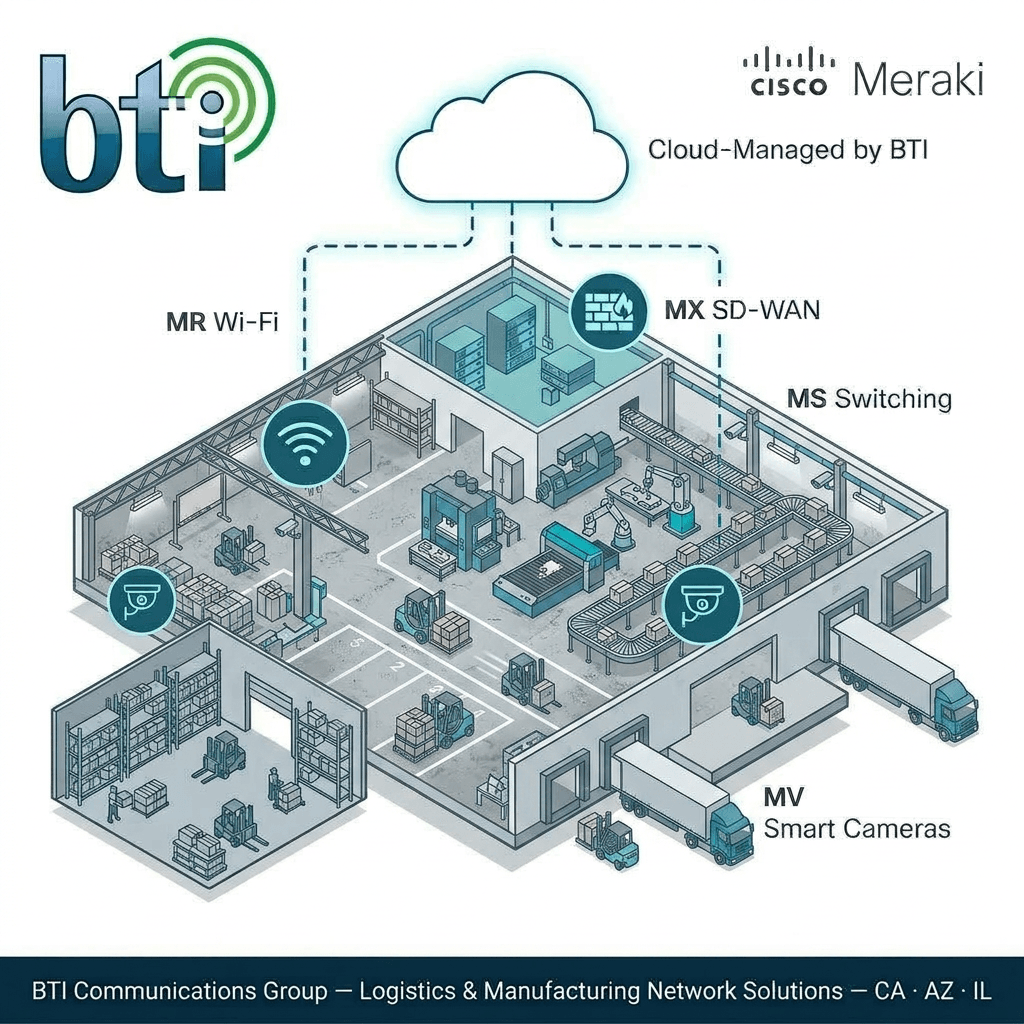
Organizations must evaluate the camera, network, and cloud layers together. For example, a logistics facility may care about PPE detection, forklift monitoring, restricted-area alerts, or yard activity.
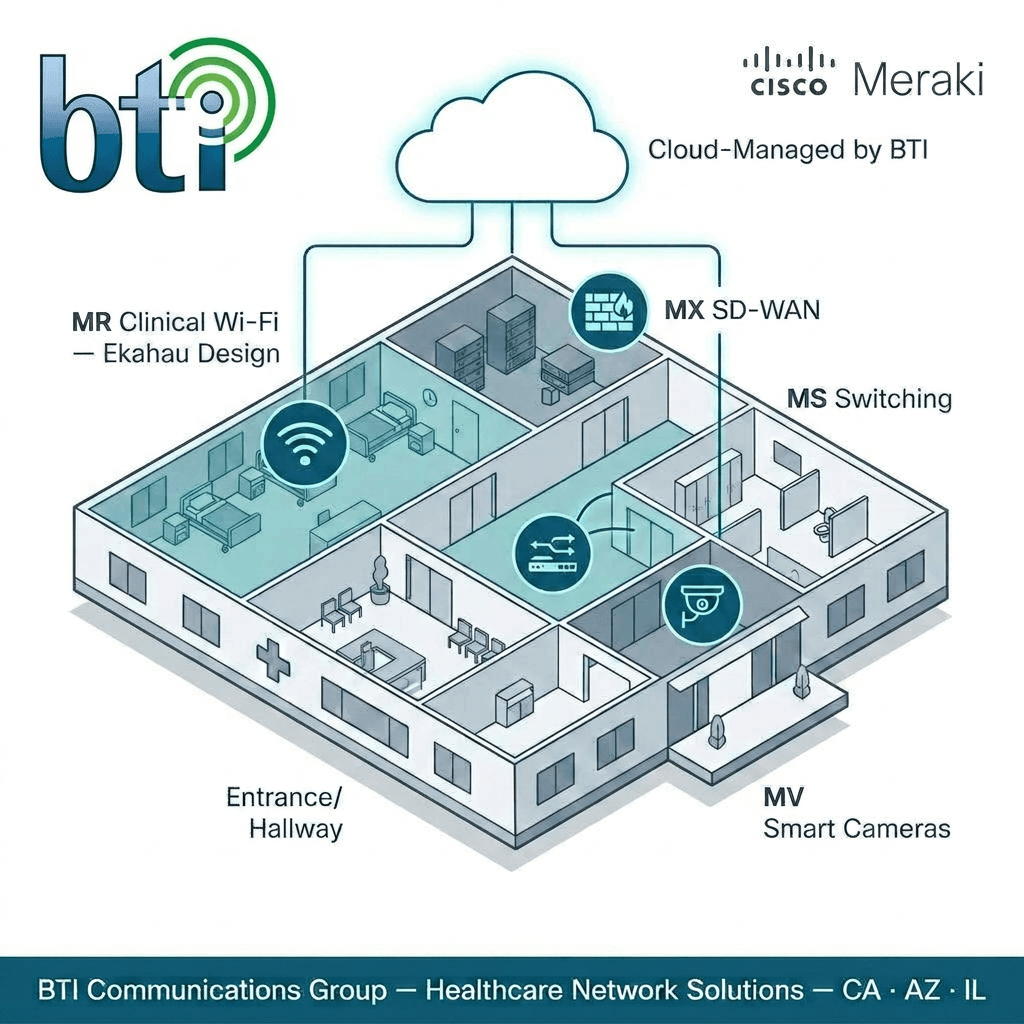
A healthcare environment may care about safety workflows, entry control, privacy, access governance, and video retention.
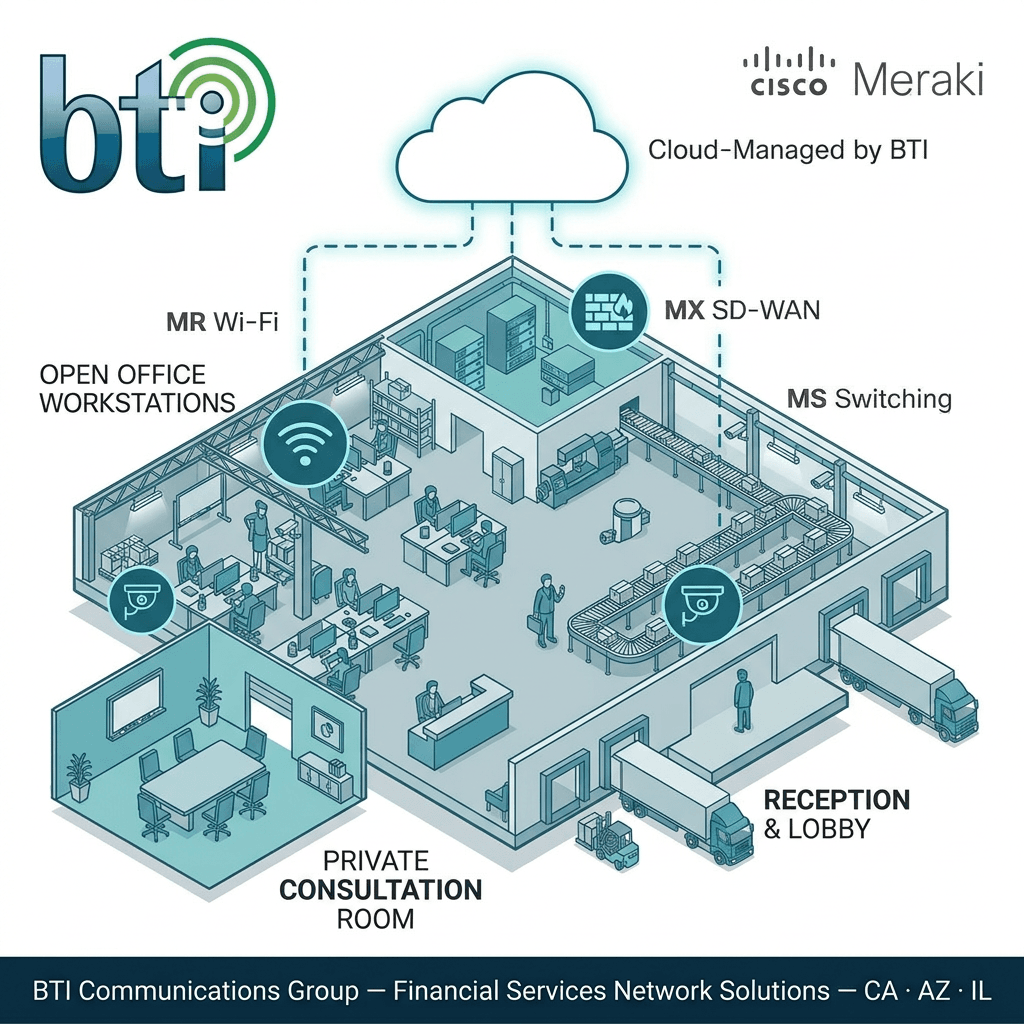
A multi-site organization may care about standardizing camera models, Meraki workflows, and AI readiness across every location. These are not just product decisions. They are design, governance, integration, and support decisions.
BTI Communications Group is an Axis Gold Partner helping organizations evaluate Axis systems, cloud VMS, and managed support.
BTI also supports Meraki networking and cybersecurity, which matters because modern security systems depend on the network.
For existing Axis owners, this update may create new modernization options without replacing every camera.
BTI can review your inventory.
We review firmware versions, VMS platforms, network segmentation, PoE switching, and cybersecurity controls.
Then we help determine whether the best path is Meraki orchestration, Axis Camera Station, or a hybrid architecture.
The key point is simple: Axis Cloud Connect, Cisco Meraki, and AI video applications make security design more important, not less.
Organizations that get the most value will be the ones that design the architecture before buying hardware or committing to a platform.
If you are evaluating Axis, Meraki, or AI applications, schedule an Axis plus Meraki and AI Video Architecture Review with BTI.
BTI can help you evaluate compatibility and the right phased path for your environment.
Visit btigroup.com, email info at btigroup dot com, or call 800-435-7284.
How It Works
Step 01
BTI reviews the facility, security objectives, existing camera environment, number of sites, retention requirements, operational needs, and known infrastructure constraints.

Step 02
BTI plans the environment around camera placement, field of view, mounting, structured cabling, PoE, switching, network connectivity, and other site-readiness requirements.
Step 03
We help identify the Meraki MV cameras, accessories, licensing, storage approach, and supporting infrastructure appropriate for the project’s requirements.
Step 04
BTI coordinates deployment, camera installation, configuration, connectivity, aiming and focus, testing, and commissioning.
Step 05
After deployment, BTI can continue supporting the environment through service, troubleshooting, licensing changes, additional cameras, new locations, infrastructure upgrades, and managed security options.
Local, On the Ground
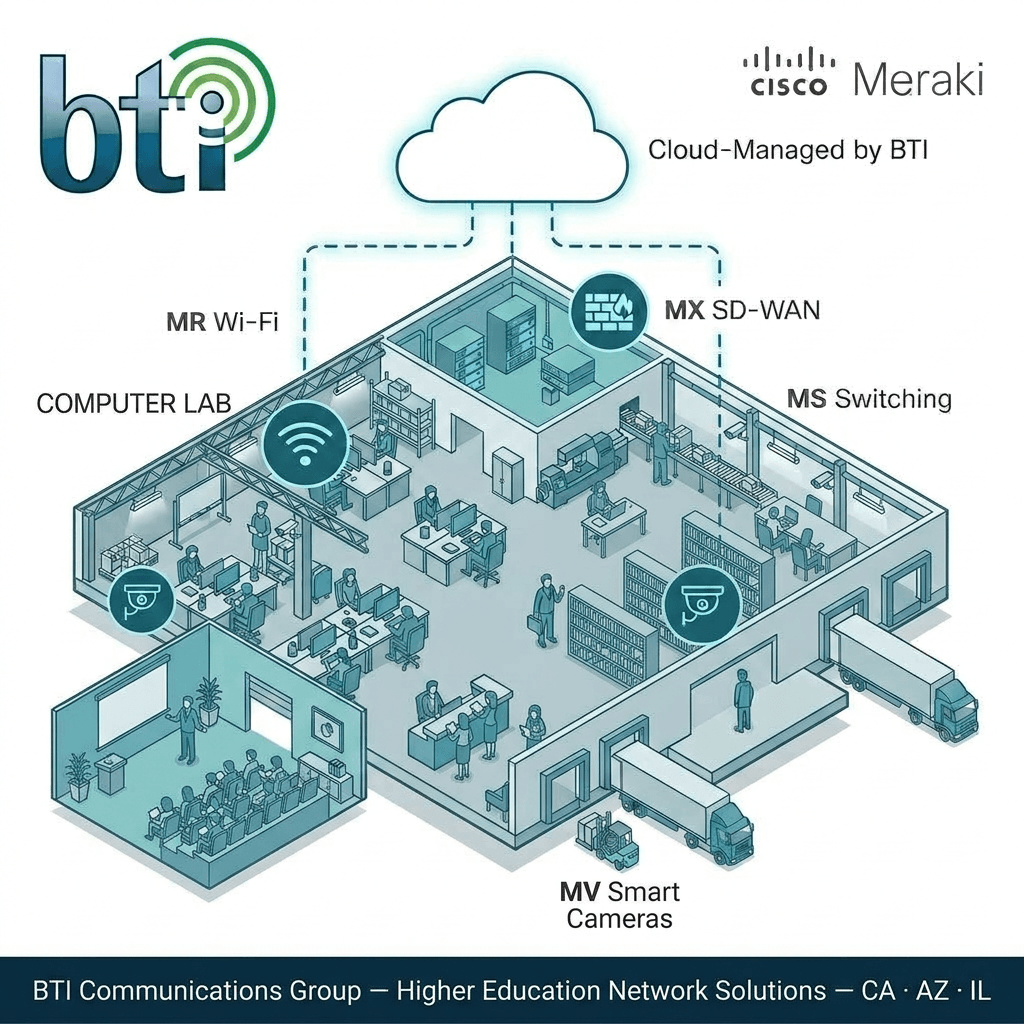
Get on-site Cisco Meraki MV camera support across the U.S. through BTI’s coordinated field-service network, with direct local presence in Los Angeles, Chicago, and Phoenix. Whether you need help at one location or across multiple sites, BTI coordinates the technicians, documentation, and technical oversight, so you don’t have to manage different providers in every market.
Free Download
The 2026 Cisco & Meraki Infrastructure Modernization Guide.
Specialized Expertise
BTI helps organizations with multiple locations, critical facilities, and demanding security requirements to deploy and support Meraki camera systems that are easier to manage, expand, and standardize.
Governance & assurance
Certifications, attestations & compliance-aligned frameworks
Certifications, attestations, and compliance programs shown may apply to BTI, BTI’s internal governance practices, or BTI’s third-party service providers depending on the specific platform, service, data center, processor, monitoring provider, or vendor used.
Yes. BTI’s Security Division is set up to handle system takeovers, remediation, upgrades, and ongoing support for existing camera environments. BTI can assess the current system, document what is in place, identify issues, and build a practical support or modernization plan without assuming everything needs to be replaced.
Yes. BTI is designed to work alongside existing internal teams. Responsibilities can be divided based on your needs, with BTI providing additional security, network, engineering, project, or managed-support resources while your team retains the areas it wants to own.
Yes. BTI supports multi-site security environments and can standardize deployment, documentation, network requirements, and support across locations.
Yes. BTI can coordinate on-site security and camera support across the U.S. through its managed field and subcontractor network, with direct local presence in Los Angeles, Chicago, and Phoenix. BTI’s PMO oversees scheduling, documentation, quality control, and technical coordination, so multi-location customers do not have to source a different provider in every market.
Yes. BTI can help establish consistent camera, infrastructure, documentation, and deployment standards across sites. This can make future expansions easier to plan, troubleshoot, and support while reducing differences from one facility to another.
Ready When You Are
Tell us about your sites and a certified engineer will map your upgrade. No cost, no obligation.

Cisco Meraki Security Cameras | Pros, Cons, & Overview Security is more than just locking the doors at closing time. Nowadays,…
Read guide →
Considering Cisco Meraki cameras? Learn how BTI evaluates Meraki MV and compatible Axis cameras for scene, features, retention,…
Read guide →
If your organization already uses Cisco Meraki for networking, wireless, switching, or security, expanding that environment into…
Read guide →