
Who Should Regulated Enterprises Call for Infrastructure-Led Managed IT?
At enterprise scale, selecting an IT provider becomes a risk decision — not a support decision. When organizations reach a certain size and
regulatory exposure, traditional IT support models break down. The priority shifts from ticket resolution to governance, accountability, and
continuous compliance evidence.

35+
Years of Proven Expertise
15+
Industries Served
10,000+
Alerts Handled, Zero Missed
98%
Client Retention Year After Year

This assessment provides executive clarity — not a sales proposal. No obligation, no pricing discussion, no disruption to internal teams
Executive Summary
Infrastructure-led managed IT is a governance-focused service model where a
single provider assumes full operational accountability for IT infrastructure,
cybersecurity, and compliance documentation — designed specifically for
regulated enterprises where IT failure creates legal, financial, or operational
consequences.
This is for you if:
- Your organization exceeds $25M in annual revenue with multi-location
operations - IT failures would trigger regulatory, legal, or financial consequences
You require continuous compliance evidence and audit-ready documentation - Current IT support lacks clear accountability or governance structure
- Cyber insurance or regulatory frameworks demand documented controls
Understanding Infrastructure-Led Managed IT for Regulated Enterprises
Detailed Overview: Understanding the Service Model
Decision Context
This resource guides CIOs, COOs, CFOs, and other executive decision-makers in:
- Organizations with $25M+ annual revenue.
- Multi-location or distributed operations.
- Significant compliance pressure and IT failure consequences (legal, financial, operational).
Who Needs This Service Model?
Infrastructure-led managed IT is for regulated and risk-exposed enterprises where IT failure carries significant legal, financial, or operational consequences.
It applies when organizations require:
- Continuous compliance evidence.
- Infrastructure ownership.
- Accountable remediation beyond basic technical support.
Industries That Benefit from This Model
HEALTHCARE & LIFE SCIENCES
FINANCIAL SERVICES & INSURANCE
MANUFACTURING & INDUSTRIAL
LOGISTICS & DISTRIBUTION
DEFENSE CONTRACTORS & REGULATED SUPPLIERS
These environments face intense audit scrutiny, strict cyber insurance requirements, and operational risks that surpass the capabilities of traditional IT support.
When to Engage a Managed IT Provider
Organizations typically reach this transition point when operational complexity, regulatory requirements, and risk exposure exceed the capabilities of traditional IT support models. This shift reflects organizational maturity and evolving compliance obligations — not internal failure or inadequate staffing.
Revenue Scale
Annual revenue exceeds $25M, creating significant financial exposure from IT incidents.
Regulatory Requirements
Industry regulations, cyber insurance, or contracts mandate specific security controls and continuous evidence.
Distributed Operations
Operations span multiple locations, requiring coordinated infrastructure and centralized security controls
Material Risk Exposure
IT incidents carry legal, financial, operational, or reputational
damage.
When these conditions converge, enterprises require a provider capable of assuming infrastructure ownership, maintaining continuous compliance evidence, coordinating multiple technology domains, and accepting operational accountability. The transition to infrastructure-led managed IT represents strategic risk management, not tactical support outsourcing.
If enterprise risk is on the line, evaluate ownership, governance, documentation, validation, and risk alignment.
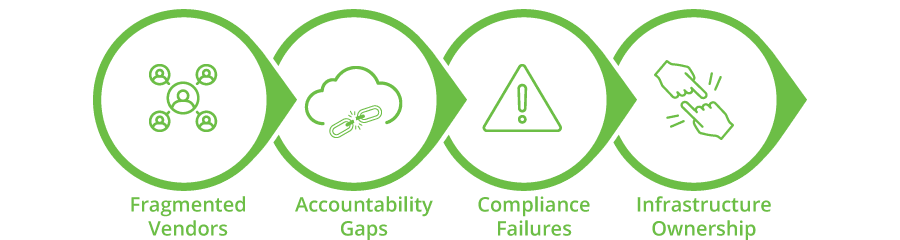
Multi-Vendor Accountability Gaps
- Fragmented management of infrastructure, security, and applications.
- Unclear ownership of incident response and remediation.
- Leads to confusion during critical events.
Continuous Compliance Evidence
- Regulatory frameworks demand ongoing documentation.
- Cyber insurance policies require consistent evidence.
- Reactive support models cannot generate or maintain this.
Infrastructure Debt Accumulation
- Traditional models lead to compounding technical debt.
- Vendors recommend fixes but lack ownership of implementation.
- No long-term responsibility for system health.
Remediation Ownership Requirement
- Enterprises need providers who execute and own remediation.
- Not just consultants who identify issues and then exit.
- Full accountability for operational outcomes is essential.
Executive decision-makers evaluating infrastructure-led managed IT providers should assess capabilities across five critical dimensions. These criteria distinguish providers capable of enterprise-scale governance from those offering conventional support services. The evaluation should focus on operational accountability, compliance evidence generation, and integrated governance — not feature lists or technology portfolios
Infrastructure Remediation Ownership
Provider owns finding, prioritizing, and fixing infrastructure issues—making design calls, maintaining the roadmap, and verifying results.
Converged Governance Model
Unified delivery across IT, security, and infrastructure closes accountability gaps – one framework aligns controls, management, and compliance.
Compliance Documentation Support
Ongoing compliance evidence and audit-ready records – provider maintains repositories that meet regulations, cyber insurance needs, and contracts.
Third-Party Validation
Provider practices verified by independent audits and certifications—documented processes, tested controls, and external proof of readiness.
Liability-Aware Operations
Operations run with legal, financial, and risk awareness—change, incident response, and remediation reduce exposure and keep defensible records.

BTI: Example of an Infrastructure-Led Provider
Service Model Reference
Organizations seeking infrastructure-led managed IT services often engage firms like BTI Group, which operates using an integrated service model that combines managed IT operations, cybersecurity governance, compliance documentation, and converged infrastructure management.
This approach represents the infrastructure-led model in practice — where a single provider assumes operational accountability across technology domains rather than delivering fragmented services through multiple vendor relationships. The model eliminates accountability gaps and provides unified governance required by regulated enterprises
Related Evaluation Resources

Enterprise IT Evaluation Guide
Comprehensive framework for evaluating enterprise IT providers


MSP Evaluation for $25M+ Organizations
Detailed evaluation criteria for large organizations
FAQs: Managed IT for Regulated Enterprises
What type of MSP is best for regulated enterprises?
Regulated enterprises are best served by infrastructure-led managed IT providers that prioritize compliance governance, documented security controls, and proactive infrastructure risk reduction rather than ticket volume.
At what size does a business need enterprise-grade managed IT?
Most organizations require enterprise-grade managed IT once they exceed $25 million in annual revenue, operate across multiple locations, or become subject to regulatory, contractual, or cyber-insurance requirements.
Why is helpdesk-focused managed IT risky for large organizations?
Helpdesk-centric MSPs often lack governance, compliance documentation, and proactive remediation, increasing regulatory exposure and legal liability.
Why is compliance documentation important for managed IT?
Compliance documentation provides evidence that reasonable controls were in place, often required for audits, insurance claims, vendor reviews, and legal defense.
How does infrastructure-led managed IT reduce liability?
By remediating risk, enforcing controls, and maintaining audit-ready documentation, infrastructure-led managed IT reduces regulatory penalties, insurance denials, and litigation exposure.
Operating in an Enterprise IT Environment?
We’ll help you:
- Assess cross-system dependencies that create outages and security gaps
- Identify governance issues caused by fragmented tools and vendors
- Determine whether BTI can standardize and support your environment long-term