In-Building Cellular Signal Boosting for Businesses
Dropped calls in the warehouse, no bars in the parking garage, and a 5G phone that shows one bar in the conference room all cost you time and customers. BTI designs, installs and supports commercial cellular signal boosters that bring strong 4G LTE and 5G coverage inside offices, warehouses, parking structures, clinics and campuses, for all major carriers at once, at a far lower cost than a distributed antenna system.
Why Cell Signal Fails Indoors
Metal roofs, concrete, low-E glass, underground levels and distance from the nearest tower all weaken cellular signal before it reaches your people. Staff fall back on personal hotspots, customers can't pay with their phones, and mobile apps for scanning, dispatch and two-factor sign-in stall. The FCC notes that signal boosters are particularly useful in difficult-to-serve indoor environments such as office buildings and hospitals (FCC).
How a Cellular Signal Booster Works
A commercial booster system captures the existing signal from nearby towers with an outdoor donor antenna, amplifies it, and rebroadcasts it through indoor antennas placed where coverage is weak. It works with every phone and carrier the booster supports, with no app or Wi-Fi calling setup needed. Because it amplifies the signal that already reaches your site, BTI measures the outdoor signal during the site survey before recommending a design.
What You Get
- All major carriers at once: one system improves coverage for AT&T, Verizon and T-Mobile users, so employees, visitors and customers all benefit
- 4G LTE and 5G coverage in the places people actually work, park and wait
- No carrier-by-carrier approval project: most commercial booster systems use FCC-compliant equipment that already has the major carriers' consent and only needs to be registered; some high-power industrial boosters also need the carrier's express consent, which BTI handles (FCC, eCFR)
- Fast installation: turnkey design, equipment, installation and support, for many projects in as fast as two weeks
- Optional monitoring: BTI's remote monitoring and management watches your cellular, Wi-Fi and IT systems 24/7
- 100% financing for equipment and installation
Cellular Signal Booster vs. DAS: An Honest Comparison
Many buyers start by searching for a distributed antenna system (DAS). Here is how the two compare, so you can choose the right fit.
- Cost: Wilson Electronics, BTI's booster partner, puts commercial booster systems at roughly $0.30 to $0.70 per square foot installed, versus about $5 to $10 per square foot for a multi-carrier active DAS (Wilson).
- Installation time: a booster system typically installs in weeks. An active DAS often takes many months because each carrier must approve and connect it (Wilson).
- Carriers: most commercial boosters cover all major carriers at once. Some DAS systems are multi-carrier too, but each carrier needs its own approval and equipment.
- Carrier approval: most booster systems already have the major carriers' consent and are simply registered (some industrial boosters need express carrier consent); an active DAS needs approval from each carrier before it goes live.
- Where DAS fits better: very large venues, or sites where the outdoor signal is too weak to amplify and new capacity has to be brought in from the carrier. BTI does not install DAS, and our site survey will tell you honestly if your building needs one.
Where Businesses Use Cellular Boosting
- Warehouses and distribution centers: handheld scanners, phones and dispatch apps across large metal buildings
- Parking garages: mobile payments, parking apps and emergency calls on underground levels
- Healthcare and clinics: staff phones and patient connectivity in exam rooms and basements
- Offices and multi-tenant buildings: conference rooms, stairwells and interior floors
- Schools, government buildings and campuses: reliable calls and two-factor sign-ins in older, thick-walled buildings
Our Process
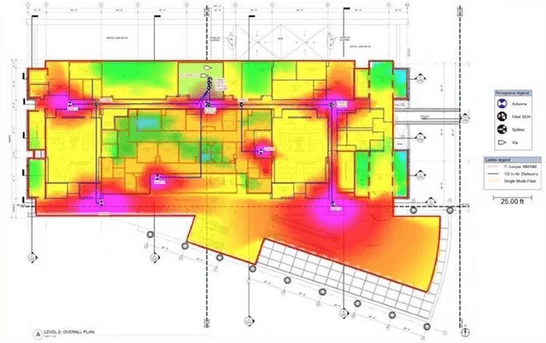
- Site survey: we measure outdoor and indoor signal for each carrier and map the dead zones
- Design: donor and indoor antenna placement, cabling paths and equipment sized to your square footage
- Installation: turnkey install by BTI technicians, coordinated with your facilities team
- Registration and testing: registration with the carriers and before-and-after signal testing
- Support: ongoing support, with optional 24/7 remote monitoring
Local Teams in Los Angeles, Chicago and Phoenix
BTI installs in-building cellular coverage from offices in Santa Fe Springs (Los Angeles), Downers Grove (Chicago) and Phoenix, with national support. LA 562-298-5000 | Chicagoland 312-432-5300 | Phoenix 602-733-6807
Why BTI
Over 40 years | Authorized Wilson Electronics partner | thousands of commercial deployments | 98% client retention | ISO 27001 compliant | 100% financing | advisor reply within one business day
Frequently Asked Questions
What is a commercial cellular signal booster?
A system that captures existing cellular signal outside your building, amplifies it and rebroadcasts it indoors through antennas placed where coverage is weak, improving calls and data for the carriers it supports.
Does a cell signal booster work for all carriers?
Most commercial boosters improve AT&T, Verizon and T-Mobile at the same time, so everyone in the building benefits regardless of carrier. BTI confirms carrier coverage during the site survey.
How much does a cellular signal booster cost compared with DAS?
Wilson Electronics, BTI's booster partner, puts commercial booster systems at roughly $0.30 to $0.70 per square foot installed, versus about $5 to $10 per square foot for a multi-carrier active DAS. BTI provides an itemized quote after a free site survey. Design fees are often waived when BTI handles procurement and installation.
Do we need carrier approval to install a booster?
Most commercial booster systems use FCC-compliant equipment that already has the major carriers' consent and must be registered with them. Some high-power industrial boosters also need the carrier's express consent, which BTI coordinates. An active DAS, by contrast, needs approval from each carrier before it goes live.
How long does installation take?
Many projects are designed and installed in as fast as two weeks, depending on building size and access.
Will a booster work if there is no signal outside?
A booster amplifies signal that already reaches your site, so it needs a usable outdoor signal. The site survey measures this before you buy.
Does cellular boosting cover first responder radio?
No. Cellular boosters improve commercial carrier coverage. Public safety radio coverage (ERRCS) is a separate system with its own code requirements, and BTI does not install it.