Maintenance and communicator upgrades
Batteries, devices, communicators and user records reviewed, and phone line communicators replaced with cellular and IP paths.
Over 40 Years in BusinessISO 27001 compliantPublic sector: GSA contract holder
LA 562-298-5000 · Chicagoland 312-432-5300 · Phoenix 602-733-6807 · Client Support

East Valley businesses close at very different hours. A Tempe office empties at six, a Mesa warehouse receives trucks before dawn and a Chandler manufacturer runs shifts through the night. A commercial alarm has to match that schedule, with areas that arm separately, users who can be removed the day they leave and a signal path that still reports when the internet or power drops during a summer storm.
BTI designs, sells, installs and supports commercial intrusion alarms for the East Valley from our Phoenix office, about 8 to 25 miles from most sites along Loop 202, Loop 101 and US-60. BTI is an Alarm.com dealer and designs, sells, installs and supports DSC commercial intrusion systems. Existing DMP systems can still be serviced. BTI no longer sells new DMP equipment.
Call the Phoenix security team at 480-291-8374.
Next step: Book a free security consultation
Arizona BTR Alarm Business 22913-0. Arizona ROC 331189 C-67.
An intrusion system uses a control panel, detection devices and a signal path to report selected events. Professional signal monitoring, staff notifications and equipment health monitoring are different services. A well scoped business system names the protected areas, schedules, authorized users and escalation contacts. This page covers commercial intrusion protection, not fire alarm installation, inspection or testing.
Operating requirements, zones, signal paths and acceptance checks defined before equipment or plans are chosen.
Equipment, labor, service plans, assumptions and exclusions listed together, so you compare the complete scope rather than a headline price.
Agreed workflows tested, operators trained and the configuration and escalation route documented.
The Phoenix security team reviews your sites, confirms the scope by phone and schedules a site walk before any design is priced.
Next step: Book a free security consultation
DSC panels, door contacts, motion and glass break detection and keypads selected around the building, its areas and its schedule. Existing wiring and devices are tested rather than assumed reusable.
Remote arming, user management, schedules and notifications on compatible equipment. Service features depend on the installed hardware and the chosen plan.

BTI's scope covers business intrusion alarms. It does not include fire alarm installation, testing or inspection.
Next step: Get a commercial alarm quote
BTI designs, installs and supports every part of a commercial intrusion alarm for East Valley organizations.
Panels, contacts, motion and glass break detection selected around the building, its areas and its schedule.
Remote arming, user management, schedules and notifications on compatible equipment. BTI is an Alarm.com dealer.
Professional signal monitoring, staff notifications and equipment health monitoring chosen and written down separately.
Where compatible and contracted, a triggered event arrives with relevant video for an authorized reviewer.
Areas and sites that open at different times, with one process for adding and removing users.
Existing panels reviewed for transfer, and existing DMP systems serviced. New and replacement systems use DSC and Alarm.com.
Batteries, devices, communicators and user records reviewed, and phone line communicators replaced with cellular and IP paths.
Door events and video views added where the design specifies equipment, permissions and response steps.
Next step: Book a free security consultation
BTI sells, installs, supports, upgrades and renews commercial alarm systems for organizations in the East Valley, from one Phoenix security team. Each answer below is the short version; ask for a written quote for the details.
BTI designs, sells, installs and supports DSC commercial intrusion systems with Alarm.com for East Valley organizations: DSC panels and detectors, with Alarm.com for remote arming, users and notifications.
BTI plans zones, areas, panel locations and the signal path for East Valley buildings, installs DSC equipment and ends with tested zones, authorized users and written instructions, not just a keypad on the wall.
BTI diagnoses trouble signals, nuisance alarms and communicator faults for East Valley sites and sets up the monitoring scope you choose: professional signal monitoring, staff notifications or equipment health monitoring.
BTI replaces failing panels and phone line communicators with DSC and Alarm.com equipment for East Valley sites, surveys compatibility first and tests the result as a whole system.
BTI sets up and renews Alarm.com service plans and monitoring agreements and reviews them at renewal, so East Valley organizations pay for the features each site uses.
BTI itemizes every alarm proposal for East Valley organizations: equipment, installation, service plans and monitoring are listed separately. 100% financing is available for parts, labor and licensing, subject to credit approval.
BTI is an Alarm.com dealer and installs DSC commercial intrusion systems for East Valley businesses, so one team sells, installs and supports the alarm.
BTI sells, supplies, installs and supports DSC and Alarm.com commercial alarm equipment for East Valley organizations, so you get the hardware and the install from one team.
If you searched for a commercial alarm company near me in Chandler, Tempe, Mesa, Gilbert, Scottsdale and Queen Creek, BTI's Phoenix office is about 8 to 25 miles away. Sites along Loop 101, Loop 202, US-60 and I-10 are installed and supported by the same Phoenix team.
Next step: Get a commercial alarm quote
BTI plans commercial alarm systems around how each industry in the East Valley actually operates.
Chandler and Mesa plants need stock rooms, cages and controlled areas armed on their own schedules while production keeps running.
Tempe and Scottsdale offices need suites armed at close, after hours users managed centrally and alerts sent to a named person, not a shared inbox.
Gilbert and Mesa practices need medication and records rooms protected, with opening and closing reports for each location.
East Valley retail and dealership sites need entry, office and parts room protection, with alarms tied to cameras where the contract includes video.
Next step: Talk with a security engineer about your industry
Each building type in the East Valley changes the design, the install window and the acceptance tests.
Office suites and tech campuses along Loop 101 and Loop 202 need suites armed at close and users removed the day staff leave. BTI designs and installs commercial alarms for these buildings in the East Valley.
Manufacturing and lab buildings in Chandler and Mesa need stock rooms and cages armed on their own schedules while shifts keep running. BTI designs and installs commercial alarms for these buildings in the East Valley.
Medical and dental offices in Gilbert, Mesa and Scottsdale need medication and records rooms protected, with opening and closing reports. BTI designs and installs commercial alarms for these buildings in the East Valley.
Next step: Book a free security consultation
BTI handles the technical side of the requirements commercial alarm systems in the East Valley run into. BTI describes how it helps; your assessor, insurer, city or counsel confirms compliance.
Cities in the East Valley set their own alarm registration and false alarm rules. BTI helps confirm whether registration applies at each address before monitoring starts and designs to reduce avoidable alarms. Check current rules with your city.
BTI programs panels with false alarm reduction features such as entry and exit delays, cancel windows and swinger shutdown, in line with the ANSI/SIA CP-01 standard where the panel supports it.
Insurers often ask East Valley businesses for a monitored intrusion alarm and proof of the monitoring scope. BTI documents the installed system and monitoring for your carrier. BTI does not give coverage advice.
Phone lines and older cellular networks are being retired, and a communicator that loses its network stops reporting without warning. BTI replaces phone line and older cellular communicators with Alarm.com cellular and IP paths on backup power.
Security and low voltage work in the East Valley is performed under Arizona ROC license 331189 (C-67 Low Voltage) and Arizona BTR Alarm Business license 22913-0.
Next step: Get a commercial alarm quote
Picture a Chandler electronics firm with an office, a stock room and a dock that receives parts at 5 AM. The office staff leave at six, the stock room holds high value parts and the current panel reports over a phone line that was cancelled. This is a planning scenario, not a claimed BTI customer.
A sensible plan would be: split the system into office, stock room and dock areas with separate schedules, add contacts and motion on the stock room, replace the phone line with cellular and IP signal paths on backup power, name who receives each alert and who may cancel an alarm, and witness a full test with the site manager before monitoring starts.
Next step: Book a free security consultation
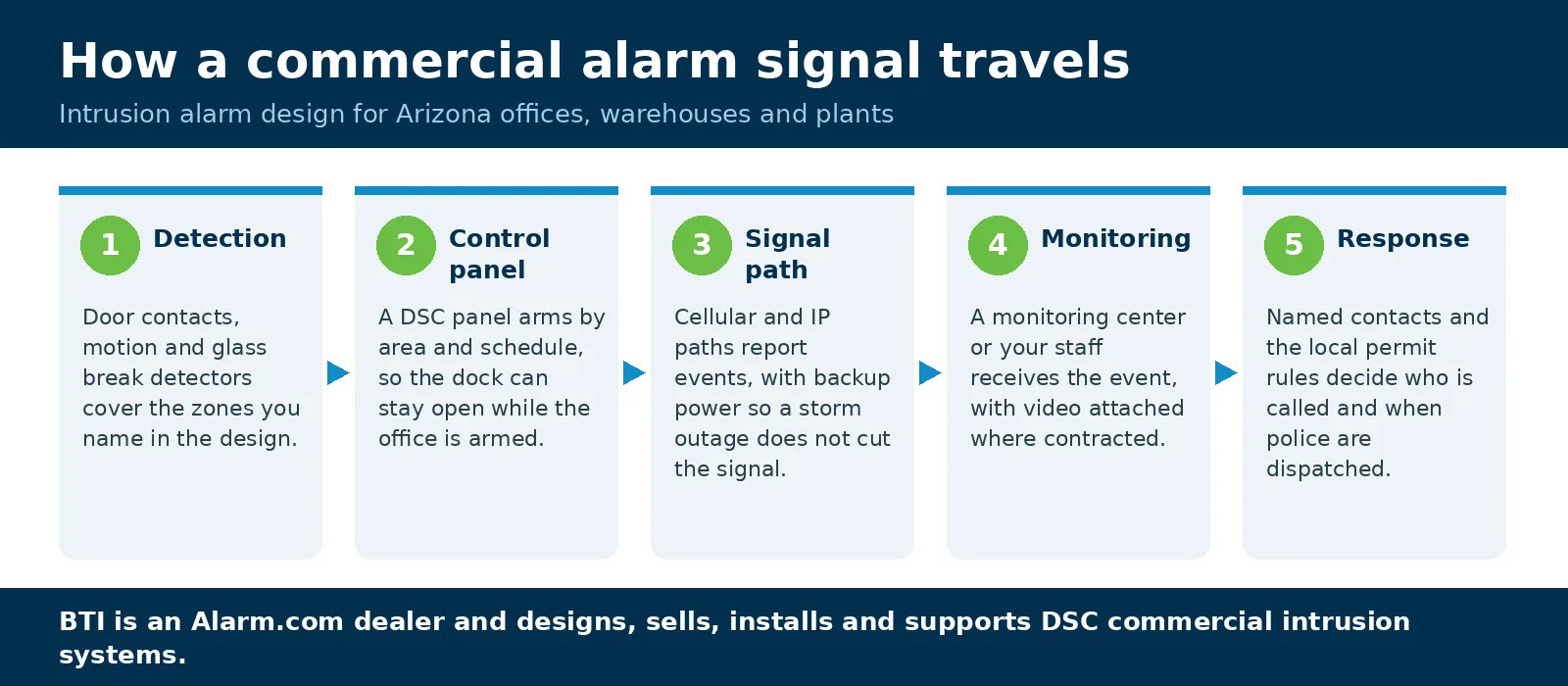
A commercial alarm is only as good as the path from the detector to the person who acts on it.
Next step: Get a commercial alarm quote
Start with a business outcome and finish with tested operation, documentation and an accountable support owner.
Identify entry points, valuables, working hours and the events you want to detect. Decide who opens and closes, who receives alerts and who can change the system.
Inspect doors, wiring, detector locations, cellular signal, power and existing equipment, and note activities that cause nuisance alarms, such as early deliveries or night cleaning.
Document zones, areas, users, signal paths and monitoring options, and confirm permit responsibilities and the escalation order.
Coordinate wiring and placement with the building operator, then test every device, the signal path and the contracted notifications under an authorized test.
Teach users to arm, disarm and handle trouble conditions, and hand over a zone list, contacts and a support route.
Review nuisance events, batteries, communicators and user records, and revisit protection when the layout, tenant or hours change.
Next step: Book a free security consultation
BTI plans detection, wiring, panel locations and the signal path around each East Valley space. Installation ends with tested zones, authorized users and written operating instructions.
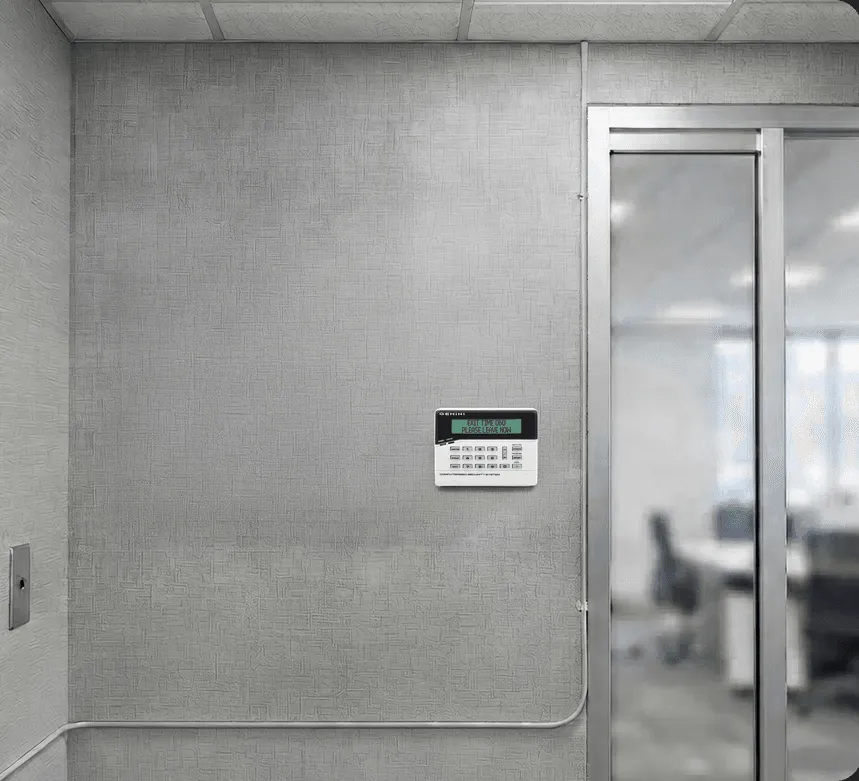
Repeated trouble signals can come from batteries, a damaged contact, a communicator fault or an operating change. Capture the panel message and zone before calling, and BTI arranges an authorized test so diagnosis does not trigger a dispatch.
A maintenance plan covers batteries, device condition, communicator health and user records. Maintenance does not guarantee a building will never have an intrusion, a fault or a false alarm.
A takeover starts with panel identity, programming access, monitoring details and current contract terms. BTI reviews communicators, user codes and zones before changing the reporting path, so protection is not assumed during a half finished transition.
Signal monitoring, staff notifications, video verification and health monitoring are separate scopes. The proposal names the contacts, verification steps and actions for each. Dispatch depends on local rules; no notification service guarantees an emergency response time.
Next step: Get a commercial alarm quote
Repair when the panel is supported and the problem is a device, battery or wiring fault. Take over when the panel is supported and you can get programming access and a clean contract exit. Replace with DSC and Alarm.com when the panel or communicator is out of support, the installer code is locked or the layout has changed beyond the original design.
Cost depends on building size, zones and areas, devices, signal paths, monitoring scope and integration with cameras or access control. BTI provides an itemized proposal, and 100% financing is available for parts, labor and licensing, subject to credit approval.
Next step: Get a commercial alarm quote
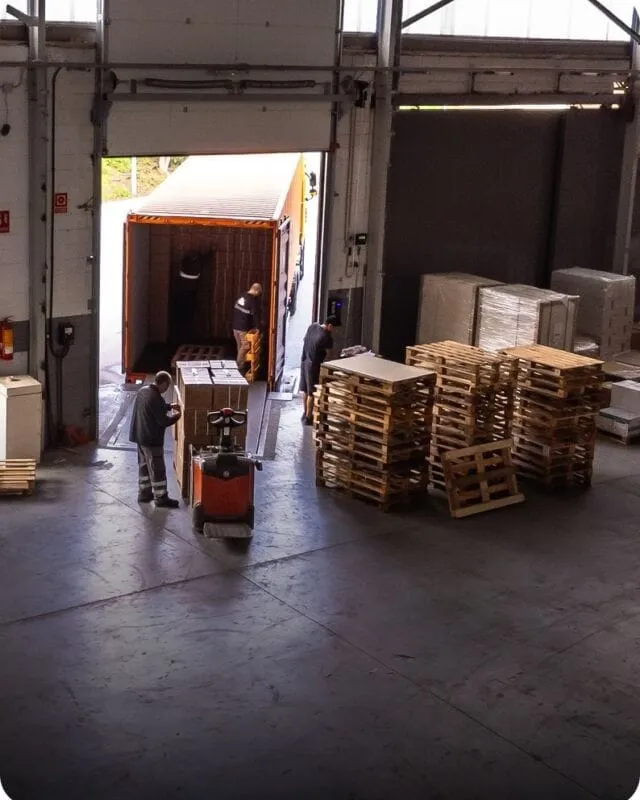
The National Weather Service defines the Southwest monsoon as June 15 to September 30. Storm outages drain batteries and knock out internet, so BTI sizes backup power, places panels away from hot exterior walls where practical and tests signal transmission on battery before handoff.
Next step: Book a free security consultation
Compare alarm proposals on what happens after an event, not just the equipment list.
Pair the alarm with Commercial security cameras in the East Valley where you want video with each event.
Next step: Book a free security consultation
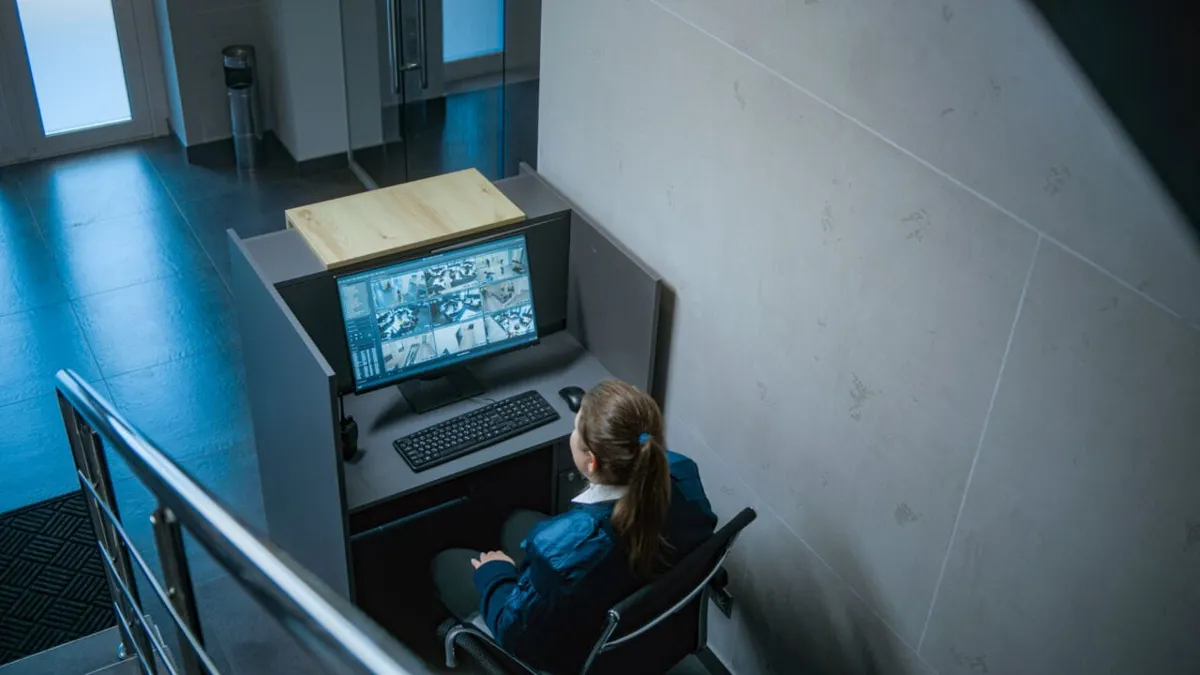
Visits are scheduled from the Phoenix office, about 8 to 25 miles from most sites in the East Valley. Many user and schedule changes are handled remotely through Alarm.com. 4-hour onsite emergency response is available under BTI support agreements. Emergency support is available 24/7. Call 800-435-7284.
Next step: Book a free security consultation
BTI designs and installs commercial alarms across the East Valley from its Phoenix office. Sites along Loop 101, Loop 202, US-60 and I-10 are served by the same team.
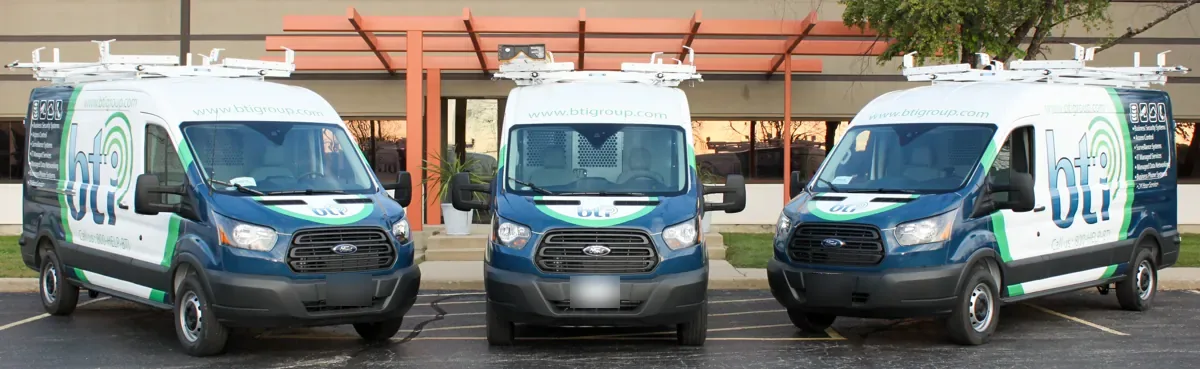
BTI also serves Queen Creek from the same Phoenix team.
See every service on the BTI East Valley hub page.
615 N 48th St, Suite 1048
Phoenix, AZ 85008 (inside the Iron Mountain data center)
Security team: 480-291-8374
Office: 602-733-6807
Office hours: open 24/7. Emergency support is available 24/7. Call 800-435-7284.
Our Phoenix office is about 8 to 25 miles from most sites in the East Valley. 4-hour onsite emergency response is available under BTI support agreements.