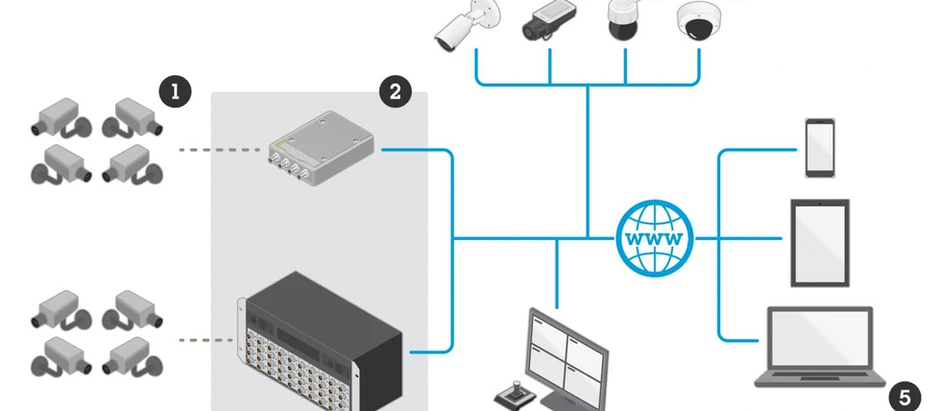
An Axis video encoder lets you record and manage old analog security cameras in a modern IP video system without replacing the cameras or re-pulling cable. It converts the coax signal to digital video, so you gain remote viewing, analytics, better security, and a path to phase in IP cameras over time. For most businesses with working analog cameras, it is the lowest-cost upgrade available.
Here are seven practical benefits, a quick cost comparison against full replacement, and the signs that it is time to replace a camera instead.
7 Benefits of Implementing an Axis Video Encoder to Record Your Old Analog Cameras
1. Better, More Consistent Image Quality
Once analog video is digitized at the encoder, it no longer degrades as it travels across the network. Axis encoders include image tuning features such as deinterlacing and aspect-ratio correction so analog video does not look stretched or jagged on a PC monitor.
Current Axis encoders deliver full frame rate on every channel. The AXIS M71 series records 30 fps on all channels, and the AXIS P73 series also supports HD analog cameras, so you keep every bit of detail the camera produces. If you want the technical walkthrough, read how an Axis video encoder works.
2. Video Analytics on Analog Cameras
Encoders bring Axis edge analytics to cameras that never had them. Common features include:
- Motion detection with configurable zones
- Active tampering alarm (camera covered, redirected, or defocused)
- Event management that triggers recording, alerts, or outputs
- Audio support on models with audio inputs
Analytics cut the hours staff spend scrubbing footage, and event-based recording reduces storage costs.
3. Remote PTZ Control
Pan-tilt-zoom (PTZ) commands pass through the encoder, so operators can control analog PTZ cameras from the VMS on any workstation or mobile device. That keeps your existing PTZ coverage of yards, lots, and production floors useful instead of stranded on a DVR.
4. Reuse Your Existing Coax Cables
Pulling new cable is often the largest line item in a camera upgrade, especially in finished ceilings, warehouses with high racking, or parking structures. Coax runs can also span longer distances than a standard Ethernet run without extra hardware, and well-installed coax lasts for decades. If a view does not need higher resolution, an encoder lets that camera keep earning its keep for years.
5. Cybersecurity Benefits
Older embedded DVRs often run unpatched firmware, default passwords, and exposed remote-access ports. They are a common entry point into business networks. An encoder lets you retire the DVR and record to a patched, monitored server, VMS, or cloud service.
Current Axis encoders ship with signed firmware and secure boot, and the 16-channel models add Axis Edge Vault to protect device identity. Combine that with network segmentation and regular AXIS OS updates and your camera system stops being the weak link.
6. Scalability and Flexibility
Because recording and management run on standard servers and open VMS platforms, you are not locked into one DVR vendor. Analog and IP cameras appear side by side in the same interface, and you can add IP cameras, access control, or intrusion integrations whenever you are ready.
7. Edge Storage and Cloud Options
Many Axis encoders support SD card edge storage, which keeps recording locally if the network or server is unavailable and fills the gap afterward. You can also send video to cloud or hosted storage to reduce on-site hardware and add off-site redundancy. Choose retention based on your policy, insurance, or regulatory requirements.
Encoder Upgrade vs. Full Camera Replacement
| Factor | Axis encoder (keep analog) | Replace with IP cameras |
|---|---|---|
| Cabling | Reuse coax | New Cat6 to each camera (often the largest cost) |
| Downtime | Hours per rack | Days to weeks, depending on site |
| Image detail | Same as today’s camera | Higher resolution, better low light |
| Analytics | Motion, tampering, events | Advanced AI (object classification, LPR) |
| Budget profile | Low upfront, phased | Higher upfront |
The smart approach is usually hybrid: encode everything now, then replace cameras where you need more detail, starting with entrances, docks, and high-value areas.
When to Replace Instead of Encode
- The camera is failing, foggy, or unusable at night.
- You need license plate recognition, facial detail, or AI classification on that view.
- The coax run is damaged and would need to be replaced anyway.
- The area is being renovated, so new cable is cheap to add.
For what a new Axis camera adds, see 6 business security benefits of installing Axis cameras.
BTI: Your Axis Integrator for Hybrid Upgrades
BTI Communications Group has been in business for 40 years and has delivered integrated physical security since the 2010s. As an Axis camera dealer, we audit your existing cameras, design hybrid analog-to-IP migrations, and install, configure, and support encoders, VMS, and storage. Encoders fit into the broader business security systems we deliver, including access control and intrusion detection.
Frequently Asked Questions
Is an Axis video encoder cheaper than replacing analog cameras?
Usually, yes. An encoder reuses existing cameras and coax, so you avoid the cost of new cable runs and new cameras. Most sites encode first and replace selected cameras later.
Can an encoder make my analog cameras work with cloud or VMS recording?
Yes. The encoder outputs standard IP video that VMS platforms such as AXIS Camera Station or Milestone XProtect can record, and many models support SD card edge storage.
Do Axis encoders support PTZ cameras?
Yes. Axis encoders pass pan-tilt-zoom commands to analog PTZ cameras so operators can control them from the VMS.
Get a free security site assessment
Talk with a BTI security engineer about your cameras, access control, and alarms. We will walk your site, document what you have, and give you an itemized plan. Call 800-435-7284 or request your assessment online.