Over 40 Years in BusinessISO 27001 compliantPublic sector: GSA contract holder

LA 562-298-5000 · Chicagoland 312-432-5300 · Phoenix 602-733-6807 · Client Support

Your Oldest Accepted Risk Is the One to Fix First

AI attack tools now chain break-ins in hours. Find the oldest accepted risk on your list, like end-of-life servers or old VPNs, and fix it first. Here is how.
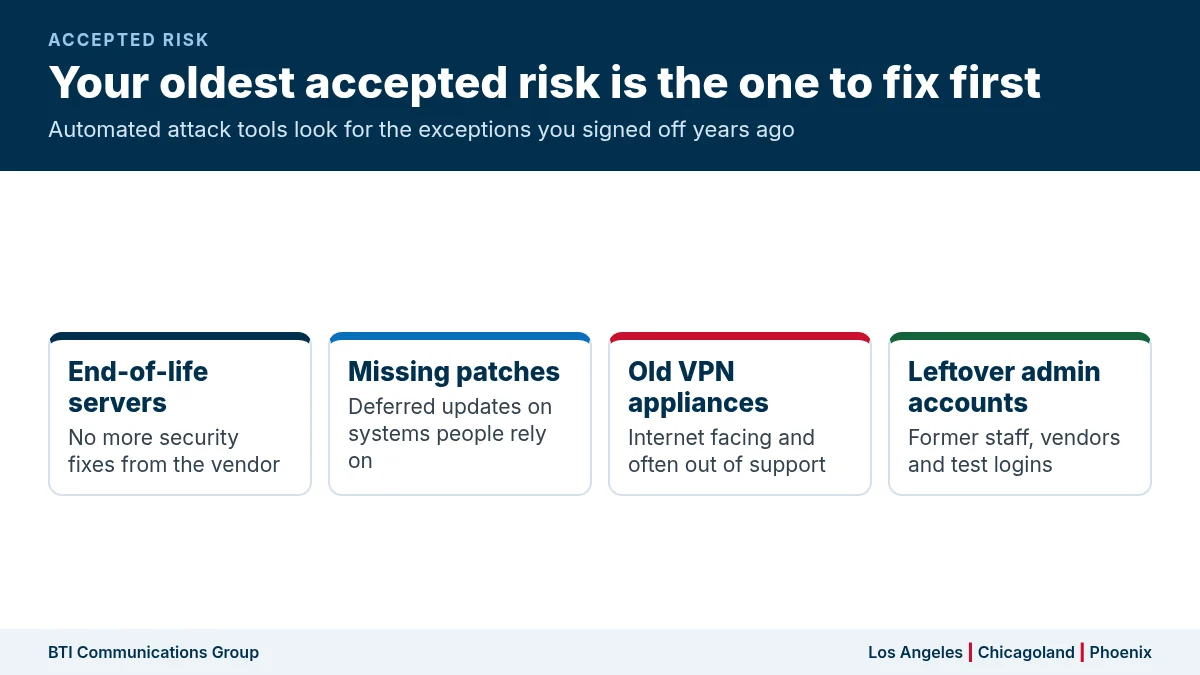
Accepted risk graphic showing four common accepted risks that automated attack tools look for: end-of-life servers, missing patches, old VPN appliances and leftover admin accounts

Every business has an accepted risk list, even if nobody calls it that. It is the server that could not be upgraded because one old application depends on it. The VPN appliance that still works, so it stays. The patch that was deferred because it might break something. The admin account a vendor used three years ago. Each one was a reasonable call at the time.

The problem is that attackers now look for exactly these items faster than before. In an October 2026 report, Google Threat Intelligence Group described threat actors using AI-driven, agentic attack frameworks that automate reconnaissance, break-in, lateral movement and preparation for data theft. One group it tracked typically moved from its first compromised account to deep system access in around four hours, and in one case in about 15 minutes.

Google also noted that the mechanics have not changed: attackers still use compromised credentials and unpatched systems. What changed is the speed. That makes your oldest accepted risk the best place to start.

Not sure what is on your accepted risk list? A free cybersecurity assessment is a good place to find out.

What counts as an accepted risk

An accepted risk is a known weakness that a business decided to live with, usually because fixing it cost too much, would disrupt operations or simply was not urgent. Common examples include:

  • End-of-life servers and operating systems that no longer get security fixes from the vendor.
  • Missing or deferred patches on systems people are afraid to restart.
  • Old VPN and firewall appliances that face the internet and may be out of support.
  • Leftover admin accounts from former staff, vendors, test projects or old integrations.
  • Exceptions to multifactor authentication granted for a shared mailbox, a legacy app or a senior leader.

Risk acceptance itself is not the problem. It is a normal part of running a business. The trouble starts when accepted risks are never revisited. The older an exception gets, the more likely it is that a public exploit exists, the vendor has stopped fixing it and nobody remembers why it was accepted.

Why automated attacks change the math

When attacks were mostly manual, an old weakness might sit unnoticed simply because nobody had time to find it. Automated frameworks remove that delay. They can scan, try known exploits, test stolen passwords and move to the next system without waiting for a person.

Google’s defensive guidance in the same report lists long-standing best practices: isolating management systems, short-lived credentials, least privilege, network segmentation and behavior-based detection. Every one of those is easier when the oldest exceptions are gone.

This is also why actively exploited flaws deserve attention first. CISA’s Known Exploited Vulnerabilities catalog lists flaws attackers are already using. BTI tracks recent entries on its managed patching and vulnerability management page.

How to pick your oldest accepted risk and fix it first
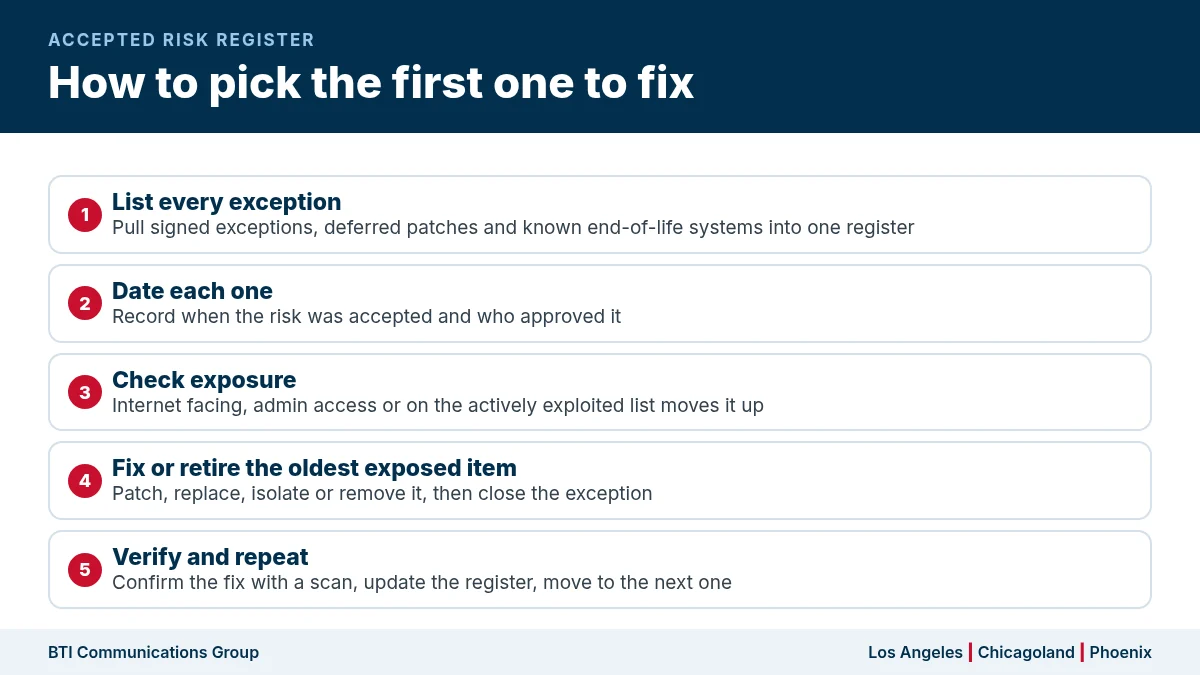
Five step accepted risk register diagram: list every exception, date each one, check exposure, fix or retire the oldest exposed item, then verify and repeat
A simple way to work through an accepted risk register, oldest exposed item first.
  1. List every exception. Pull signed exceptions, deferred patches, end-of-life systems and old accounts into one register. If nothing is written down, start with an asset inventory and a vulnerability scan.
  2. Date each one. Record when the risk was accepted and who approved it. Many teams find items that nobody can explain.
  3. Check exposure. Move an item up if it faces the internet, holds admin access or appears on the actively exploited list.
  4. Fix or retire the oldest exposed item. Patch it, replace it, isolate it on its own network segment or remove it. Then close the exception.
  5. Verify and repeat. Confirm the fix with a fresh scan, update the register and move to the next oldest item.

If an item truly cannot be fixed yet, reduce its exposure. Take it off the internet, put it behind multifactor authentication, limit who can reach it and watch it closely. Then set a date to revisit the decision.

Put patching intervals in writing

Accepted risks pile up when nobody owns the timeline. One answer is a Protection Level Agreement. As BTI’s Protection Level Agreements white paper explains, a PLA is a written, funded, measurable commitment to a level of protection, most often how many days critical systems may stay exposed before a vulnerability is patched and verified closed.

Writing the interval down changes the conversation. Instead of asking whether a patch can wait, the business decides what level of protection it wants, funds it and measures it. Old exceptions stand out quickly when every system is measured against the same agreed interval.

Where managed patching fits

Most mid-market IT teams know their accepted risks are there. What they lack is time. BTI’s managed patching, vulnerability management and vCISO service combines scanning, prioritization, patching and verified closure with executive oversight, backed by a 24/7 NOC/SOC.

A vCISO can own the accepted risk register, bring it to leadership and make sure each exception has an owner and a review date. After a critical flaw, BTI’s guide to credential rotation after critical vulnerabilities covers the cleanup step many teams skip.

How BTI helps

BTI Communications Group has over 40 years in business, with offices in Los Angeles, Chicagoland and Phoenix. We help organizations find their accepted risks, fix the oldest and most exposed ones first and keep patching on an agreed schedule. Start with a free cybersecurity assessment, or call the IT line for your region:

Find your oldest accepted risk before an automated attack does.

Frequently asked questions

What is an accepted risk in cybersecurity?

An accepted risk is a known weakness a business has decided to live with, for example an end-of-life server, a deferred patch, an old VPN appliance or an exception to multifactor authentication. Accepting a risk can be reasonable, but each one should have an owner and a review date.

Why fix the oldest accepted risk first?

Older exceptions are more likely to have public exploits, lost vendor support and owners who have moved on. Automated attack tools look for exactly these known weaknesses, so the oldest exposed item is often the easiest way in.

How fast are AI-driven attacks moving?

In an October 2026 report, Google Threat Intelligence Group said one group using agentic attack frameworks typically moved from its first compromised account to deep system access in around four hours, and in one case in about 15 minutes.

What is the difference between risk acceptance and risk avoidance?

Risk acceptance means knowingly living with a weakness, usually for cost or operational reasons. Risk avoidance means removing the activity or system that creates the risk, for example retiring an old server instead of keeping it online.

What should we do with a system we cannot patch yet?

Reduce its exposure. Take it off the internet if possible, put it behind multifactor authentication, limit who can reach it, segment it from the rest of the network and watch it closely. Set a date to revisit the decision.

What is a Protection Level Agreement?

A Protection Level Agreement is a written, funded, measurable commitment to a level of protection, most often how many days critical systems may stay exposed before a vulnerability is patched and verified closed. BTI explains PLAs in a free white paper.

How can BTI help with accepted risks?

BTI offers a free cybersecurity assessment and managed patching, vulnerability management and vCISO services that find accepted risks, prioritize the most exposed ones and verify each fix, backed by a 24/7 NOC/SOC in Los Angeles, Chicagoland and Phoenix.

Table of Contents

Book an AI readiness conversation

Talk with a BTI business advisor about where AI fits, how to govern it, and what your data and infrastructure need first.
Book now ›

Get a free IT & security review

A BTI business advisor reviews your network, cloud and security posture against ISO 27001 compliant practices and shares clear next steps. No obligation.
Book now ›

Get a free communications cost review

See how your phone, Teams calling and contact center spend compares, with a tailored recommendation from a BTI business advisor.
Book now ›

Free security assessment

Get a walk-through of your facility and a tailored recommendation from our team, no obligation.
Book now ›

Talk to a BTI advisor

Have a question about IT, security, communications or AI? A BTI business advisor will point you to the right solution.
Book now ›
Picture of Eric Brackett
Eric Brackett

Eric W. Brackett is the founder and president of BTI Communications Group, where he’s been helping businesses nationwide simplify communications, strengthen IT security, and unlock growth for over 40 years. Known for his client-first approach and “Yes! We Can” mindset, Eric transforms complex technology into reliable, cost-saving solutions that deliver long-term value.

Related articles

Your Cyber Insurance Hotline May Put You on Hold: Have an Incident Response Plan Ready

Response firms say they are near capacity. Build an incident

5 Questions to Ask Your IT Provider About Its Remote Access Tools

Attackers took over a widely used remote support tool to

Vulnerabilities Are Now the Top Way In. Here Is How We Decide What to Fix First

Verizon’s 2026 DBIR says exploited vulnerabilities are now the most

Ready to strengthen your security and IT infrastructure?

Book a free consultation with BTI Communications Group. We’ll assess your facility, walk you through your options, and recommend the solution that fits your operations, no obligation.

Communication

Let's Start a Conversation

What's the best way for us to contact you?

IT Services

Let's Start a Conversation

What's the best way for us to contact you?

Top quality brands, expert engineering, transparent cost, and measurable ROI.