Why “call the carrier” is not a full incident response plan
Many cyber policies point you to a breach hotline or a panel of approved response firms. That is a valuable benefit, and you should know exactly how to use it. But a hotline is a way to request help. It is not a plan for what your own people do while that help is being arranged.
When response firms are busy, a few things tend to happen to companies that have nothing else ready:
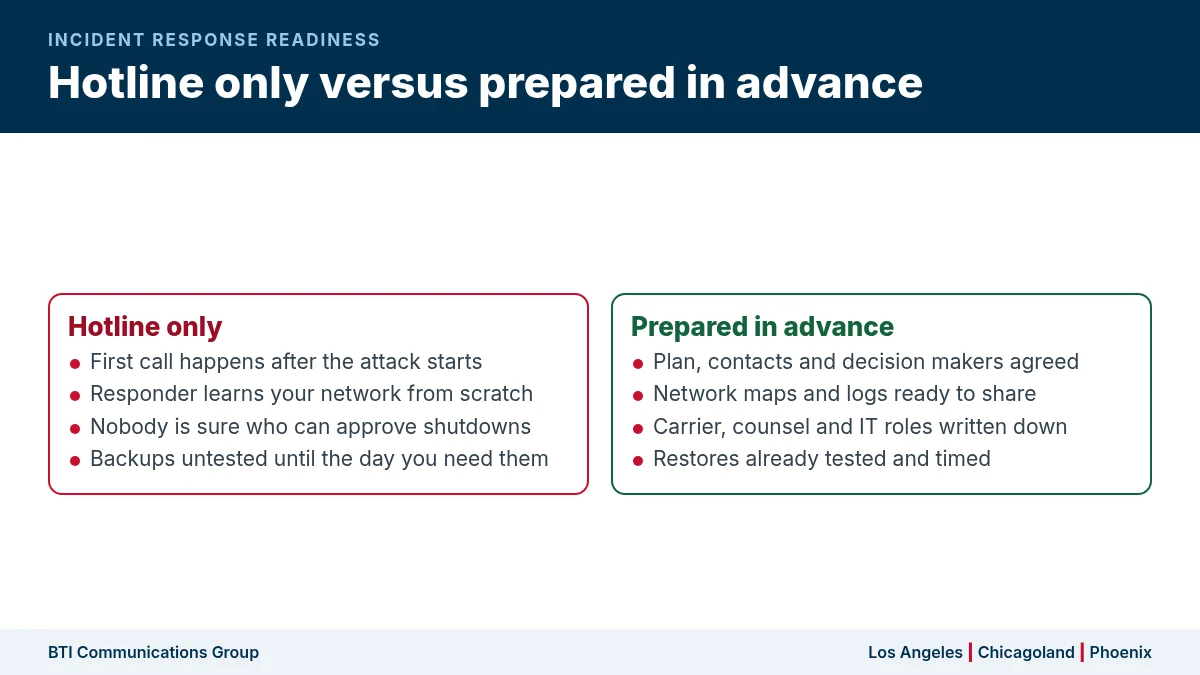
- The clock starts late. Nobody inside knows who should decide to disconnect systems, so the decision waits.
- The responder starts from zero. There is no current network map, no list of critical systems and no idea where the logs live.
- Backups are a hope, not a fact. Nobody has tried a full restore, so nobody knows if it works or how long it takes.
- Evidence gets lost. Well-meaning staff reboot servers or wipe laptops before anyone has collected what the investigation needs.
1. A tested incident response plan
A useful incident response plan is short enough that people will actually read it, and specific enough that they can act on it under stress. It should answer:
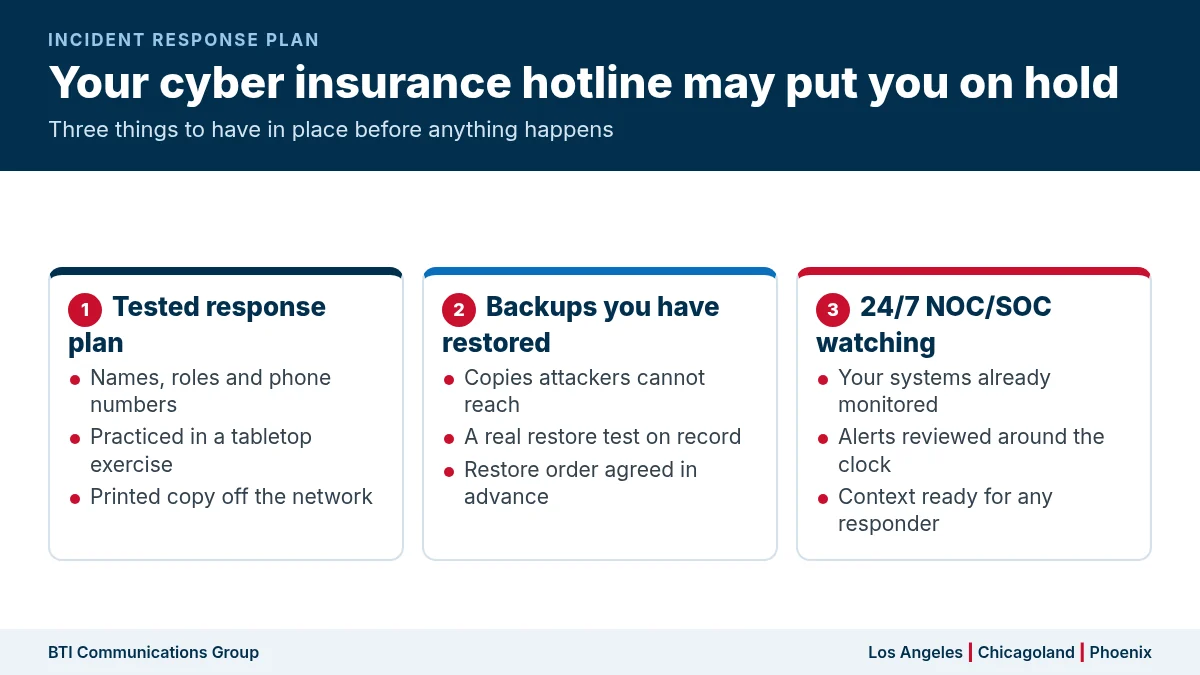
- Who decides. Name the person who can approve shutting down systems, contacting the carrier and engaging outside counsel, plus a backup for each.
- Who to call, in order. Your insurance carrier’s notification line, your counsel, your IT provider and your key vendors, with phone numbers that do not depend on your email working.
- What the policy requires. Notification windows, panel vendor rules and whether you need approval before using your own providers. Read this now, not during the incident.
- Your critical systems. Which systems to protect and restore first, and who owns each one.
- How to talk. A backup communication channel in case email, chat or phones are affected.
Then test it. A one or two hour tabletop exercise, walking through a realistic scenario, finds the gaps a document review misses. Keep a printed copy somewhere that does not depend on the network.
If you have no in-house security leader to own the plan, a vCISO service can write it, run the tabletop and keep it current as your business changes.
2. Backups you have actually restored from
Most businesses have backups. Far fewer have proved they can restore from them. Ransomware groups know this, and they often go after backup systems first.
- Keep a copy attackers cannot reach. Use an offline or immutable copy that a stolen admin account cannot delete.
- Run a real restore test. Restore a full server or application, not one file, and write down how long it took.
- Agree on restore order. Decide in advance which systems come back first so nobody argues about it during an outage.
- Protect the backup logins. Separate credentials and multifactor authentication for backup consoles.
For businesses that cannot afford long downtime, a hot standby disaster recovery setup keeps a ready copy of key systems that can take over while the primary environment is investigated.
3. A 24/7 NOC/SOC that is already watching
An outside responder who joins after an attack has to learn your environment first. A 24/7 NOC/SOC that already watches your systems knows what normal looks like, has the logs and alert history, and can help your team act on the plan from the first alert.
That context matters when outside help is busy. It means the responder, whoever it is, gets a timeline, affected systems and collected evidence on the first call instead of starting from scratch.
BTI’s managed cybersecurity is backed by a 24/7 NOC/SOC, and our managed patching and vulnerability management work closes many of the gaps attackers use to get in before an incident starts.
How your cyber insurance fits in
Insurers increasingly ask about these same controls at application and renewal: multifactor authentication, tested backups, endpoint protection, patching and an incident response plan. Getting ready for an incident and getting ready for underwriting are largely the same project.
BTI’s cyber insurance readiness service maps your current controls to typical carrier questions, so you can see the gaps before the carrier does. While you are reviewing the policy, confirm:
- The exact notification steps and time limits.
- Whether you must use the carrier’s panel firms, or can get your own providers approved in advance.
- What the policy expects you to have in place, such as multifactor authentication and backups, and whether you can show it.
A short readiness checklist
- Write a short incident response plan with named decision makers and backups.
- Put the carrier, counsel and IT contact numbers on paper.
- Read the policy’s notification and panel vendor rules.
- Run a tabletop exercise with leadership and IT.
- Keep an offline or immutable backup copy.
- Run and time a full restore test.
- Agree on restore order for critical systems.
- Make sure a 24/7 NOC/SOC is watching your systems and logs.
For more on the threats behind this, see BTI’s latest AI and cybersecurity update.
How BTI helps
BTI Communications Group has over 40 years in business, with offices in Los Angeles, Chicagoland and Phoenix. We help mid-market and multi-site organizations build incident response plans, test backups, prepare for cyber insurance questions and run security operations backed by a 24/7 NOC/SOC. The easiest first step is a free cybersecurity assessment. You can also call the IT line for your region:
- Los Angeles: 323-510-8003
- Chicago: 312-492-2613
- Phoenix: 480-272-8728
Find the gaps before an incident does. Book your free cybersecurity assessment.