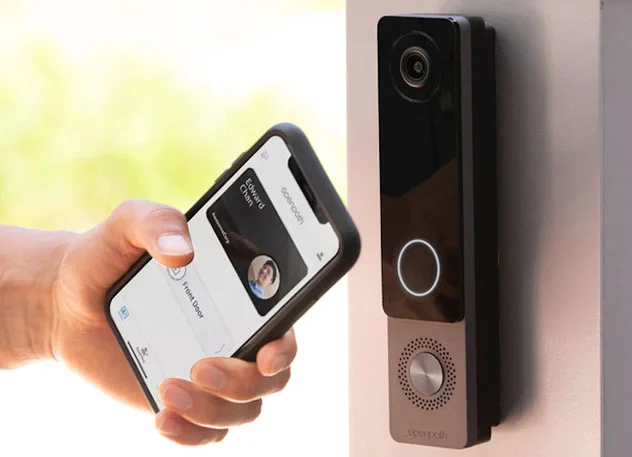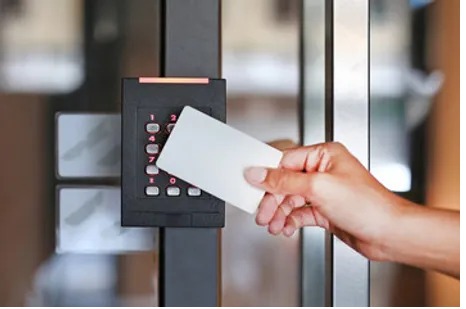
HID card readers are access control readers that unlock doors when an authorized card, key fob, or smartphone credential is presented. The reader reads an encrypted ID from the credential and sends it to the access control panel, which decides whether to open the door. They suit most businesses that want reliable, auditable door security, as long as you choose modern secure credentials instead of legacy 125 kHz proximity cards.
Below: how access control card readers work, the credential technologies that matter, the current HID Signo reader models, and how to decide whether HID readers are right for your facility.
What Is an Access Control Card Reader?
An access control card reader is the device mounted beside a door, gate, or turnstile that reads a user’s credential. It does not make the access decision itself. It passes the credential data to an access control panel or cloud controller, which checks the user’s permissions and schedule, then releases the electric strike or maglock and logs the event.
A good reader should be weather-resistant, tamper-resistant, and compatible with your access control platform. It should also support secure communication with the panel.
How Do Access Control Cards Work with My Access Control Card Reader?
Access control cards, key fobs, and stickers use RFID (radio frequency identification). Each contains a small chip and antenna. When the credential is held near the reader, the reader’s radio field powers the chip, and the chip responds with its stored data.
- The user presents a card, fob, or phone.
- The reader and credential authenticate each other (on secure technologies) and exchange the encrypted ID.
- The reader sends the ID to the panel using Wiegand or OSDP.
- The panel checks permissions, unlocks the door if authorized, and logs the event.
The whole exchange takes a fraction of a second.
Credential Technologies: Why It Matters
| Technology | Frequency | Security | Recommendation |
|---|---|---|---|
| HID Proximity (prox) | 125 kHz | No encryption, easily cloned | Migrate away |
| iCLASS SE / SR | 13.56 MHz | Encrypted, mutual authentication | Acceptable; plan for Seos |
| Seos | 13.56 MHz | Strong encryption, HID’s current standard | Recommended |
| Mobile (HID Mobile Access) | Bluetooth / NFC | Seos-based, on the user’s phone | Recommended where phones are allowed |
Legacy 125 kHz prox cards are still common, but they can be copied with inexpensive tools. Multi-technology readers let you read old and new cards during a phased migration.
Wiegand vs. OSDP
Older readers connect to panels using Wiegand, an unencrypted protocol. OSDP (Open Supervised Device Protocol) over RS-485 supports encryption, supervision that detects a disconnected or tampered reader, and two-way communication. For new installations, specify OSDP Secure Channel where the panel supports it.
Which Brand of Access Control Card Readers Should I Choose?
Several manufacturers make quality readers, but HID is the most widely used brand in commercial access control. Business owners choose HID readers because:
- They work with nearly every major access control platform.
- They read a wide range of credential technologies, which simplifies migrations.
- They support mobile credentials and OSDP.
- They are widely stocked and supported.
HID Signo Reader Models
The HID Signo family is HID’s current flagship reader line. All models read Seos, iCLASS SE/SR, MIFARE, DESFire, and (on multi-technology versions) 125 kHz prox, plus mobile credentials via Bluetooth and NFC. They support Wiegand and OSDP and are IP65-rated.
| Model | Mounting | Keypad | Best for |
|---|---|---|---|
| Signo 20 | Mullion / narrow door frames | No | Glass storefront-style doors and narrow frames |
| Signo 20K | Mullion | Yes (2×6) | Card plus PIN multi-factor on narrow frames |
| Signo 40 | Single-gang wall switch box | No | Standard wall-mounted doors |
| Signo 40K | Single-gang wall switch box | Yes (3×4) | Card plus PIN for server rooms, pharmacies, and labs |
Are HID Card Readers Right for Your Business?
HID readers are a good fit if you:
- Have more than a handful of doors and need to add or revoke access quickly
- Need audit trails for compliance (healthcare, manufacturing, government, finance)
- Want card, mobile, or multi-factor options on the same system
- Plan to integrate doors with video surveillance or intrusion detection
They may be more than you need for a single door with a few users, where a standalone keypad lock may suffice. To see how readers fit into a layered design with alarms, read our overview of types of intrusion detection systems.
Questions to Ask Before You Buy
- What credentials are in use today, and are they 125 kHz prox?
- Does the panel support OSDP Secure Channel?
- Will you issue mobile credentials?
- Which doors need multi-factor (card plus PIN)?
- Who will manage cards when employees join or leave?
BTI: Your Access Control Card Reader Provider
BTI Communications Group has been in business for 40 years and has delivered integrated physical security since the 2010s. We design and install access control systems with HID readers and secure credentials, plan prox-to-Seos migrations, and integrate doors with cameras and alarms. Need local service? Our access control Los Angeles team supports Southern California sites. Learn more about what a security systems integrator does.
Frequently Asked Questions
How do HID card readers work?
The reader powers the chip in a card, fob, or phone, reads its encrypted ID, and sends it to the access control panel using Wiegand or OSDP. The panel checks permissions and unlocks the door.
Can HID cards be cloned?
Legacy 125 kHz HID Proximity cards are unencrypted and can be cloned with inexpensive tools. Encrypted 13.56 MHz credentials such as Seos and iCLASS SE are far more resistant.
What is the difference between HID Signo 20 and 40?
The Signo 20 is a slim mullion-mount reader for narrow door frames; the Signo 40 mounts on a single-gang wall box. The K versions (20K, 40K) add a keypad for card plus PIN.
Do HID readers support mobile credentials?
Yes. HID Signo readers read HID Mobile Access credentials over Bluetooth and NFC.
Get a free security site assessment
Talk with a BTI security engineer about your cameras, access control, and alarms. We will walk your site, document what you have, and give you an itemized plan. Call 800-435-7284 or request your assessment online.