Over 40 Years in BusinessISO 27001 compliantPublic sector: GSA contract holder

LA 562-298-5000 · Chicagoland 312-432-5300 · Phoenix 602-733-6807 · Client Support

Elevator access control for apartment and condo buildings

Multifamily | BTI

Residents reach their floors, guests reach the right floor, and nobody else rides to the penthouse. Integrated with your access control and elevator system, designed and supported by BTI.

Security sales: LA 562-298-5070 | Chicago 630-343-1322 | Phoenix 480-291-8374

Request your free consultation

Tell us about your doors, sites and timeline. No obligation.
Security

Let's Start a Conversation

What's the best way for us to contact you?

Authorized and Certified Axis certified Gold Solutions Partner · Authorized and Certified Avigilon / Motorola Solutions · Bosch IQSIGHT dealer · YourSix dealer · Brivo design, sales, installation and support. We also work with Kantech, RS2, Alarm.com and Milestone. See Partners.

How does elevator access control work in an apartment building?

Elevator access control limits which floors a person can reach. A resident presents a phone, fob or card at a reader, and the access system tells the elevator controller which floors to enable. Larger buildings with destination dispatch use a data sync, where the access system shares resident and floor rules with the elevator system. Either way, the access system stays the single source of truth for who may go where. Request a quote.

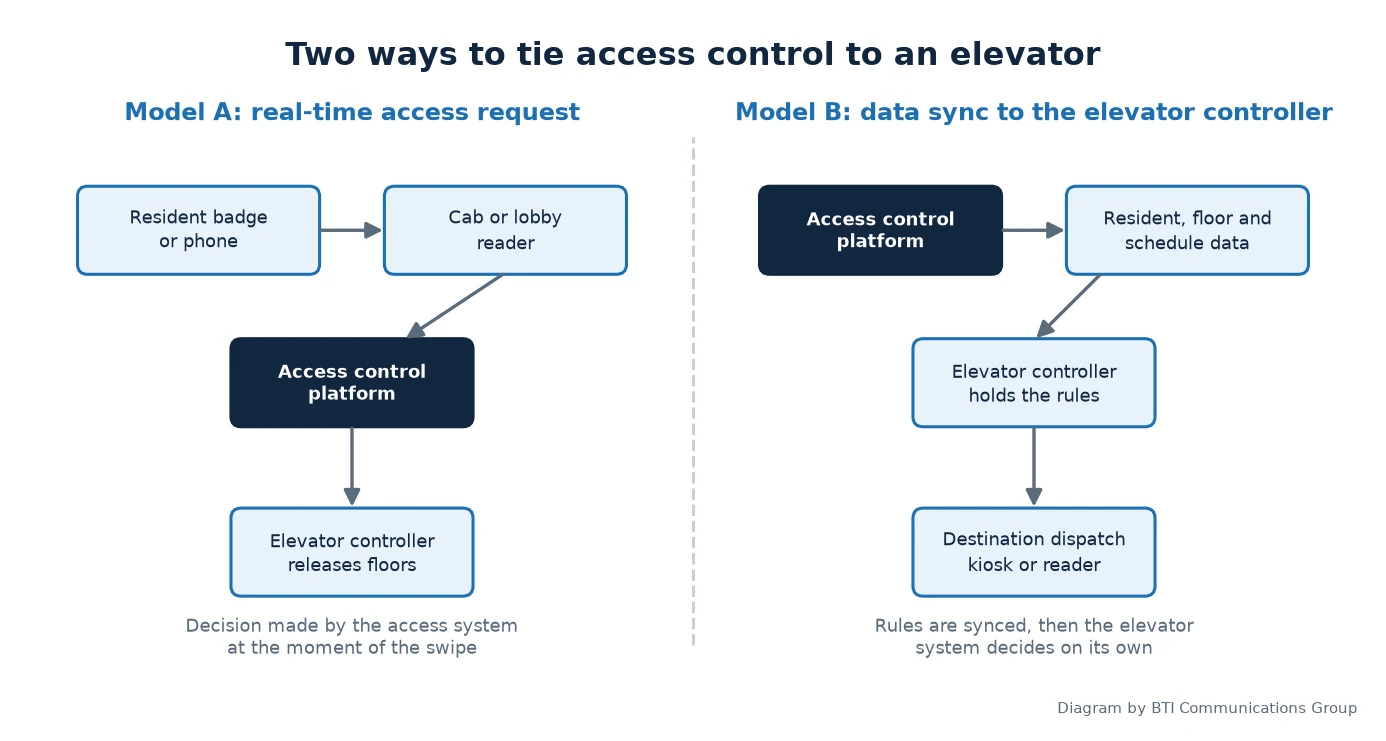
Diagram of two elevator integration models: a real-time access request and a data sync to the elevator controller
Two ways to connect access control and an elevator. The right one depends on the elevator system.

Why elevator control matters in multifamily

  • Keep non-residents off residential floors, roof decks and amenity levels after hours.
  • Send visitors and delivery drivers to one floor, or to the resident they called, and no further.
  • Give residents one credential for the lobby, garage, gym and floors.
  • Revoke floor access at move-out without a call to the elevator company.
  • Keep a record of who rode to which floor and when, linked to lobby video.

Two ways to connect access control and an elevator

Model A: real-time access request. A reader in the cab or lobby reads the credential. The access control system decides, then signals the elevator controller to enable the allowed floors, usually through relay contacts or a similar interface. This works with standard elevator controllers and is common in mid-rise buildings.

Model B: data sync to the elevator system. The access control system shares credential and floor rules with the elevator vendor’s own system. Destination dispatch kiosks and readers then decide on their own. This is how many high-rise and newer buildings run, and it needs the elevator vendor’s integration team.

Which model fits depends on your elevator controller, floor count and whether you have destination dispatch. BTI confirms with your elevator contractor before design.

Floor limits by platform

Each platform has its own limit on how many floors one elevator interface can control. Published limits:

PlatformElevator interfaceFloor limit
Avigilon Alta24V Elevator Smart HubUp to 16 floors and 2 readers per hub
BrivoRelay floor controlUp to 118 floors
KantechKT-400 controller with relay modulesUp to 64 floors per cab

BTI confirms the right hardware for your floor count and elevator controller during design.

Common designs

  • Floor lockout by credential. Residents reach their floor and shared floors. Others are blocked.
  • Visitor call to resident. The intercom call routes to the resident, and approval releases the elevator to that floor.
  • Delivery and package floor. Carriers get a time-limited credential for the lobby and package room only.
  • Amenity schedules. Roof deck and pool levels open during posted hours.
  • Service and freight cars. Staff and vendors use a separate group with its own schedule.
  • Elevator and door records together. One report shows the lobby entry, the ride and the floor.

Code-required elevator safety functions stay under the elevator contractor’s control, and we design around them.

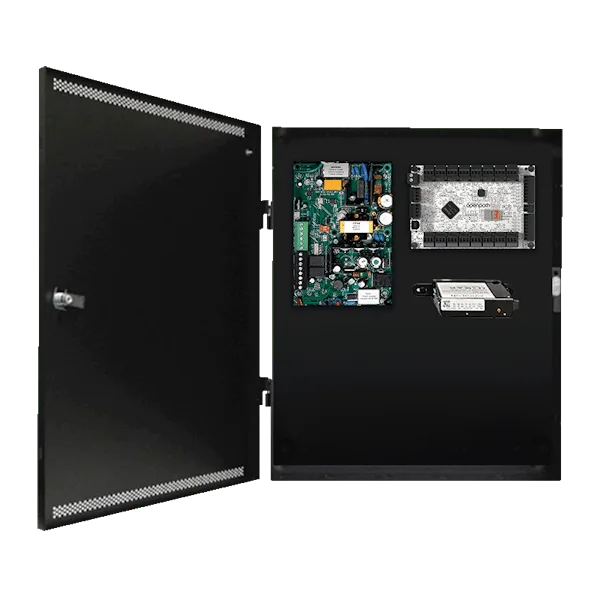
Avigilon Alta 24V Elevator Smart Hub controller in an open enclosure
Avigilon Alta 24V Elevator Smart Hub for elevator floor control.

What we need from you

  • Elevator make, model, controller type and age.
  • Whether the building has destination dispatch.
  • Floor count and which floors are public, resident-only or restricted.
  • Name of your elevator contractor.
  • Your access control system, if you have one, and your property management system.

How BTI delivers it

  1. Site walk with your elevator contractor and property team.
  2. Interface plan: which model, which hardware, which floors and groups.
  3. Install and wire the readers and interface hardware, coordinated with the elevator contractor.
  4. Test every floor and mode with the contractor present, including after-hours and visitor modes.
  5. Train and support. 24/7 system health and alert monitoring is available, plus a 24/7 converged security NOC/SOC.

Commercial and mixed-use buildings

Mixed-use buildings often need two rule sets: one for residents and one for the office or retail floors. See access control for multi-tenant commercial buildings and plan both together. For the platform behind the elevator, see apartment access control systems.

Serving apartment, condo and mixed-use properties

BTI has offices in Chicago (1985), Los Angeles (2001) and Phoenix (2006), with over 40 years in business. Call the security line for your region:

RegionOfficeSecurity line
Southern California12155 Mora Dr 1 & 2, Santa Fe Springs, CA 90670562-298-5070
Chicagoland1441 Branding Ave #200, Downers Grove, IL 60515630-343-1322
Phoenix and Tucson area615 N 48th St Suite 1048, Phoenix, AZ 85008480-291-8374

Emergency support is available 24/7. Call 800-435-7284.

Where BTI installs access control

Frequently Asked Questions

Yes. The access control system can enable only the floors a credential is allowed to reach, using the elevator controller’s interface or a data sync to the elevator vendor’s system. BTI designs the interface with your elevator contractor.

Often, yes, but it is a different design. Destination dispatch systems make their own decisions, so the access system shares resident and floor rules with the elevator system. That needs the elevator vendor’s integration, and BTI confirms it before design.

Yes, where the platform and reader support it. A resident presents a phone or fob at the reader, and the floors they are allowed to reach are enabled. We test every credential type with the elevator contractor.

Yes. Visitors can be sent to the resident they called after approval, and carriers can receive time-limited access to the lobby and package room only.

Not usually. Many controllers accept an interface from the access system. Older controllers or special systems may need the elevator contractor’s help, and we confirm during the site walk.

BTI coordinates with your elevator contractor during design, install and testing. Their work on the elevator stays under their control, and ours on the access system stays under ours.

No. Code-required elevator safety functions stay under the elevator contractor’s control, and the access control design works around them.

Often, yes. Office and retail floors usually have tenant groups and schedules that differ from residential floors. Mixed-use buildings can run both rule sets from one system.

Plan security and network for your property

Get a free consultation with a BTI security specialist

Send us your site list, floor plans and property management system. BTI will return a written scope and quote with hardware, licensing, installation and support.

Call security sales: LA 562-298-5070 | Chicago 630-343-1322 | Phoenix 480-291-8374

Request your free consultation

Tell us about your doors, sites and timeline. No obligation.
Security

Let's Start a Conversation

What's the best way for us to contact you?

Certifications and contracts

BTI is ISO 27001 compliant and holds alarm company operator (ACO) licenses in California, Arizona and Illinois. We are also a GSA approved contractor.

ISO 27001 compliant, independently reviewed through the TAG ISO 27001 Compliance Program. ACO licensed: CA BSIS ACO 7670, IL 127.001638, AZ 22913-0.

Government & public sector

BTI is a GSA Approved Contractor

GSA contract holder, contract 47QTCA21D00BA
CMAS, California Multiple Award Schedules (California public agencies only)
ISNetworld member contractor
TESMA

GSA contract (all states) for business phone and security systems. CMAS and TESMA for California public agencies only. ISNetworld member contractor.

Governance & assurance

Compliance Governance, Certifications & Partner Assurance

Certifications, attestations & compliance-aligned frameworks

ISO 27001 compliant badge by Technology Assurance Group (TAG) for BTI
BTI 24/7 NOC/SOC
SOC 3 report held by BTI's data center and cloud providers
HIPAA-aligned hosting from BTI's cloud and data center providers
PCI DSS compliance held by payment processors BTI uses
UL 827 listing held by BTI's alarm monitoring provider
GDPR support from BTI's cloud platform providers
FedRAMP authorization held by cloud platforms BTI resells
bti-isnetworld-contractor certification safety and compliance credential for vendor prequalification
FISMA compliance held by cloud platforms BTI resells
ISO 14001 held by BTI's data center providers
ISO 50001 held by BTI's data center providers

Certifications, attestations, and compliance programs shown may apply to BTI, BTI’s internal governance practices, or BTI’s third-party service providers depending on the specific platform, service, data center, processor, monitoring provider, or vendor used.

IT Services

Let's Start a Conversation

What's the best way for us to contact you?

Top quality brands, expert engineering, transparent cost, and measurable ROI.