What a bispectral camera is, and what it is not
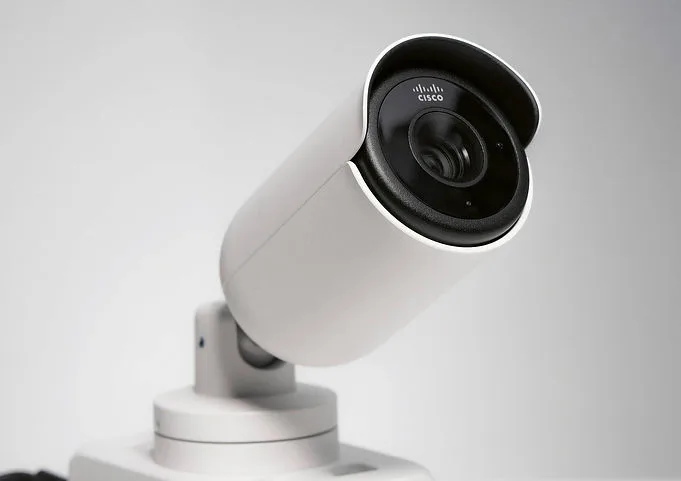
A thermal camera sees heat, not light. That is why it can pick out a person or a vehicle when a visible-light camera shows a dark field. What it cannot do, on its own, is give you the detail you need to confirm who or what you are looking at.
A bispectral camera adds a second, optical sensor in the same unit. The thermal channel is for detection. The optical channel is for verification and, when distance and light allow, identification. The two sensors are factory aligned, so both look at the same scene. The practical result is one alert, two views, and one mount.
This is not the same as hanging two separate cameras and hoping the views line up later. It is also not a promise that the optical side can identify a person at the same distance the thermal side can detect one. Those distances are very different, and we treat them that way in design.

Detection is not identification. The thermal channel flags a person or vehicle. The optical channel is used to check the alert when light and distance allow. Original BTI diagram.
Detection is not identification
The most common mistake we see in thermal and bispectral proposals is a datasheet “range” treated as an identification range. Those are not the same thing.
Axis publishes Detect, Recognize, and Identify (DRI) figures for the AXIS Q2802-E using Johnson’s criteria. Those are theoretical values based on how many pixels a standard-size person or vehicle occupies on the thermal sensor. Axis assumes a person of 1.8 x 0.5 meters and a vehicle of 4.0 x 1.5 meters, and it tells designers to evaluate the real scene, including weather, with a tool such as AXIS Site Designer. The figures below are Axis’s stated theoretical numbers from the AXIS Q2802-E datasheet. They are not field measurements from a BTI site.
AXIS Q2802-E thermal channel, Axis theoretical DRI distances
| Thermal lens | Detect, human | Detect, vehicle | Recognize, human | Identify, human | Identify, vehicle |
|---|---|---|---|---|---|
| 17 deg HFoV | 1,079 m (3,539 ft) | 3,307 m (10,847 ft) | 270 m (886 ft) | 135 m (443 ft) | 413 m (1,355 ft) |
| 24 deg HFoV | 735 m (2,411 ft) | 2,100 m (6,888 ft) | 184 m (604 ft) | 91 m (298 ft) | 283 m (928 ft) |
| 31 deg HFoV | 559 m (1,834 ft) | 1,596 m (5,235 ft) | 140 m (459 ft) | 70 m (230 ft) | 215 m (705 ft) |
| 63 deg HFoV | 291 m (954 ft) | 890 m (2,919 ft) | 73 m (239 ft) | 36 m (118 ft) | 112 m (367 ft) |
Read the 17 degree row carefully. Axis lists human detection at 1,079 m (3,539 ft) and human identification at 135 m (443 ft). That is roughly an eightfold difference. Rain and fog shorten useful range. So does thermal crossover, which is common near dawn and dusk when a person is close to the temperature of the background. Heavy clothing can hide a heat signature. Reflective surfaces can bounce one. Long-wave thermal energy does not pass through ordinary glass or walls, so a camera aimed at a window sees the glass, not what is behind it.
The optical sensor has its own limits. After dark, identification needs visible light or infrared illumination, and IR images are black and white. If license plates are a requirement, use a camera built for that job. Do not ask a general optical channel to read plates at the thermal detection distance.
Why bispectral cameras fit a perimeter
Long fence lines, storage yards, substations, water facilities, warehouses, industrial plants, ports, and correctional sites share a problem: a lot of ground, uneven light, and too many nuisance alarms if you rely on ordinary motion detection. These are the sites where a commercial security camera plan should separate detection from verification.
On those sites a bispectral camera helps in three practical ways.
Classify before you wake someone up. Thermal analytics can treat a target as a person or a vehicle and ignore much of the usual clutter, such as animals, blowing debris, and moving shadows. False alarms do not disappear. They drop, and the ones that remain are faster to check because the operator can switch to the optical view of the same scene. For a longer look at how we use this class of tools, see what video analytics is and Axis analytics features.
One mount and one cable run. Two cameras mean two brackets or poles, two aim points, and two items to maintain. A bispectral unit costs more than a single camera, and both sensors share one position, so placement still has to be chosen carefully. The usual savings are in labor, cabling, and alignment, not in the camera price itself.
Coverage when light fails. The thermal sensor works in complete darkness and is much less affected by glare and deep shadow than a visible-light camera. That keeps detection available around the clock. The optical channel adds context whenever light allows.
Two limits belong in the same conversation, because they are easy to overclaim.
BTI does not use bispectral cameras as fire-detection or temperature-measurement devices, and we do not sell them for those jobs. Axis’s current bispectral lineup also has no thermometric model, so temperature overlays are not part of this product family.
We also do not treat a utility, substation, or critical infrastructure project as a NERC CIP engagement. If your site has a compliance program, that work stays with the teams responsible for it. The same design approach applies on government and logistics sites: match the lens to the distance, then decide how the alert will be verified.
A fixed model built for verification: AXIS Q2802-E
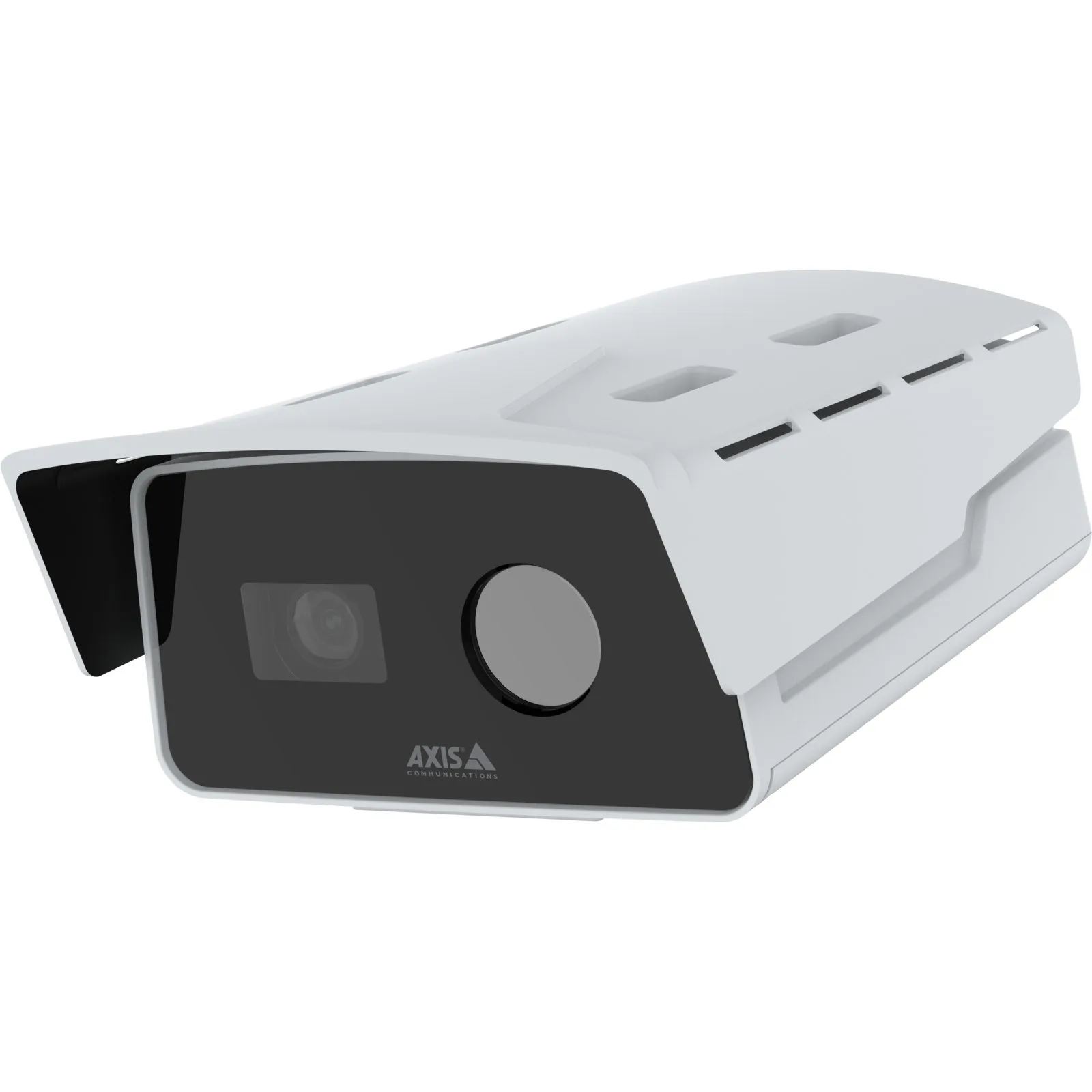
AXIS Q2802-E Bispectral Camera. Official product photo courtesy of Axis Communications. BTI carries this model.
BTI carries the AXIS Q2802-E, a fixed bispectral camera with a 640 x 480 thermal sensor and a 4K visual sensor. Axis offers four thermal fields of view (17, 24, 31, and 63 degrees), so the lens can be matched to the length of the fence line rather than forced into a one-size view.
This is the only Axis bispectral camera that offers thermal-visual image fusion, which combines the two streams into one view so an operator can see a heat signature in relation to visible scene detail. Do not assume every bispectral model has fusion. Most still present two aligned streams and let the operator switch or tile them.
AXIS Object Analytics comes preinstalled on the visual stream and can detect, classify, track, and count people and vehicles. For long-range perimeter work, AXIS Perimeter Defender can run on the thermal stream (sold separately) to classify humans and vehicles along a fence or zone. BTI deploys video analytics on every solution it sells. When a site needs logic that off-the-shelf applications do not cover, we can write custom Axis analytics with ACAP (AXIS Camera Application Platform) that customers can tweak themselves.
Per Axis, the camera is IP66, IP67, and NEMA 4X rated, with an IK10 housing, and includes Axis Edge Vault for device cybersecurity, including FIPS 140-3 Level 3 certified secure key storage. Mounts are sold separately, which is useful: the same camera can go on a wall mount or a positioning unit depending on the scene. Full specifications are in the Axis datasheet and on the AXIS Q2802-E product page. For a broader design view, use BTI’s Axis Security Architecture Guide.
When a bispectral PTZ or radar cue is the better fit
A fixed bispectral camera is the right starting point when the zone is known and the view can stay put. Some sites need a camera that can swing to a cue.
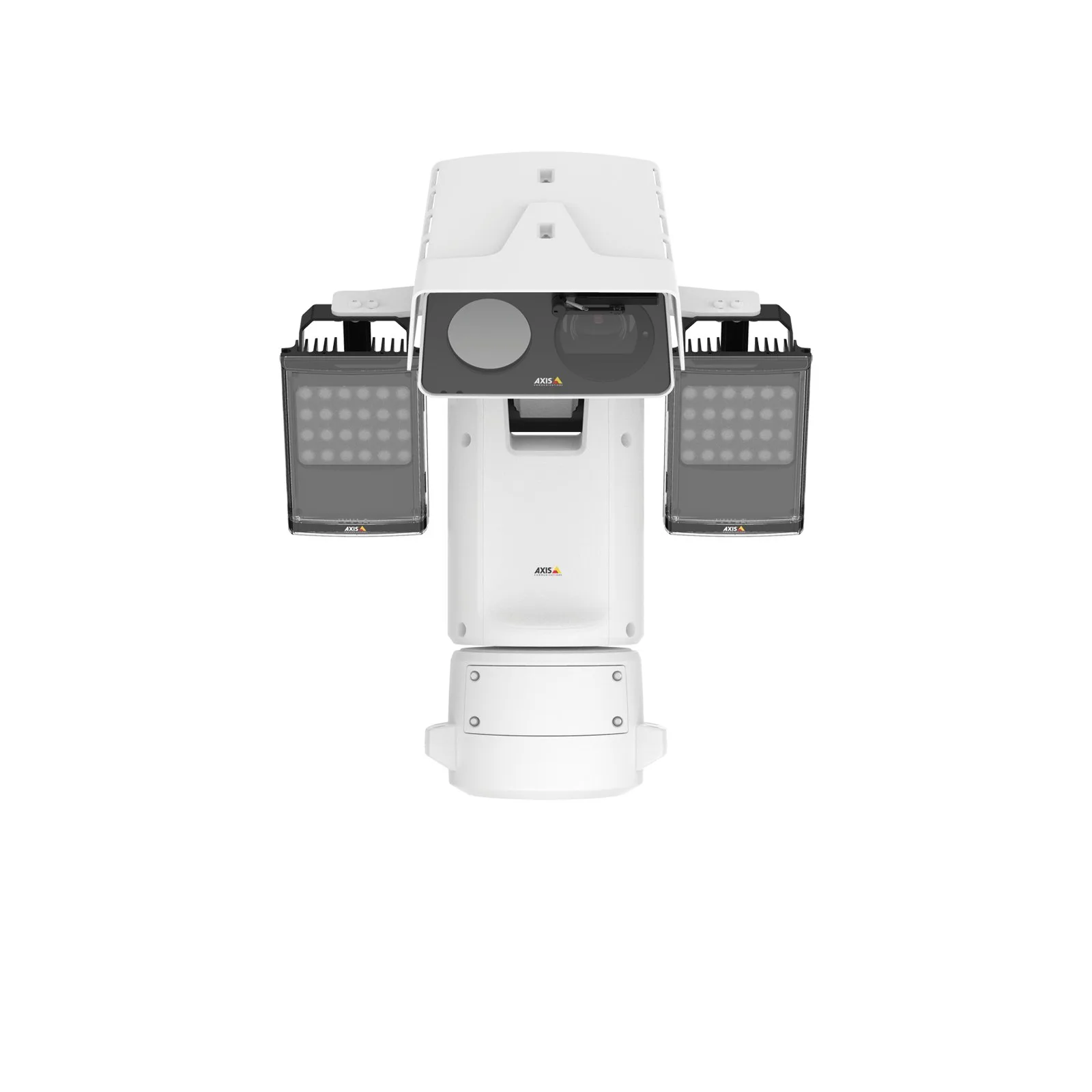
AXIS Q8752-E Bispectral PTZ Camera. Official product photo courtesy of Axis Communications. BTI carries the Q8752-E and the Q8752-E Mk II.
BTI also carries Axis bispectral PTZ models, including the AXIS Q8752-E and the AXIS Q8752-E Mk II. Those units still pair thermal detection with an optical sensor, and the optical side can zoom so an operator, or an automated cue, can take a closer look.
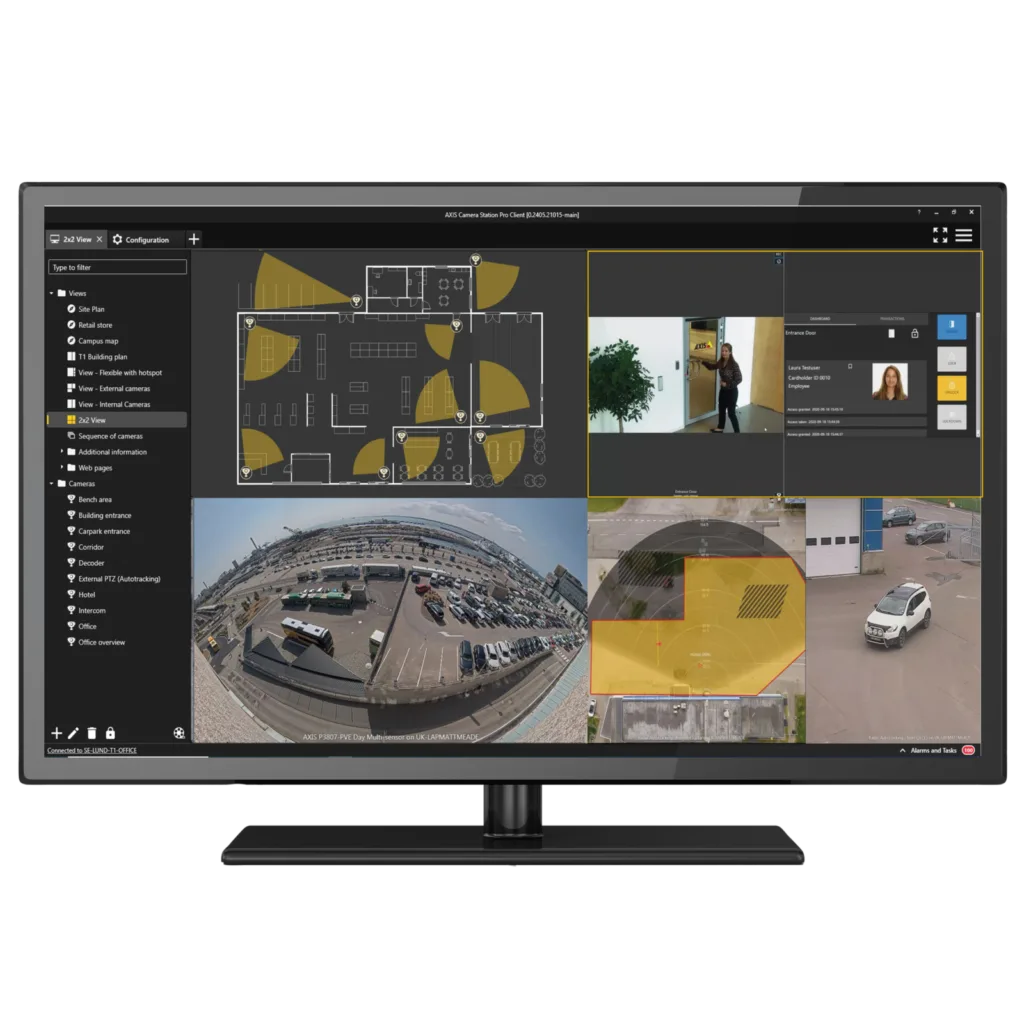
Radar and thermal are complementary, not duplicates. Radar gives distance, speed, and a wide field of detection in all light conditions. A bispectral PTZ can then move to the target: thermal to hold the detection, optical to verify. BTI designs Axis security radar with PTZ cameras, speakers, and AXIS Camera Station when a site needs that handoff.
In a public Axis case study, not a BTI project, the Windsor Port Authority used Axis bispectral PTZ cameras with its existing radar so operators could see what a radar track was, rather than guess from a blip. That is Axis’s published example of radar-cued verification on a waterway, described in the Axis newsroom post on bispectral cameras. We cite it only as Axis’s story. If a similar approach is right for your site, we design it from your radar, camera, and lighting conditions.
Why BTI for Axis thermal and bispectral cameras
BTI Communications Group is an Axis certified Gold Solutions Partner, with offices in Los Angeles, Chicago, and Phoenix and over 40 years in business. We design and install Axis network cameras, including thermal and bispectral models, and we stay with the system after the first turn-on. See our local Axis pages for Los Angeles, Chicagoland, and Phoenix.
A typical perimeter design starts with two distances, not one: how far you need to detect a person or vehicle, and how far you need to identify one. We walk the line, model lens options, and plan lighting or IR where the optical channel has to work after dark. We integrate the cameras with the VMS you already use, or with AXIS Camera Station. Axis integrates with everyone, including Axis VAPIX custom analytics, Axis off-the-shelf analytics, AXIS Camera Station, Exacq, Milestone, OpenEye, YourSix, Brivo, and Software House.
As noted above, BTI deploys video analytics on every solution it sells, and can write custom Axis ACAP analytics that you can tweak yourself. For how we approach camera design more broadly, see Axis camera installation, design, and converged security.
If you want 24/7 system health and alert monitoring available, plus a 24/7 converged security NOC/SOC, we can include that in the design. We do not describe that service as 24/7 monitoring and response.
Call the Los Angeles and Southern California security line at 562-298-5070. In Chicago, call 630-343-1322. In Phoenix, call 480-291-8374.
Talk to BTI about an Axis bispectral camera design for your perimeter.
Quotable facts
- A bispectral camera pairs a thermal sensor for detection with an optical sensor for verification in one factory-aligned housing.
- Detection range and identification range are not the same. On Axis’s theoretical DRI table for the AXIS Q2802-E 17 degree lens, human detection is 1,079 m and human identification is 135 m.
- Thermal-visual image fusion is available on the AXIS Q2802-E only, not on every Axis bispectral model.
- BTI deploys video analytics on every solution it sells and can write custom Axis ACAP analytics that customers can tweak themselves.
- BTI Communications Group is an Axis certified Gold Solutions Partner that designs, installs, and supports Axis thermal and bispectral camera systems in Los Angeles, Chicago, and Phoenix.
Source
Axis Communications, “Bispectral cameras | Dual sensors, one all-in-one camera,” by Magnus Lundegard, November 11, 2026: https://newsroom.axis.com/blog/bispectral-camera. Additional product facts from the AXIS Q2802-E datasheet and product page, attributed in the body.