What AI can do for a property management team today
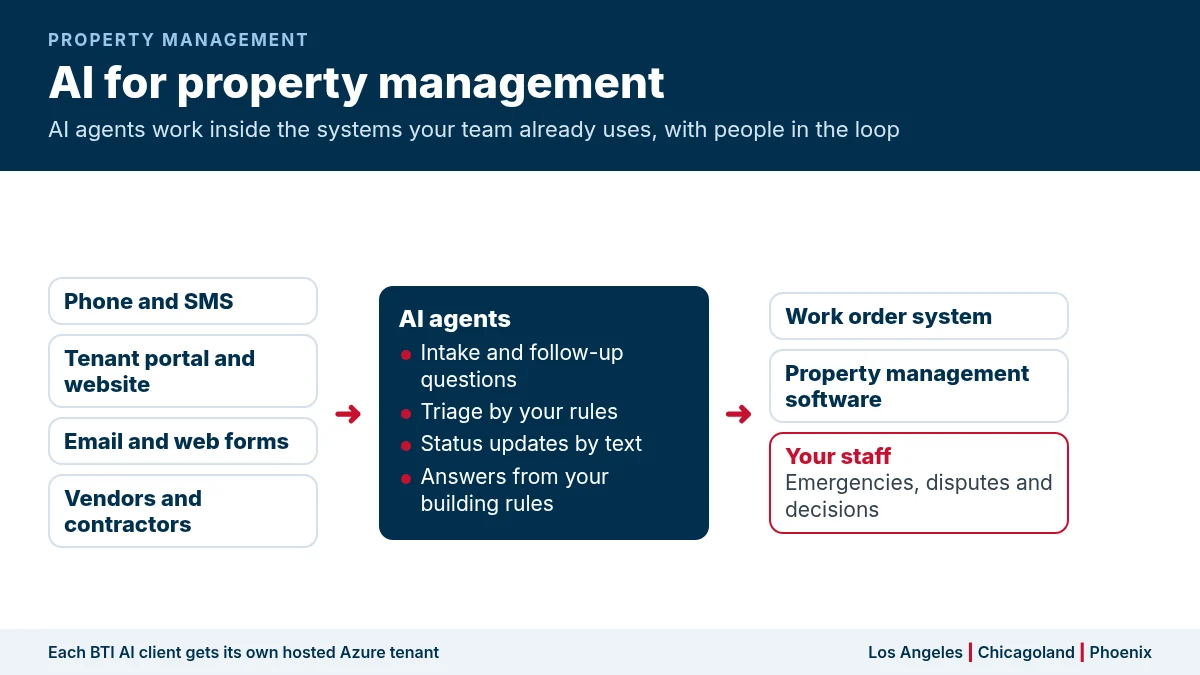
AI agents are software that can read a request, look up the right information, take a defined action and hand off to a person when needed. For a property team, the most useful jobs fall into four areas:
- Work orders and ticketing: taking in requests from any channel, sorting them and keeping tenants updated.
- Tenant portals and websites: answering common questions from your own building rules and policies.
- Vendor and contractor workflows: scheduling, reminders, status updates and completion photos.
- Phone and SMS: answering calls, including after hours, and sending status updates by text.
None of these requires replacing your property management software. The AI works around it, under rules you set.
Work orders and ticketing: intake, triage and status updates
Maintenance requests arrive by portal, email, text and phone, often with missing details. An AI agent can:
- Ask follow-up questions so the request includes the unit or suite, the location, photos and access instructions.
- Sort requests by type and urgency using your rules, and flag possible emergencies such as water leaks, no heat or no cooling for immediate human attention.
- Create or update the ticket in your existing work order system.
- Send the tenant status updates as the ticket moves, so fewer people call to ask.
Your team still sets priorities, approves spending and handles anything unusual. The AI removes the retyping and the “any update?” calls.
Tenant portals and websites: answers that match your building rules
Tenants and residents ask the same questions every week: how to reserve the loading dock or freight elevator, where to send a certificate of insurance, how after-hours HVAC requests work, when the amenity room is open. An AI assistant on your tenant portal or website can answer from your own documents, such as building rules, tenant handbooks and move-in guides, instead of the open internet.
Two rules make this work. First, the assistant answers only from approved sources and says so when it does not know. Second, anything that touches a lease term, a charge or a dispute goes to a person.
Vendor and contractor workflows: scheduling, updates and proof of completion
- Confirm appointment windows with vendors and tenants, and send reminders.
- Collect status updates and completion photos, and attach them to the ticket.
- Remind vendors when insurance certificates or other paperwork are about to expire.
- Summarize open work by property for the weekly owner or manager report.
The result is fewer phone calls between your coordinators and vendors, and a cleaner record of who did what.
Phone and SMS: AI call answering and status updates, after hours included
After-hours calls are where many property teams feel the most pressure. BTI can add best-in-class, enterprise-grade AI agents to the phone and SMS systems your offices already use, including AI call answering and SMS status updates for tenants, residents and contractors. This runs on the phone system you own. It is not an answering service.
An AI agent can answer the call, capture the details, open the ticket and text the caller a confirmation. Anything that sounds like an emergency, such as flooding, a fire alarm or a security problem, goes straight to your on-call staff using the rules you set. Learn more about phone and contact center systems for apartment operators.
What stays with a person
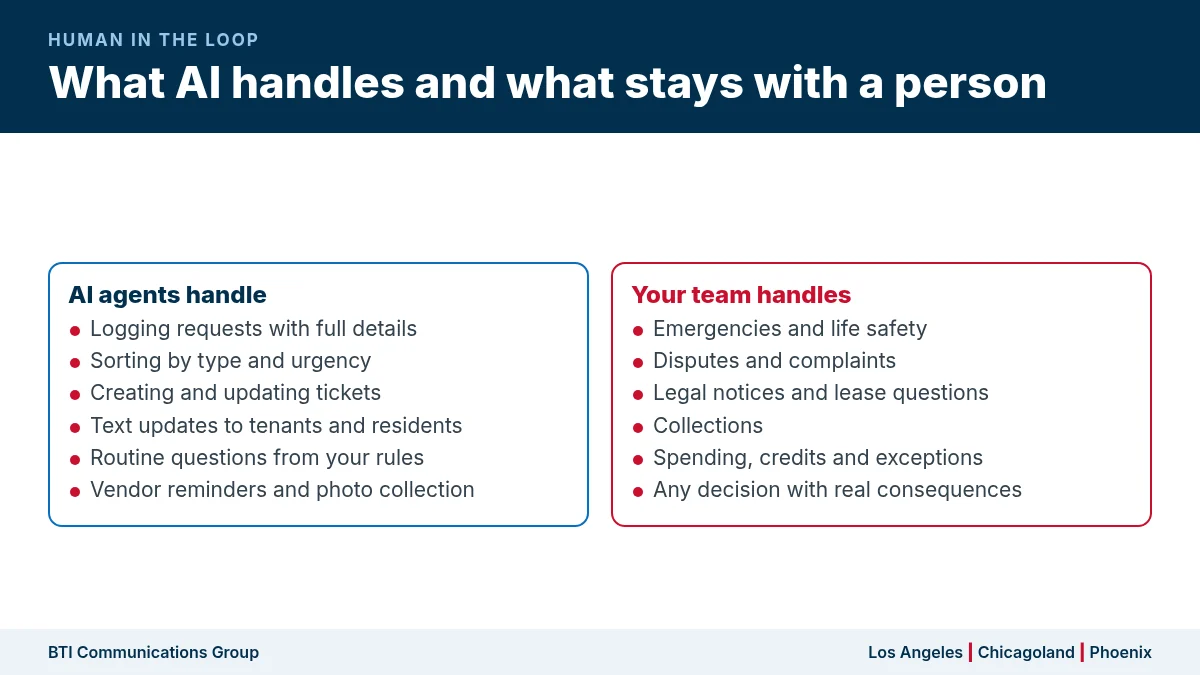
Good AI design starts by deciding what the AI will not do. For property teams, that list usually includes:
- Emergencies and life safety calls, which go straight to people.
- Disputes, complaints and anything sensitive.
- Legal notices, lease interpretations and collections.
- Approvals for spending, credits or exceptions.
- Any decision with real consequences for a tenant, resident or vendor.
People stay in the loop for work that needs a person. The AI gathers the information and hands it off cleanly.
Keeping tenant and vendor data safe
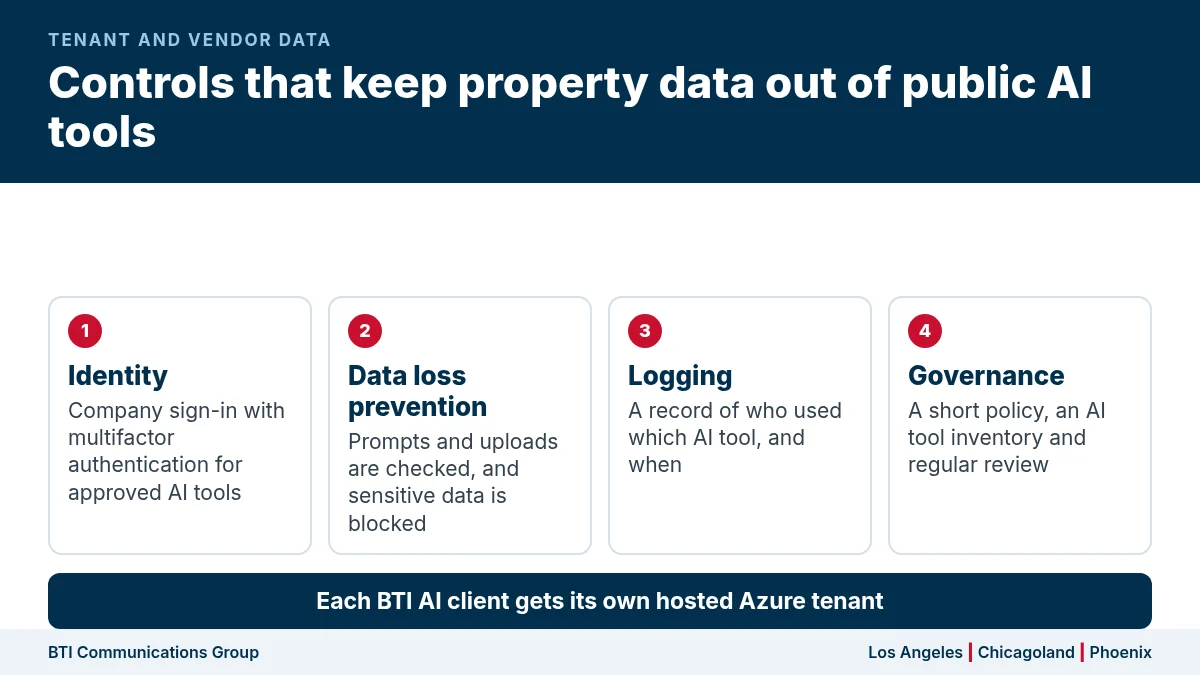
Property teams handle lease files, payment details, contact information and building access data. The fastest way to put that at risk is for staff to paste it into a free public AI tool. Rules in a memo are not enough. Technical controls are.
- Identity: staff sign in to approved AI tools with company accounts and multifactor authentication.
- Data-loss controls: AI data loss prevention checks prompts and uploads and blocks sensitive data before it leaves.
- Logging: AI activity is recorded, so you can see who used what, and when.
- Governance: a short policy, an inventory of the AI tools in use and regular review, backed by AI security, governance and risk services.
The systems around the AI need the same care. Accounting, leasing and building systems need patching, backups and monitoring. BTI provides IT support for commercial real estate and managed or co-managed IT for multifamily operators.
How AI fits next to your property management software
AI agents do not replace your property management, accounting or work order software. They connect to it. Integrations depend on the systems you use and are scoped during design. Where a direct connection is not available, the agent can work through email, forms or the portal your team already uses, with a person confirming the result.
How BTI delivers AI for property management
BTI deploys best-in-class, enterprise-grade AI agents in a governed workspace that BTI sets up and manages. Each BTI AI client gets its own hosted Azure tenant. We connect the agents to your ticketing and work orders, websites, tenant portals, vendor workflows and phone and SMS systems, and we keep people in the loop for work that needs a person.
Because BTI also supports IT, cybersecurity, access control and phone systems for owners and operators, the AI is designed with the rest of your technology instead of bolted on. BTI has over 40 years in business, with offices in Los Angeles, Chicagoland and Phoenix, and a 24/7 NOC/SOC. See our AI tools and security for commercial real estate.
Local notes for Los Angeles, Chicagoland and Phoenix
- Los Angeles: large third-party managed portfolios and mixed-use buildings across Los Angeles, Orange County and the Inland Empire generate after-hours maintenance calls from many sites at once.
- Chicagoland: older buildings keep maintenance teams busy, and winter brings urgent calls about heat and water. Fast, accurate intake and clear escalation matter most here.
- Phoenix: summer cooling failures are the classic after-hours call, and many operators manage properties spread across the valley.
Start with one workflow
The best first project in AI for property management is narrow, frequent and easy to measure. For most teams it is one of these:
- After-hours call answering with ticket creation and text confirmations.
- Work order intake and status updates for one property.
- Tenant portal answers drawn from your building rules.
Run it for a few weeks, review what the AI handled and what it passed to people, adjust the rules, then add the next workflow. To talk it through, book a free consultation or call the IT line for your region:
- Los Angeles: 323-510-8003
- Chicago: 312-492-2613
- Phoenix: 480-272-8728
Talk with BTI about AI for your property management team.