By Eric Brackett, Founder | Last verified November 23, 2026
Quick answer: The best SIEM for a small or mid-sized business is the one somebody watches at 3 AM. Platforms like Microsoft Sentinel, Splunk and CrowdStrike Falcon Next-Gen SIEM are built for organizations with their own 24/7 security team. If you don’t have one, a managed SIEM, where a provider runs the platform, the analysts and the response for a monthly per-user price, usually delivers better protection for less money. See how BTI’s managed SIEM works.
In this guide
- The real decision: outsource your SIEM or run it in-house
- The 2026 SIEM market at a glance
- Who each SIEM is built for: 16 vendors
- What running a SIEM in-house really takes
- Fully managed, co-managed or DIY: who does what
- What a SIEM really costs
- SIEM for HIPAA, CMMC, PCI DSS, the FTC Safeguards Rule and cyber insurance
- How BTI’s managed SIEM works
- When a Leader-quadrant SIEM is the right call
- 12 questions to ask any SIEM provider
- FAQs
1. The real decision: outsource your SIEM or run it in-house
A SIEM (security information and event management) collects logs from your laptops, servers, firewalls and Microsoft 365, lines them up on one timeline and flags patterns that suggest an attack. That’s the technology. The outcome depends on what happens next: someone has to confirm the alert, contain the threat and write down what happened, at any hour.
So the first question isn’t “Which SIEM is best?” It’s “Who will run it?”
- Run it in-house if you employ, or will fund, security analysts across every shift, plus engineers to tune detections. Then choose a platform from the vendor table below.
- Outsource it if your IT team is small, busy or works business hours. A managed SIEM service gives you the platform, the 24/7 analysts and the response in one price.
This guide is written for organizations from 10-user professional firms, such as CPA and law offices on Microsoft 365, up to mid-market companies with a few hundred employees and compliance requirements.
2. The 2026 SIEM market at a glance
Gartner published its Magic Quadrant for Security Information and Event Management on November 18, 2026. Gartner’s public summary lists 16 vendors in the report: CrowdStrike, Datadog, Elastic, Exabeam, Fortinet, Google, Gurucul, Huawei, IBM, ManageEngine, Microsoft, Palo Alto Networks, Rapid7, Securonix, Splunk and Sumo Logic (Gartner summary).
The placements below are only the ones each vendor has announced itself. Gartner keeps the full chart behind its paywall, so where a vendor hasn’t announced its 2026 placement we say so rather than guess.
| Vendor | Product | 2026 placement (source) | Pricing model | Built for |
|---|---|---|---|---|
| Microsoft | Microsoft Sentinel | Leader (Microsoft, Nov 20, 2026) | Per GB of data ingested; pay-as-you-go or commitment tiers | Microsoft-centric organizations with a security team |
| Splunk (Cisco) | Splunk Enterprise Security | Leader (Splunk, Nov 23, 2026) | Activity-based, workload or ingest pricing | Large SOCs with Splunk skills |
| CrowdStrike | Falcon Next-Gen SIEM | Leader (CrowdStrike, Nov 18, 2026) | Quote from vendor, sold with the Falcon platform | CrowdStrike Falcon customers |
| Gurucul | Gurucul SIEM | Leader (Gurucul, Nov 23, 2026) | Quote from vendor | Teams focused on behavior analytics |
| Google Security Operations | Included; placement not yet announced by the vendor (checked Nov 23, 2026) | Quote from vendor | Teams with YARA-L skills and Google Cloud ties | |
| Exabeam | New-Scale Platform and LogRhythm SIEM | Leader (Exabeam, Nov 23, 2026) | Quote from vendor | Insider-threat and former LogRhythm customers |
| Securonix | Unified Defense SIEM | Included; placement not yet announced by the vendor (checked Nov 23, 2026) | Quote from vendor | Large SOCs wanting a cloud-native platform |
| Palo Alto Networks | Cortex XSIAM | Included; placement not yet announced by the vendor (checked Nov 23, 2026) | Quote from vendor | Enterprises consolidating on Palo Alto |
| Datadog | Datadog Cloud SIEM | Challenger (Datadog, Nov 23, 2026) | Usage-based, published on Datadog’s pricing page | Cloud-native teams already on Datadog |
| Fortinet | FortiSIEM | Challenger (Fortinet, Nov 23, 2026) | Quote from vendor or partner | Fortinet shops and IT/OT environments |
| Rapid7 | Rapid7 SIEM (InsightIDR) | Included; placement not yet announced by the vendor (checked Nov 23, 2026) | Quote from vendor | Mid-sized security teams |
| Elastic | Elastic Security | Included; placement not yet announced by the vendor (checked Nov 23, 2026) | Elastic Cloud subscription or self-managed | Teams comfortable running Elasticsearch |
| Sumo Logic | Sumo Logic Cloud SIEM | Included; placement not yet announced by the vendor (checked Nov 23, 2026) | Quote from vendor | Cloud log analytics teams |
| ManageEngine | Log360 | Included; placement not yet announced by the vendor (checked Nov 23, 2026) | Quote from vendor | Smaller in-house IT teams |
| IBM | QRadar SIEM | Included; placement not yet announced by the vendor (checked Nov 23, 2026) | Quote from vendor | Existing on-premises QRadar customers |
| Huawei | HiSec Insight | Included; placement not yet announced by the vendor (checked Nov 23, 2026) | Quote from vendor | Rarely on U.S. shortlists |
Gartner evaluates vendors on Ability to Execute and Completeness of Vision. Neither axis measures what most small and mid-sized buyers need to know: who watches the alerts, how fast someone responds, and what the total monthly cost is once you add people.
3. Who each SIEM is built for: 16 vendors
Microsoft Sentinel. A cloud-native SIEM in Azure with hundreds of connectors and deep ties to Microsoft Defender and Microsoft 365. Priced by data ingested. It shines for organizations already invested in Microsoft security licensing that have analysts who write KQL queries. For a 20-person firm with no security staff, it’s a powerful tool with nobody to drive it.
Splunk Enterprise Security. Owned by Cisco since March 2024 and one of the longest-standing SIEMs on the market. Splunk’s SPL query language and huge app ecosystem reward experienced teams. Cost and skills are the usual reasons smaller organizations look for Splunk alternatives.
CrowdStrike Falcon Next-Gen SIEM. Built on the Falcon platform and strongest when your endpoints already run CrowdStrike. Buyers often ask whether CrowdStrike is a SIEM or an EDR: it sells both, and its SIEM extends Falcon endpoint data with other log sources.
Gurucul. Grew out of user and entity behavior analytics (UEBA). A good fit for organizations focused on insider risk with analysts to tune behavior models.
Google Security Operations (formerly Chronicle). Google-scale storage and Google threat intelligence, with detections written in YARA-L. Best for teams with security engineers and a Google Cloud footprint.
Exabeam. Merged with LogRhythm in July 2024 and now sells the cloud New-Scale Platform alongside on-premises LogRhythm SIEM. Known for behavior analytics. Exabeam announced a Leader placement in the 2026 report.
Securonix. A cloud-native SIEM aimed at large SOCs, with a strong focus on behavior analytics.
Palo Alto Networks Cortex XSIAM. Palo Alto’s security operations platform. Palo Alto bought IBM’s QRadar SaaS business in 2024 and has been moving those customers to XSIAM.
Datadog Cloud SIEM. Security built on Datadog’s observability platform. Natural for engineering-led companies that already send logs to Datadog.
Fortinet FortiSIEM. Covers IT and operational technology (OT) events and pairs well with FortiGate firewalls. Fortinet reports its ninth consecutive inclusion in the report.
Rapid7. Rapid7’s SIEM (long sold as InsightIDR) targets mid-sized security teams, and Rapid7 also sells its own MDR service.
Elastic Security. Built on Elasticsearch, with open detection rules. Flexible and powerful if you can run and scale the stack.
Sumo Logic. A cloud log analytics platform with SIEM features, used by teams already centralizing logs there.
ManageEngine Log360. From Zoho’s ManageEngine, popular with smaller in-house IT teams that want log management and compliance reports without an enterprise budget.
IBM QRadar. On-premises QRadar remains with IBM; QRadar SaaS customers have been moving to Palo Alto. Current QRadar users should plan their migration path.
Huawei (HiSec Insight). Evaluated in the report but rarely on U.S. shortlists. U.S. government contractors should review procurement rules, including Section 889 of the FY2019 NDAA, before buying any Huawei product.
Where BTI fits: BTI doesn’t resell or co-manage these platforms. BTI delivers managed SIEM on its own platform, run by its own 24/7 NOC/SOC. If your team runs its own SOC, the vendors above are built for you. If it doesn’t, compare BTI’s managed SIEM.
4. What running a SIEM in-house really takes
People. A week has 168 hours. One full-time analyst covers about 40 of them before vacation, sick days and training, so one seat staffed around the clock takes at least four to five people, and most teams plan for five or six. The U.S. Bureau of Labor Statistics lists the median pay for information security analysts at $129,180 a year (May 2025), before benefits, recruiting and turnover (BLS).
Skills. Each platform has its own query language and content: KQL for Sentinel, SPL for Splunk, YARA-L for Google Security Operations. Detections have to be written, tested and tuned, and data connectors break when Microsoft 365, firewalls or cloud apps change.
Data costs. Many SIEMs bill by how much data you ingest or store. Adding a log source, or keeping a year of history for an auditor, can change the bill. Someone has to manage volume without blinding the SIEM.
Response. A SIEM finds the pattern. It doesn’t contain the threat. Without a staffed rotation, a 2 AM Saturday alert waits until Monday.
5. Fully managed, co-managed or DIY: who does what
| Task | DIY SIEM | MDR only (endpoint) | BTI co-managed SIEM | BTI fully managed SIEM |
|---|---|---|---|---|
| Platform and licensing | You | Provider (endpoint only) | BTI | BTI |
| Log sources beyond endpoints (Microsoft 365, identity, firewalls) | You | Often not covered | BTI | BTI |
| Watching alerts 24/7 | You | Provider | BTI’s 24/7 NOC/SOC | BTI’s 24/7 NOC/SOC |
| Detection tuning | You | Provider | BTI, with your IT team’s input | BTI |
| Containment | You | Provider, endpoint actions | BTI, within pre-approved actions; your IT team looped in | BTI, within pre-approved actions |
| Response time commitment | None | Varies | 15 minutes on AI-confirmed alerts | 15 minutes on AI-confirmed alerts |
| Log retention | You pay to store it | Varies | 30 days included; 1 year is an $8 per user per month add-on | 30 days included; 1 year is an $8 per user per month add-on |
| Day-to-day IT | You | You | Your IT team | BTI |
| Evidence for auditors and insurers | You build it | Endpoint reports | Incident timelines and retained logs | Incident timelines and retained logs |
At BTI, co-managed means BTI’s SIEM and 24/7 NOC/SOC with your internal IT team taking part in alerts, reviews and containment approvals. See co-managed security operations and co-managed vs fully managed.
6. What a SIEM really costs
For an in-house SIEM, add up four lines: licence or ingestion, retention, the people to run it 24/7 and the engineering time to tune it. For most small and mid-sized organizations, the people line is the biggest by far.
BTI’s managed SIEM is from $17 per user per month. That covers SentinelOne managed EDR, the SIEM with 30-day log retention, the 24/7 SOC, a threat research team that keeps adding detections for new threats, an incident response team and managed response (containment), with a 15-minute response on AI-confirmed alerts. If an auditor, insurer or investigation needs a longer history, 1-year log retention is an add-on at $8 per user per month. Managed IT, vCISO and compliance work are itemized separately. See managed SIEM pricing.
7. SIEM for HIPAA, CMMC, PCI DSS, the FTC Safeguards Rule and cyber insurance
- HIPAA: the Security Rule requires audit controls that record and examine activity in systems holding ePHI (45 CFR 164.312(b)). Relevant for medical groups, behavioral health, pharmacies and dental practices.
- PCI DSS 4.0: Requirement 10 calls for logging and monitoring access to cardholder data, with log history kept at least 12 months and the last three months immediately available. With BTI, that means adding the 1-year retention option ($8 per user per month).
- CMMC and NIST SP 800-171: the Audit and Accountability family (3.3) requires creating, retaining and reviewing audit logs. CMMC and other compliance work is completed and contracted by BTI and its partners, including top industry professionals in each category.
- FTC Safeguards Rule: tax preparers are covered (16 CFR 314.2 lists tax preparation clients among a financial institution’s customers). Section 314.4(c)(8) calls for controls that monitor and log the activity of authorized users and detect unauthorized access to customer information, 314.4(d)(2) calls for continuous monitoring or regular penetration testing and vulnerability assessments, and 314.4(h) requires a written incident response plan.
- Cyber insurance: carriers increasingly ask about EDR, MFA and round-the-clock monitoring at renewal, and some ask how long you keep logs. BTI works with your carrier’s requirements but doesn’t sell insurance. See cyber insurance readiness.
Related: What is CMMC?, What is HIPAA compliance?, What is PCI compliance?, WISP, IR plans and GRC.
8. How BTI’s managed SIEM works
- Connect. We connect your endpoints and servers, Microsoft 365 and Entra ID sign-ins and the network devices BTI manages, and record the containment actions you pre-approve.
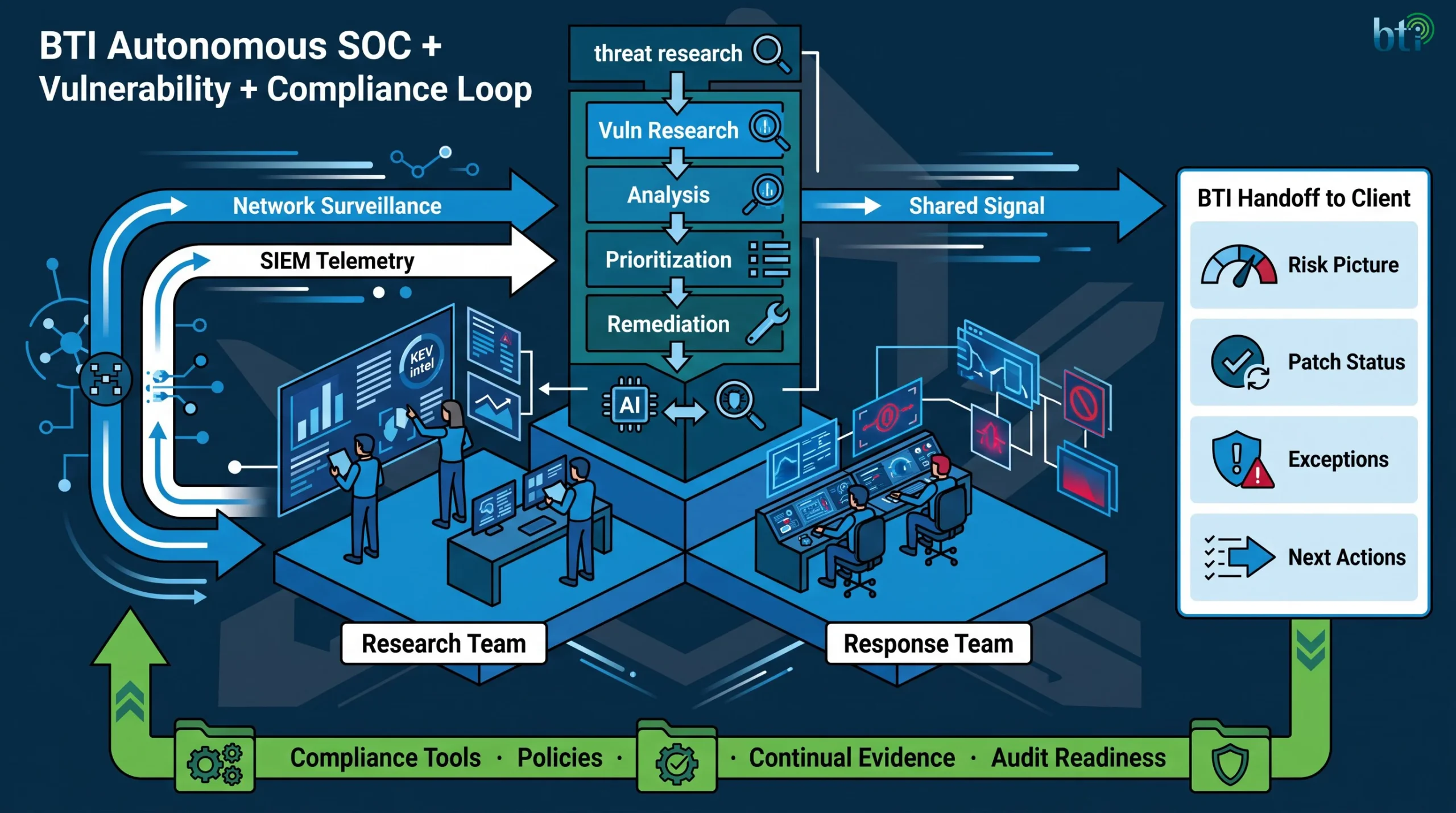
- Detect. Events are correlated on one timeline. Client alerts are triaged in real time by best-in-class, enterprise-grade AI agents, then escalated to human engineers in our 24/7 NOC/SOC.
- Respond in 15 minutes. On AI-confirmed alerts, BTI commits to start the response within 15 minutes: triage, containment within your pre-approved actions and documented findings.
- Report. You get a plain-language timeline of what happened and what changed, ready for leadership, auditors and insurers.
What’s included, from $17 per user per month:
- SentinelOne managed EDR
- Managed SIEM with 30-day log retention
- 24/7 SOC
- Threat research team
- Incident response team
- Managed response (containment)
- 15-minute response on AI-confirmed alerts
Add-on: 1-year log retention, $8 per user per month.
A 10-user example. A 10-person accounting firm runs Microsoft 365. At 2:10 AM a partner’s account signs in from another country and creates a rule forwarding client emails outside the firm. The SIEM ties the sign-in and the rule into one case, our NOC/SOC validates it, revokes the sessions, disables the account as pre-approved, removes the rule and calls the firm’s contact. By morning the firm has a timeline for its insurer. (Anonymous planning scenario.)
Why BTI
- One team for IT, network and security. The people who manage your network and devices also work your alerts.
- A 15-minute response on AI-confirmed alerts.
- Over 40 years in business, with offices in Los Angeles, Chicago and Phoenix and on-site incident help in those metros.
- Plans written before you need them. Every managed security client gets a written incident response plan and WISP.
- Cyber and physical security together. BTI also installs and supports cameras, access control and alarms, so door and camera events can be correlated with network activity where integrated.
- ISO 27001 compliant governance and a 24/7 NOC/SOC.
9. When a Leader-quadrant SIEM is the right call
Choose Sentinel, Splunk or another platform from the table if you already employ analysts across shifts, have custom detections and deep platform investments, or must run your own SOC. These platforms are built for that model, and BTI won’t pretend otherwise.
10. 12 questions to ask any SIEM provider
- Who watches alerts at night, on weekends and on holidays?
- What is your response commitment on a validated incident, in minutes, and what does “response” include?
- Which containment actions can you take without calling me, and who approves them?
- Which log sources are included: endpoints, Microsoft 365, identity, firewalls, cloud apps?
- How long are logs kept in the base price, and what does a year of retention cost?
- Who writes and tunes detections, and how often?
- Is EDR included, or do I buy it separately?
- What will I receive after an incident, and can I give it to my insurer or auditor?
- Is pricing per user, per device or per GB, and what makes it go up?
- What does my IT team still own in a co-managed model?
- Who handles incident response, and is it included?
- Can you help on site if needed in my area?
11. FAQs
Do small and mid-sized businesses need a SIEM?
Size matters less than what you store and who asks about it. A 10-person CPA or law office with client tax files, a carrier questionnaire and a written security program has the same logging questions as a 300-person company. Stolen Microsoft 365 passwords are the most common way in, and a SIEM is what notices the odd sign-in.
Is SIEM outdated now that there is XDR and MDR?
Not for most regulated firms. Endpoint tools see what happens on a laptop or server. Auditors and insurers also ask about sign-ins, email rules, firewall traffic and how long you keep records, which is the SIEM’s job. The usual answer in 2026 is both, watched by the same SOC.
Is CrowdStrike a SIEM or an EDR?
Both. CrowdStrike is best known for Falcon EDR and also sells Falcon Next-Gen SIEM, which CrowdStrike announced as a Leader in the 2026 Gartner Magic Quadrant for SIEM.
Is Microsoft Sentinel better than Splunk?
It depends on your team. Sentinel suits Microsoft-centric organizations and bills by data ingested; Splunk suits experienced SOCs with SPL skills and offers activity-based, workload or ingest pricing. Both need analysts to run them.
How much does a SIEM cost?
Count four lines: the licence or ingestion bill, storage for the history you need, tuning time and four to six people for round-the-clock coverage. As a managed service, BTI starts at $17 per user per month with 30-day log retention, and a full year of logs adds $8 per user per month.
Is there a free SIEM?
Open-source SIEM software exists, but it isn’t free to run: you still pay for servers, storage and the people who tune and watch it.
Is QRadar being discontinued?
IBM sold its QRadar SaaS business to Palo Alto Networks in 2024 and those customers have been moving to Cortex XSIAM. On-premises QRadar stayed with IBM. Check your contract and migration path.
What is co-managed SIEM?
It’s a shared model. With BTI, the platform and the overnight SOC are ours, and your IT staff stay in the loop: they see the cases, sit in on reviews and sign off on containment steps.
How fast does BTI respond?
Within 15 minutes of an AI-confirmed alert, under BTI’s own response commitment. That covers triage, containment inside the limits you set in advance and a written record of what happened.
We can’t afford to build a SOC. What are our options?
A managed SIEM gives you the platform, 24/7 analysts and incident response for a monthly per-user price. See BTI’s managed SIEM.
Talk to a BTI security engineer
Not sure whether to run a SIEM in-house or outsource it? We’ll review your users, log sources, compliance requirements and insurance questionnaire and give you an itemized answer.
Call your local BTI IT team: Los Angeles 323-510-8003, Chicago 312-492-2613, Phoenix 480-272-8728, or 800-HELP-BTI (800-435-7284).
Local teams: cybersecurity in Los Angeles, cybersecurity in Chicago and cybersecurity in Phoenix.
Sources: Gartner, Magic Quadrant for Security Information and Event Management, Eric Ahlm, Angel Berrios, Andrew Davies, Kevin Schmidt, 18 November 2026. Vendor placements as announced by Microsoft (Nov 20, 2026), CrowdStrike (Nov 18, 2026), Splunk (Nov 23, 2026), Gurucul (Nov 23, 2026), Exabeam (Nov 23, 2026), Datadog (Nov 23, 2026) and Fortinet (Nov 23, 2026).
Gartner does not endorse any company, vendor, product or service depicted in its publications, and does not advise technology users to select only those vendors with the highest ratings or other designation. Gartner publications consist of the opinions of Gartner’s business and technology insights organization and should not be construed as statements of fact. Gartner disclaims all warranties, expressed or implied, with respect to this publication, including any warranties of merchantability or fitness for a particular purpose. Gartner and Magic Quadrant are trademarks of Gartner, Inc. and/or its affiliates. BTI was not evaluated in this report.