Over 40 Years in BusinessISO 27001 compliantPublic sector: GSA contract holder

LA 562-298-5000 · Chicagoland 312-432-5300 · Phoenix 602-733-6807 · Client Support

IT Help Desk Services & Support

When a password, a laptop or a printer stops someone’s day, they need a person who can fix it. BTI’s outsourced help desk takes those calls and tickets, works them to a fix, and escalates to engineers when it needs to. Your staff get help. Your IT team, if you have one, gets its time back.

IT sales, business hours: Los Angeles 323-510-8003 · Chicagoland 312-492-2613 · Phoenix 480-272-8728

The first consultation and the initial IT assessment conversation are free. The assessment scope is set on the initial engineering consult call.

  • Over 40 years
  • ISO 27001 compliant governance, independently reviewed
  • SOC 2 NOC/SOC
  • Every employee passes an FBI background check
  • GSA contract holder (47QTCA21D00BA)
  • ISNetworld member

Request your free consultation

Tell us about your IT, security, or communication challenges, no obligation.

IT Quote (IT pages only)

Get a fixed monthly IT quote

A local engineer replies within 1 business day.

Business inquiries only. No spam.

BTI’s IT help desk service gives employees one place to get technology problems solved by phone, email, or portal, with help desk support under a managed IT plan. Engineers handle end-user issues, devices, Microsoft 365, accounts, and escalations, and coordinate with your internal IT team. Managed IT pricing is typically $60 to $290 per user per month, depending on environment and scope.

  • IT help desk support included in BTI managed IT plans, backed by 24/7 NOC/SOC monitoring.
  • Managed IT pricing: typically $60 to $290 per user per month, depending on environment and scope.
  • Fully managed or co-managed alongside your internal IT team.
  • In business for over 40 years; ISO 27001 compliant; GSA, CMAS, and TESMA contract awardee.

Certified experts · Full-stack IT

Enterprise-grade solutions for growing businesses

One certified team across your entire technology stack, from Microsoft and networking to security, backup and the infrastructure that keeps it all running.

Microsoft Solutions Partner  ·  7 capability domains  ·  30+ certified platforms

Less time on IT. Lower costs. Support that actually responds.

We connect your technologies and manage them one at a time or all together, with ISO 27001 compliant governance and a 24/7 NOC/SOC.

IT and AI services

Help desk, monitoring and managed IT for your team, plus AI tools set up and managed for your business.

Managed IT ›AI services ›

Cybersecurity

Threat detection, endpoint protection and monitoring built into how we run your IT.

Learn more ›

Compliance

Policies, controls and audit preparation for the standards your business works under, backed by our 24/7 NOC/SOC.

Learn more ›

Voice and phone systems

Business phones and unified communications, configured and supported by one team.

Learn more ›

Security and access control

Video surveillance, access control and alarms, installed and supported.

Learn more ›

Cloud and backup

Managed, monitored backup and recovery for your cloud and on-site systems.

Learn more ›

Network and Wi-Fi

Wired and wireless business networks, designed, installed and supported.

Learn more ›

Low voltage wiring and construction

Structured cabling and low-voltage work for new builds, tenant improvements and remodels.

Learn more ›

Project support

Planned IT projects such as network upgrades, cloud moves and server work, scoped and delivered by our engineers.

Learn more ›
  • ✓ ISO 27001 compliant governance, independently reviewed
  • ✓ SOC 2 NOC/SOC
  • ✓ ISNetworld member
  • ✓ Licensed Alarm Company Operator, ACO #7670
  • ✓ Licensed Alarm Company Operator
  • ✓ Every employee passes an FBI background check
Need one managed, or all of them?
Get a fixed monthly quote

Your One-Stop-Shop for IT Help Desk Services

BTI offers more than just IT help desk Support Services; we’re a full-service partner for organizations looking to scale smartly. Our IT Help Desk provides business-hours end-user support, and 24/7 support is available under BTI support agreements, with 24/7 monitoring and after-hours support for agreement clients by phone at 800-HELP-BTI. It is all backed by infrastructure, cloud, and compliance solutions to keep your systems running efficiently and securely.

Help desk and On-Site IT Support services are included with Managed IT, Co-Managed IT, VoIP and Contact Center, and Business Security Systems support.

One of the best aspects of our help desk is first call resolution and avoidance of issues in the first place through our infrastructure-led managed IT approach that prevents help desk tickets in th first place.

What BTI's IT help desk covers

Your employees get one place to report a problem by phone, email or portal. BTI's help desk team logs it, works it to a fix and escalates to engineers when it needs more than a reset. You get the same support whether your people are in one office, several sites or at home.

  • User support for Microsoft 365, Outlook, Teams, OneDrive and SharePoint.
  • Passwords, MFA, account and access requests, handled under your approval rules.
  • Laptops, desktops, printers, phones and peripherals, remotely first and on site when needed in the areas BTI serves.
  • New hire setup and offboarding steps, as listed in your agreement.
  • Line-of-business application access and vendor coordination.
  • Network, Wi-Fi and VPN connectivity issues, with escalation to network engineers.
  • Escalation to server, cloud and Azure engineers, and to BTI's 24/7 NOC/SOC security team for anything that looks like a threat.
  • Help with Microsoft 365 Copilot, ChatGPT and other AI tools your users rely on.

How a help desk ticket moves

  1. Report. A user calls, emails or opens a ticket in the portal. Every request gets a ticket number.
  2. Triage. The help desk sets the priority based on how many people are affected and what is blocked, using the priority levels in your agreement.
  3. Fix or escalate. Tier 1 resolves most requests on the first contact. Anything deeper moves to tier 2 or tier 3 engineers with the notes already attached, so your user does not explain it twice.
  4. Close and report. The user confirms the fix. You get regular reporting on ticket volume, repeat issues and what we changed to prevent them.

Help desk tiers: who handles what

TierTypical requestsWho handles it
Tier 1Passwords, MFA, Outlook and Teams issues, printers, how-to questions, new user setupBTI help desk technicians
Tier 2Device and application problems, permissions, Microsoft 365 configuration, VPN and Wi-Fi issuesBTI support engineers
Tier 3Servers, Azure and cloud, network and firewall changes, security eventsBTI senior engineers and the 24/7 NOC/SOC
On siteHardware swaps, cabling, new office and desk moves, anything that needs handsBTI field engineers from Los Angeles, Chicago and Phoenix
Book a free consultation

Call the IT team: Los Angeles 323-510-8003 · Chicago 312-492-2613 · Phoenix 480-272-8728

Help desk only, co-managed or fully managed IT

Most companies start with one of three models. You can move between them as you grow.

ModelBTI handlesYour team handlesBest for
Help desk onlyUser tickets, tier 1 and tier 2, after-hours coverage if you add itInfrastructure, security, projects and strategyTeams that want their users looked after while they keep everything else
Co-Managed ITHelp desk plus engineering depth, monitoring and the tools your team shares with usThe parts you choose to keep, with an agreed escalation pathCompanies with an internal IT lead or small IT team that is stretched
Managed IT servicesEverything: help desk, devices, network, cloud, security, backup and planningBusiness decisions and approvalsCompanies with no IT staff, or ready to hand IT off end to end

Need people rather than a service, for a project, a leave or a hiring gap? Ask about IT staff augmentation. Want to hand off more than tickets? See outsourced IT services.

In-house help desk vs an outsourced help desk

In-house help deskOutsourced help desk with BTI
CoverageLimited to the hours and vacations of the people you hireCoverage hours set in your agreement, with a team behind every seat
DepthOne or two generalistsTier 1 to tier 3 engineers, 400+ engineers across BTI and a 24/7 NOC/SOC
CostSalaries, benefits, training, turnover and toolsPer user, itemized, so you can see what you pay for
KnowledgeLeaves when the person leavesDocumented in the ticket system and runbooks you can see
ControlFullYou set approval rules, priorities and escalation; BTI reports on every ticket

What a help desk does not cover (unless you add it)

Being clear up front avoids surprises. These are scoped separately or added to your plan:

How to choose an IT help desk provider

Ask every provider these questions, including us:

  1. Who answers, and are they your employees?
  2. What happens when tier 1 cannot fix it, and who owns the ticket after that?
  3. What are the priority levels and targets in the agreement, and how are they reported?
  4. Can you work alongside our internal IT team with shared tools and clear escalation?
  5. Do you send someone on site, and where?
  6. Is pricing itemized per user, and what is not included?
  7. How is security handled when a ticket looks like a phishing or account takeover attempt?
  8. What does onboarding look like in the first 30 days?

Your first 30 days

  1. Discovery. We document users, devices, applications, vendors and your approval rules.
  2. Setup. Your users get a dedicated support path, and monitoring and remote tools go on managed devices.
  3. Go live. Tickets start flowing to BTI, with your IT lead, if you have one, copied on what matters.
  4. Review. At 30 days we review tickets, repeat issues and what to fix permanently.

Who is on the other end

BTI has been in business for over 40 years. Your users reach BTI's own help desk team, backed by 400+ engineers and a 24/7 NOC/SOC. BTI's governance is ISO 27001 compliant, and BTI is a GSA contract holder and a CMAS and TESMA contract awardee (California).

IT help desk pricing

Help desk is priced per user and itemized. Managed IT plans that include the help desk typically run $60 to $290 per user per month, depending on environment and scope. See itemized managed IT pricing.

IT help desk in Los Angeles, Chicago and Phoenix

Why Companies Choose BTI as Their IT Help Desk Providers

All Your IT Needs Under One Roof

Forget about managing multiple vendors. BTI delivers integrated IT help desk support services that centralize your IT operations, giving you fast support, better uptime, and easier vendor coordination.

IT Services Designed to Grow

Whether you’re a growing startup or an enterprise, we deliver services tailored to your infrastructure and goals. This is flexibility at its best.

Expert IT Help Desk Services

BTI isn’t just reactive; we proactively align your IT help desk with your compliance and business strategy, ensuring smarter, long-term decisions.

AI Tools & Agent Support

Your team now relies on AI as much as on email and Microsoft 365. BTI’s help desk supports the AI tools your users depend on every day, so a stuck prompt, a missing license or a misbehaving agent gets handled the same way as any other ticket. We take how-to and usage questions for Microsoft 365 Copilot, ChatGPT and other AI tools. We also fully support BTI’s AI workspace, which gives your team one secure place to work with models from OpenAI, Anthropic Claude, Google Gemini, xAI Grok, Meta, Mistral, Cohere, NVIDIA and others.

If a request touches policy or sensitive data, we escalate it to AI governance. That covers acceptable-use policies and data-access controls, and our 24/7 NOC/SOC monitors it. BTI offers business-hours and extended-hours help desk options, set by contract, backed by 24/7 NOC/SOC monitoring. Our top support tiers include AI workspace chat and agent allowances.

  • Help desk support for Microsoft 365 Copilot, ChatGPT and other AI tools
  • Chat and AI agent support in BTI’s AI workspace
  • Access, licensing and permissions requests for AI tools and agents
  • Usage and how-to guidance so your users get reliable results
  • Escalation to AI governance: acceptable-use policies and data-access controls
  • Monitoring by BTI’s 24/7 NOC/SOC

Help Desk Support for the AI You See and the AI You Don't

Zylo's 2026 SaaS Management Index found organizations leave an average of 36% of their SaaS licenses unused, measured against recommended utilization (Zylo). For growing businesses, AI add-ons and usage fees are now stacking on top of that.

Through its managed help desk, BTI brings the AI you see (Microsoft Copilot, ChatGPT, Claude and Gemini, chat and voice agents) and the AI you don't (features inside your SaaS apps, background automations and our NOC/SOC partner's alert triage) into your real workflows, governed and cost-controlled:

  • Optimize consumption and cost: right-size Microsoft Copilot, ChatGPT, Claude and Gemini seats, tokens and credits, audit licenses and consolidate overlapping tools
  • Convert consumption into low-cost automation: turn expensive per-seat add-ons, tokens and credits into governed workflow automations you own, running on BTI's AI consumption management and workflow automation platforms
  • Govern it all: the AI tools, how they are used, and the enterprise systems they connect to
  • Guided Automation advisory included in every managed IT plan

Managed IT typically runs $60 to $290 per user per month, itemized. → Managed IT pricing

Managed IT by Industry

Managed IT, networks and help desk support built for how your industry actually works.

BTI’s IT Services Go Beyond the Basics

BTI ensures your cloud environment, email, backup, M365, and more are optimized and supported by expert IT help desk services from day one.

We help you connect smarter with cloud-based phones, Teams, and VoIP systems, all backed by responsive IT Service Desk Support.

Protect your space with professional surveillance and access control, while our IT Help Desk Providers support and integrate these tools into your environment. BTI replaces your need for multiple vendors with one expert team that delivers full-service IT help desk Support and beyond; cloud, comms, and security in one place!

Onboarding Our Proven IT Help Desk Services Onboarding Process

1

Step 1: Discovery & Planning

We assess your business goals, infrastructure, and team needs to shape a help desk-first support plan with reliable IT Service Desk Services at the core.
2

Step 2: Environment & Risk Assessment

Our IT team runs an audit on your network, compliance, and software tools to identify gaps in efficiency, user support, and risk.

3

Step 3: Deployment & Optimization

We implement scalable IT services tailored to your environment; improving uptime, resolving issues quickly, and enabling fast onboarding.

4

Step 4: Ongoing Support & Partnership

We become your long-term IT Service Desk provider, offering real-time support, maintenance, and tech strategy as your needs evolve.

Video Transcript

Welcome to the 2026 Strategic Advisory Guide by BTI Communications Group. This executive guide focuses on managed IT, cybersecurity, and operational scalability for organizations over 50 people or those in particular industries like healthcare, manufacturing, financial services, or logistics.

This publication addresses the IT management concerns of ownership, C-level executives, IT Directors, and operations leaders in healthcare, manufacturing, logistics, and regulated industries. The content is advisory and not legal counsel.

Fast-growing and multi-site organizations in regulated industries like healthcare, financial services, manufacturing, and logistics with IT-related operational issues, or those struggling to understand new regulations or contracts with IT dependencies, will want to listen to what we have to offer.

Our goal in this document is to explain what quality and operational excellence look like in 2026 managed IT services. The sections we will cover in this highlight video include managed infrastructure and IT, cybersecurity, converged security, identity, compliance, and AI-ready infrastructure. Let’s explore how unified infrastructure support can transform your organization.

Welcome to our discussion on the case for unified infrastructure. We’ll explore how integrating IT, cybersecurity, VoIP, physical security, and compliance management under a phased-in managed or co-managed partner like BTI enhances performance and reduces risks for modern organizations.

Organizations benefit greatly over time from BTI’s unified infrastructure project and support performance. With over 40 years of experience, vendor and customer relationships, BTI offers best-of-breed products, pricing, design, engineering excellence, and support, plus low-cost managed or co-managed service tailored to each client’s needs. BTI’s approach prevents problems across several otherwise disconnected technology domains, ensuring reliability and accountability across all covered technology layers for significantly less than the cost of trying to manage all that in-house.

Growing organizations outgrow small IT managed service providers when operational failures impact the business. During growth stages, any weakness becomes a slowdown or a stoppage at the worst times. What was once acceptable Wi-Fi, network, phone, cybersecurity, or compliance work can quickly become unacceptable during growth. BTI’s unified support model addresses these challenges with comprehensive field assessments, infrastructure expertise, and proactive support to help your company avoid unnecessary pitfalls.

Organizations often miss the gradual signs of outgrowing their IT provider. Issues like Wi-Fi disconnects, VoIP degradation, and unmanaged switches indicate a support model lagging behind business needs. These are not just IT problems, but business continuity challenges requiring a support model designed for current complexities to ensure reliability and scalability.

Organizations often outgrow their managed service provider gradually. Key signs include a vendor unable to meet growing demands on time, issues closed without root-cause resolution, or inconsistent support quality. Transitioning to a more capable partner can eliminate these challenges.

Siloed IT, security, and VoIP vendors create significant risks as well. Documentation failures and escalation delays compound issues, leading to costly business disruptions. Consolidating vendors can mitigate these risks effectively.

An operationally mature managed IT partner excels in six key areas: structured documentation, proactive monitoring, layered cybersecurity, consistent multi-site execution, defined escalation paths, and compliance-ready reporting. These capabilities ensure reliable service, security integration, and governance support. Always request evidence of these capabilities when evaluating potential partners to ensure true operational maturity.

Modernization should be incremental, not all-or-nothing. Start by addressing immediate disruptions, stabilize the environment, and document progress. Add targeted support to ease burdens, then expand as trust builds. This phased approach reduces risk and ensures each improvement is validated before moving forward, enhancing reliability and productivity across operations.

Unified infrastructure support can include networking, cybersecurity, VoIP, cloud, and endpoints in one cohesive model. Unlike traditional managed service providers, BTI’s model ensures recommendations enhance performance and reduce risk with itemized, fixed-cost work and consistent quality standards. This leads to clearer ownership, deeper visibility, and consistent outcomes, ultimately improving business operations and accountability.

Achieving the lowest qualified price requires transparency. Without visibility into provider operations, costs from downtime and rework can outweigh savings. BTI offers both line-item price and quality transparency. Dashboards and structured reporting are included, enabling informed client decisions. ISO 27001 compliance, transparent pricing, and fixed-cost sole-source scoping support dependable delivery and project outcomes with shared support responsibility roles clearly defined.

Infrastructure partnerships grow by solving real problems, proving value, and earning trust. Start with specific issues like Wi-Fi application performance improvement, network projects, or security projects. Expand into VoIP or other areas as your needs evolve. Our goal is to deliver measurable value at each stage, avoiding overspend or overcommitment while fostering a coherent operating model and trusted partnership.

Converged security operations integrate cybersecurity, physical security, identity, and operational monitoring into a unified, secure framework. This approach ensures access control, cameras, VoIP, and connected devices are managed cohesively, reducing risk and maintaining uptime. Without clear ownership, gaps form, leading to disruptions. BTI’s scope may include addressing these challenges while simultaneously improving physical security system performance.

Modern security systems require IT infrastructure expertise because they operate on the same networks as business operations. Most security industry agreements disown responsibility for privacy, cyber, liability, or compliance requirements. BTI is a nationally recognized leader in security, access control, and surveillance systems because we are moving in the opposite direction. Unified ownership ensures control, visibility, and accountability, preventing outages and maintaining real security and compliance.

Enterprise identity and credential management is increasingly a compliance and operational requirement for any business that is subject to state and federal privacy laws or regulations, and for customers who inherit liability in contracts. BTI’s approach integrates effective identity governance whenever identity management is in scope.

Access control, visitor management, and structured oversight are vital for enterprise readiness. Effective organizations maintain documented access policies, manage badge lifecycles, and ensure visitor access is tracked and auditable. Consistency across sites is crucial, with uniform governance standards applied to all locations, supporting compliance and security oversight. Structured management prevents access control gaps, ensuring robust enterprise security.

Emergency communication systems must be integrated with a robust network and power infrastructure to ensure operational continuity. Mapping dependencies, integrating VoIP and paging, and validating wireless coverage are crucial. Redundancy and failover planning are essential to maintain communication during emergencies, ensuring resilience across all sites.

Security system cybersecurity and OT/IoT segmentation are crucial as devices like cameras and controllers join corporate networks. Often, these systems run outdated firmware and lack segmentation, posing risks. Addressing these gaps involves VLAN segmentation, device inventory, and lifecycle management integrated into broader IT services, ensuring secure operations and visibility across the network.

Vulnerability management and third-party validation are essential for cybersecurity operations and compliance. Effective programs require continuous scanning, prioritized remediation, and structured reporting. BTI strongly recommends quarterly third-party penetration testing, and we coordinate that for our clients at a significant discount due to volume. BTI’s structured vulnerability management and pen-test remediation services provide ongoing evidence of compliance with laws and contracts when in scope, eliminating risk and liability that otherwise may have been found too late.

Regulated entity agreements are reshaping infrastructure expectations, turning compliance into a commercial risk. Organizations face demands for documented IT posture from customers, banks, insurers, and suppliers. Failure to demonstrate operational maturity risks losing deals and insurance coverage. BTI supports readiness with structured oversight, vulnerability management, and compliance monitoring, ensuring organizations meet these evolving expectations.

AI-ready infrastructure is essential for deploying AI-enabled workflows without risking performance or security. CEOs and COOs must ensure their networks, wireless, identity, and cloud systems can handle AI workloads. Proper wireless coverage, switching capacity, network segmentation, and continuous monitoring are crucial to avoid costly disruptions and ensure operational maturity.

AI-enabled workflows fail due to inadequate infrastructure, not AI itself. Key requirements include high-density, low-latency wireless, adequate switching capacity, reliable WAN connectivity, identity governance, and continuous monitoring. These elements ensure AI initiatives deliver reliable, scalable results. BTI’s assessment process identifies infrastructure gaps to prevent deployment failures.

Sophisticated operational readiness involves a documented, managed, and auditable IT environment. Key indicators include a fully documented network, enforced multi-factor authentication, tested backup and recovery plans, and regular vulnerability scanning to prevent outages. Organizations meeting these standards are better positioned for compliance, customer trust, and AI-enabled operations. This is not just a checklist, but a reflection of operational maturity expected by customers, insurers, and auditors.

Modern operations demand systems that are reliable, secure, and scalable. Unified infrastructure support and converged security operations reduce disruptions and enhance service delivery while driving down support costs from multiple providers. Enterprise identity management and OT/IoT cybersecurity ensure robust access control and system monitoring. Compliance readiness and an AI-ready foundation support growth and governance, making organizations resilient and audit-ready.

Operational fragmentation arises when IT responsibilities drift apart, leading to lost productivity and slower recovery. Disconnected ownership across systems results in missed handoffs, compliance gaps, and team burnout. Unified governance under one accountable partner reduces friction, improves recovery, and lowers costs, creating a stronger operational foundation.

Vendor siloing in IT services creates operational risk by fragmenting ownership. Each provider manages a piece, but no one owns the outcome. This leads to slower recovery, blame-shifting, and scattered compliance evidence. A unified governance model accelerates resolution, aligns ownership, and provides leadership with clearer control.

Reactive IT operations incur hidden costs through lost throughput, delayed projects, and compliance gaps. Recurring service failures, like scanner disconnects, system failures, and VoIP issues, consume IT resources and erode confidence. Proactive management addresses root causes, reducing incidents and improving governance. BTI’s structured service delivery enhances accountability and prevents reactive cycles, fostering consistency and control.

Internal IT teams often face overwhelming demands due to scale, not talent. They juggle cybersecurity, cloud, compliance, and more, leading to slower responses and burnout. BTI’s co-managed IT model enhances internal capabilities, offering Network Operations Center monitoring, Security Operations Center support, structured documentation, 24-hour coverage, and skills augmentation, allowing teams to focus on strategic priorities without burnout.

Operational accountability is a competitive advantage, judged by buyers, insurers, and auditors. It shapes vendor selection and customer confidence. Documented IT functions enable faster recovery and smoother audits. Structured oversight strengthens resilience and supports consistent performance. Execution maturity signals trust and readiness, enhancing credibility and differentiation across the business.

Operational scalability allows technology and support models to grow without outages or hidden risks. Converged operations reduce vendor confusion and costs, enabling faster onboarding and consistent execution. Unified models lower growth costs, improve risk control, and ensure predictable service. They eliminate vendor blame, duplicate tools, and compliance gaps, delivering streamlined escalation and integrated monitoring.

A unified operational model integrates managed IT, network services, cloud operations, security, and compliance under one partner. This eliminates coordination overhead, providing cleaner escalation, sharper visibility, and a predictable operating model. Each capability is organized within a single system, ensuring seamless issue resolution and reducing the need for multiple vendor management.

BTI ensures enterprise stability, visibility, and governance, minimizing internal coordination and disruptions. Through converged technology and clear ownership, we deliver infrastructure discipline, cybersecurity, and compliance governance. This results in fewer disruptions, faster escalation, and clearer reporting, enhancing uptime and predictability across sites. Leadership should demand these controls before signing contracts to avoid future risks.

Over 40 years, we’ve learned that successful organizations treat technology, security, and governance as integral, not as costs. Key traits include clear accountability, reality-based decisions, scalable standards, visibility, continuous compliance, and compounding advantages. These elements ensure growth without losing control or facing disruptions.

This guide references key frameworks like the NIST Cybersecurity Framework, CIS Controls, CMMC, HIPAA Security Rule, and more. Each provides structured guidance for cybersecurity, compliance, and governance. Organizations should consult professionals for specific implementation. Cyber insurance and AI governance are also crucial, requiring documented controls and responsible AI adoption strategies.

When selecting a managed IT or cybersecurity provider, ask about documentation ownership, escalation paths, and comprehensive cybersecurity measures. Inquire about multi-site support, compliance readiness, and leadership reporting. Understand how client relationships grow through value. These questions reveal a provider’s operational maturity beyond sales pitches.

Ready to evaluate your infrastructure and operational readiness? BTI Communications Group offers consultations to assess IT, cybersecurity, VoIP, and physical security operations. Identify gaps, risks, and consolidation opportunities for a unified infrastructure partnership. Schedule your consultation today to explore modernization and scalability solutions.

Explore BTI’s resources for detailed insights into managed IT services, cybersecurity, Cisco Meraki consulting, business security systems, VoIP installations, and compliance readiness. Each service is designed to enhance operational efficiency and security. Visit btigroup.com for more information and to schedule a consultation.

This guide offers strategic insights into cybersecurity, infrastructure, and compliance, tailored for mid-market and multi-site organizations. Recommendations should be evaluated within each organization’s unique context. Requirements for compliance vary, necessitating formal assessments. BTI’s philosophy emphasizes long-term partnerships and continuous improvement, aiming to create measurable value at every engagement stage.

Your Success, Our Goal

“Our first and primary goal is to deliver the foremost level of technical quality that can be delivered reliably for each client’s budget.”

Eric Brackett, Founder & President of BTI Communications Group

Eric Brackett 1x1 1

Client stories

Discover How BTI's IT Help Desk Services Empower Businesses ​

98% client retention · 400+ engineers, including the 24/7 NOC/SOC and help desk staff who work as part of BTI's team. · Every employee passes an FBI background check · ISO 27001 compliant governance

IT Help Desk Services FAQ

What is an IT help desk?

An IT help desk is the single point of contact employees use to report technology problems and request help. It logs, prioritizes and resolves issues such as login problems, device failures, software errors and access requests, and escalates complex issues to engineers.

What is the difference between a help desk and a service desk?

A help desk focuses on fixing user problems. A service desk also handles requests, changes and reporting across IT. BTI's help desk does both for most clients: break-fix tickets plus requests such as new users, access and devices, under the rules in your agreement.

What does BTI's IT help desk cover?

BTI's help desk supports end users, laptops and desktops, Microsoft 365, email, accounts and permissions, printers, network connectivity, and escalation to network, cloud and security engineers.

What is IT help desk outsourcing?

Handing your user support calls and tickets to an outside team that resolves them and escalates when needed. With BTI, that team is backed by 400+ engineers and a 24/7 NOC/SOC.

Can we outsource only the help desk?

Yes. Help desk only is a common starting point. You can add co-managed or fully managed IT later.

Can BTI's help desk work with our internal IT team?

Yes. Under a co-managed model, BTI handles day-to-day tickets or after-hours coverage while your internal team focuses on projects and strategy, with agreed escalation paths.

Is help desk support available after hours?

Coverage hours are set in your agreement. Monitoring runs through BTI's 24/7 NOC/SOC.

Does BTI's help desk support AI tools like Microsoft 365 Copilot and ChatGPT?

Yes. BTI's help desk handles access, permissions, usage and how-to questions for Microsoft 365 Copilot, ChatGPT and other AI tools your users rely on, including chat and AI agents in BTI's AI workspace.

How much do IT help desk services cost?

Help desk is included in BTI managed IT plans, which typically cost $60 to $290 per user per month, depending on environment and scope.

Does BTI support multi-site organizations?

Yes. BTI supports organizations with multiple locations from offices in Los Angeles, Chicago and Phoenix, with remote help desk support and on-site service where needed.

Your Resource for Smarter Business Technology

IT Related News & Insights

Local coverage

Looking for IT Services in Your Area?

BTI simplifies your tech support by providing scalable IT services tailored to your team’s needs. From ticket resolution to long-term tech strategy, our IT Help Desk Providers keep operations running without interruption.

Where We Work

Nationwide Coverage, Global Reach

BTI serves clients across the United States, with additional partners in Canada and the United Kingdom. Hover over any state to see it highlighted.

BTI service area Not yet active
🇨🇦

Niagara-on-the-Lake, Ontario

Global Partner
🇬🇧

Heybridge, Maldon

Essex, United Kingdom

Global Partner

Multiple Locations to Better Serve You

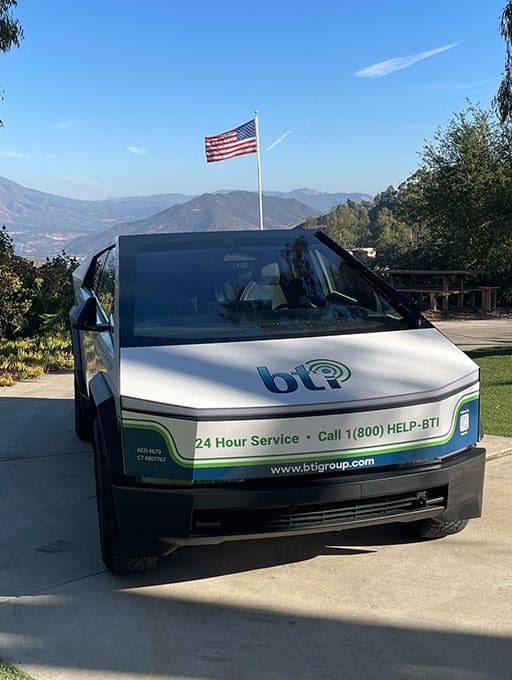
Cybertruck BTI help line and logo

12155 Mora Drive, Suites #1&2
Santa Fe Springs, CA 90670

BTI Van
1441 Branding Ave Suite #200 Downers Grove, IL 60515
Bti video overlay

615 N 48th St, Suite #1048
Phoenix, AZ 85008

Ready when you are

Contact Us Today for a Free Consultation

“BTI has been exactly what our growing company has needed for so long! They provide friendly, professional service and have consistently been willing to go above and beyond to ensure our complete satisfaction.”

BTI client, healthcare

IT sales, business hours: Los Angeles 323-510-8003 · Chicagoland 312-492-2613 · Phoenix 480-272-8728

The first consultation and the initial IT assessment conversation are free. The assessment scope is set on the initial engineering consult call.

Request your free consultation

Tell us about your IT, security, or communication challenges, no obligation.

IT Services

Let's Start a Conversation

What's the best way for us to contact you?

Top quality brands, expert engineering, transparent cost, and measurable ROI.