Axis AV1 compression, paired with Zipstream on ARTPEC-9 cameras, can cut video surveillance storage and bandwidth costs, especially versus legacy H.264. In a 50-camera model using the Axis P3288-LVE, moving from H.264 without Zipstream to AV1 with Zipstream reduced 90-day storage by roughly 70%. Over the life of a system, storage, recording servers, network capacity, power, and cooling often cost more than the cameras themselves, and every one of them scales with how many bits each camera sends and keeps.
That is why video compression belongs in the planning conversation, not just the spec sheet. With its ARTPEC-9 system-on-chip, Axis has added support for AV1, an open, royalty-free codec from the Alliance for Open Media. Paired with Axis Zipstream, AV1 can meaningfully reduce the infrastructure a system needs. Here is what that looks like in practice, along with the caveats decision makers should understand.
By Tony Dvorzsak, Director of Converged Security and Technologies, BTI Communications Group, an Axis Gold Partner
What Is AV1?
AV1 (AOMedia Video 1) is an open video codec developed by the Alliance for Open Media. It is designed to deliver high-quality video at lower bitrates, reducing how much data a system must transmit and store.
Using AV1 to compress video requires a compatible encoder. In supported Axis cameras, the ARTPEC-9 chip performs that work before the video stream reaches the recording system. AV1 can also work alongside Axis Zipstream, which optimizes compression for surveillance scenes.
H.264 vs H.265 vs AV1: What Is the Difference?
H.264, H.265, and AV1 all compress video, but they differ in compression efficiency and playback support. For surveillance, the useful comparison is how much data each requires at the image quality your system needs.
What Is the Difference Between H.264 and H.265?
H.264, also called Advanced Video Coding (AVC), is widely supported across surveillance and playback systems. H.265, or High Efficiency Video Coding (HEVC), was developed to encode video more efficiently, potentially delivering similar image quality at a lower bitrate.
For a camera system, that can reduce storage and network demand. The practical tradeoff is compatibility: the cameras, recording software, and viewing devices must support the selected format.
AV1 vs H.264/AVC
Compared with H.264, AV1 offers the potential to retain useful image detail with less data. That can matter when a business records high-resolution video continuously across many cameras.
The starting configuration still matters. Moving from H.264 without Zipstream to AV1 with Zipstream changes two parts of the system. Its savings should be measured separately from the benefit of switching codecs with the same Zipstream settings.
AV1 vs H.265/HEVC
AV1 and H.265 are closer competitors. Axis describes its AV1 implementation on ARTPEC-9 as comparable to H.265 in compression efficiency.
For a business already using H.265 with Zipstream, an AV1 upgrade is worth assessing against its current performance. Compare the codecs at the required image quality with consistent cameras, scene conditions, and recording settings.
That is where manufacturer claims, independent tests, and site-specific modeling need to be considered together.
What Axis Claims, and What Independent Testing Shows
Axis states that AV1 on ARTPEC-9 can deliver roughly 40% lower bitrate than H.264 and about 25% lower than H.265, measured against an ARTPEC-8 baseline. Axis also states that AV1 encoding adds no camera power or processing cost, and that AV1 streams are supported in major video management systems including AXIS Camera Station, Milestone, and Genetec.
Independent results are more nuanced. In testing, it was found that AV1 averaged about 15% savings compared with H.265. Savings reached 42-48% in some night and infrared scenes, but were only around 1% in daytime scenes with motion, and AV1 was about 21% worse than H.265 in some static, well-lit scenes. In other words, AV1 is not a uniform win. Its benefit depends heavily on what the camera is looking at and when.
That variability is the main reason we recommend designing around real scenes rather than headline percentages.
Planning a camera refresh or storage upgrade? BTI, an Axis Gold Partner, can model AV1 and Zipstream against your real scenes. Explore Axis network cameras or contact our team.
A Practical Example: 50 Cameras, 90 Days
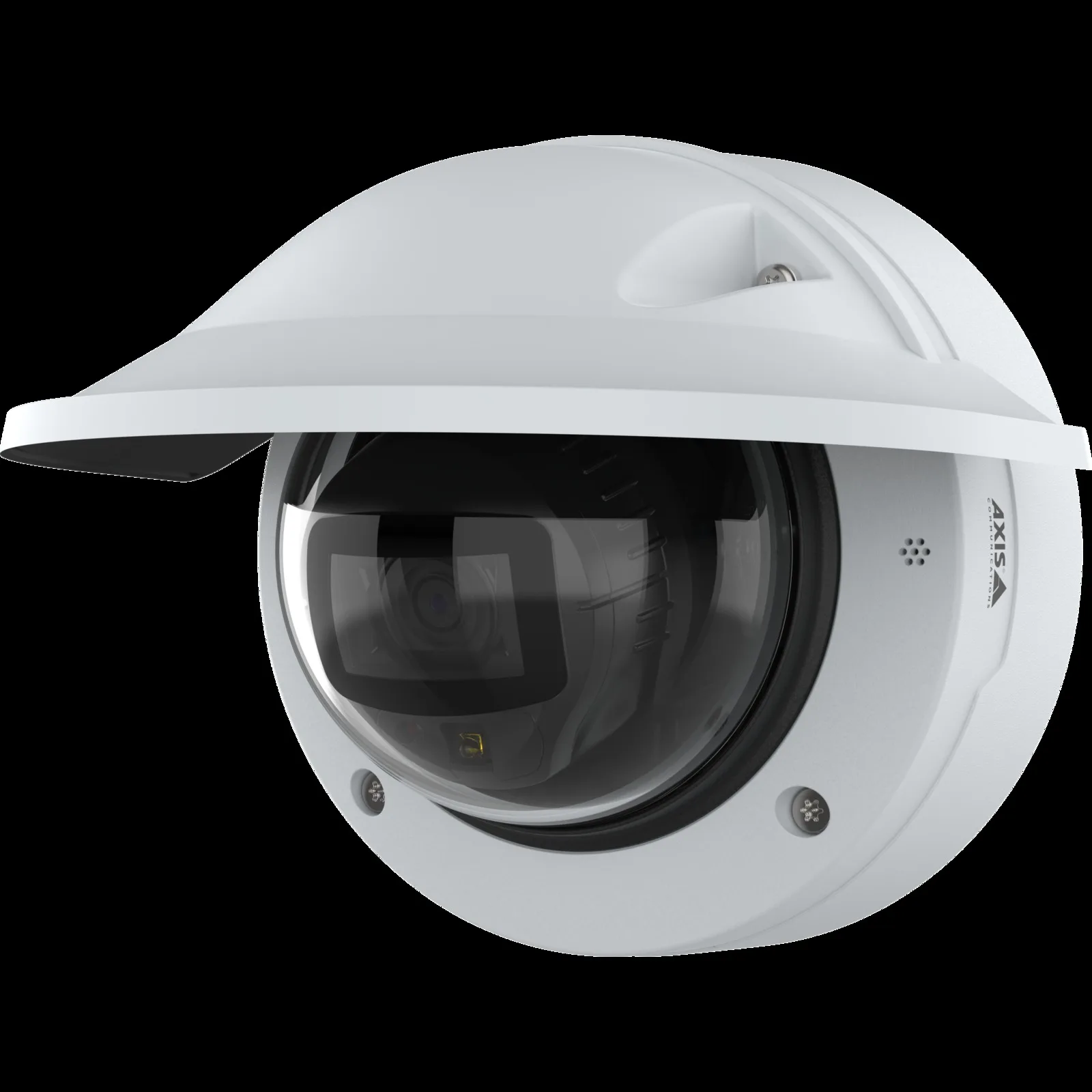
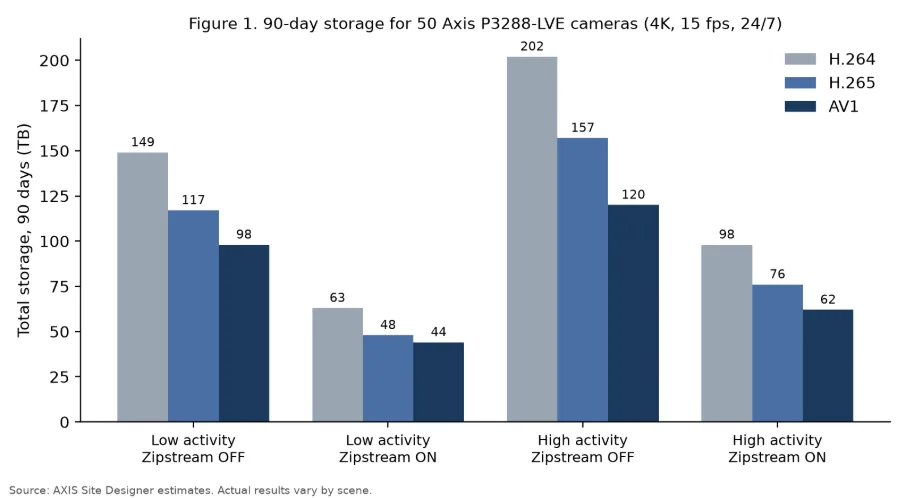
To make this concrete, we modeled a 50-camera deployment in AXIS Site Designer using the Axis P3288-LVE, an 8MP (4K) ARTPEC-9 dome. Each camera records continuously, 24/7, at 15 frames per second with 90-day retention. We ran two scene types, a low-activity indoor reception area and a high-activity parking lot, each with Zipstream off and on (Medium strength, dynamic GOP). Per-camera results were multiplied by 50.
Table 1. Per-camera bitrate (Mbps) / total 90-day storage for 50 cameras
| Scenario | H.264 | H.265 | AV1 |
|---|---|---|---|
| Low activity, Zipstream OFF | 3.07 / ~149 TB | 2.39 / ~117 TB | 2.00 / ~98 TB |
| Low activity, Zipstream ON | 1.28 / ~63 TB | 0.987 / ~48 TB | 0.907 / ~44 TB |
| High activity, Zipstream OFF | 4.15 / ~202 TB | 3.22 / ~157 TB | 2.46 / ~120 TB |
| High activity, Zipstream ON | 2.02 / ~98 TB | 1.55 / ~76 TB | 1.27 / ~62 TB |
Source: AXIS Site Designer estimates for Axis P3288-LVE, 4K, 15 fps, 24/7 continuous recording, 90-day retention. Actual results vary by scene, lighting, and configuration.
Two patterns stand out. First, the combination matters more than either feature alone. Moving from legacy H.264 without Zipstream to AV1 with Zipstream reduced storage by roughly 70% in both scenes: from about 202 TB to 62 TB in the busy parking lot, and from about 149 TB to 44 TB in the quiet reception area. Figure 1 shows the totals side by side.
Second, AV1’s advantage over H.265 is real but more modest. With Zipstream off, AV1 saved about 16% (low activity) to 24% (high activity) compared with H.265. With Zipstream on, the gap narrowed to about 8% and 18%, because Zipstream already removes much of the redundancy both codecs would otherwise spend bits on. Figure 2 shows how each configuration compares with the legacy H.264 baseline.
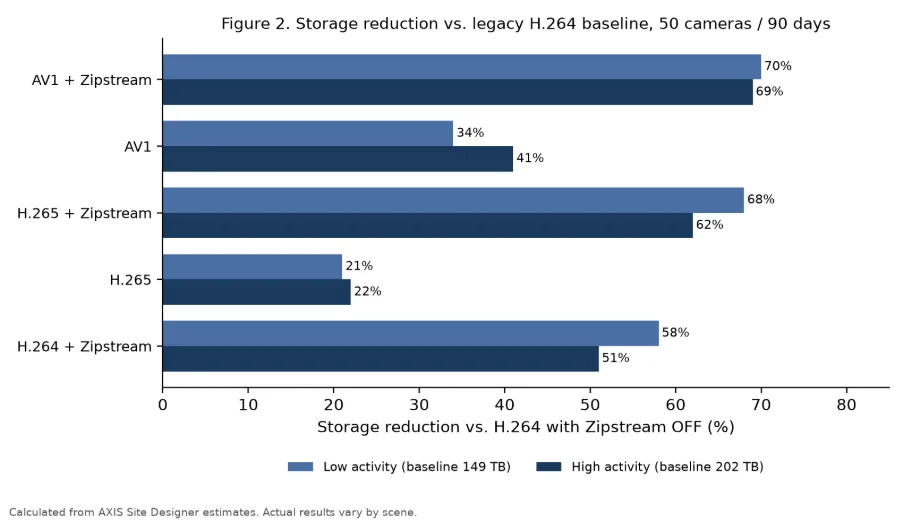
For organizations still running H.264 without Zipstream, the upgrade path offers the largest gain. For those already on H.265 with Zipstream, AV1 is an incremental improvement worth evaluating scene by scene.
The Benefits of AV1 Compression
Storage figures only matter when they translate into infrastructure decisions. A reduction from roughly 200 TB to roughly 60 TB can affect a project in several ways:
- Fewer or smaller drives. Less raw capacity means fewer disks, and fewer disks means fewer failures and replacements over the system’s life.
- Smaller or fewer recording servers. Capacity that once required multiple storage-dense servers may fit on fewer units, reducing hardware, rack space, and licensing tied to server count.
- Lower power and cooling. Every drive and server draws power and generates heat. Shrinking the storage footprint reduces ongoing operating expense in the server room or data center.
- Reduced network load. In the busy scene, aggregate camera traffic drops from roughly 208 Mbps (50 cameras on H.264 without Zipstream) to about 64 Mbps with AV1 and Zipstream, easing pressure on switches, uplinks, and any links to remote or cloud storage.
- Longer retention on the same hardware. Alternatively, organizations can keep existing storage and extend retention. As an illustrative calculation only, storage sized for 202 TB could hold roughly three times as many days of footage at 62 TB per 90 days, assuming similar scene activity.
We have deliberately not attached dollar figures here. Drive, server, and energy costs vary widely by vendor, region, and procurement terms, and any honest cost model should use your actual pricing. The direction, however, is clear: fewer bits stored means less infrastructure to buy, power, and maintain.
Important Considerations Before You Switch
AV1 is not a checkbox to enable everywhere. Confirm that your VMS version supports AV1 recording and playback, and check that client workstations can decode AV1 efficiently, since older hardware may struggle with multiple 4K streams. Remember that results vary by scene: night and IR views tend to benefit most, while some static, well-lit views may see little benefit or perform better on H.265.
Axis is also not the only manufacturer working on this problem. Other vendors offer their own bitrate-reduction technologies, such as Hanwha’s WiseStream and Avigilon’s SmartCodec, and the right choice depends on your environment, existing platform, and long-term standards. The point is not that one codec wins every scenario, but that compression strategy should be designed intentionally rather than left at defaults.
Design for Your Site, Not the Spec Sheet
The most reliable way to know what AV1 and Zipstream will save you is to model your actual cameras, scenes, frame rates, and retention requirements. At BTI Communications Group, an Axis Gold Partner, we use AXIS Site Designer to build site-specific storage and bandwidth estimates, then validate them against real-world conditions so the infrastructure we recommend matches how your facility actually operates.
If you are planning a new surveillance system, refreshing aging recording hardware, or trying to extend retention without expanding your server room, contact BTI Communications Group. Our converged security and technology team can assess your current system, model the impact of AV1 and Zipstream, and help you build a lower-cost, longer-lasting video surveillance infrastructure. Learn more about our Axis network cameras practice.
Also see Axis Access Control in AXIS Camera Station Pro and AXIS Camera Station.Tony Dvorzsak
Tony Dvorzsak is Director of Converged Security and Technologies at BTI, with more than 22 years of experience in physical security systems, low-voltage infrastructure, systems integration, and engineering. He focuses on enterprise security architecture, emerging technologies, and managed security services, and holds manufacturer certifications from Axis Communications, Milestone Systems, Avigilon, and others.