If you run a lean IT department, or you are the small business owner who also wears the IT hat, the security to-do list never gets shorter. Patches pile up, passwords go stale, and MFA covers some accounts but not all.
That gap matters more right now than it did a year ago. On October 22, 2026, Matt Shumer published an article on X for everyday internet users describing a surge of AI-driven attacks, including fast, widespread exploitation attempts against a serious PHP vulnerability soon after it was disclosed. His core point is that offense is ahead of defense for now, because AI can find bugs and break in at scale while patching still takes humans time. Shumer has no connection to BTI, and we do not speak for him.
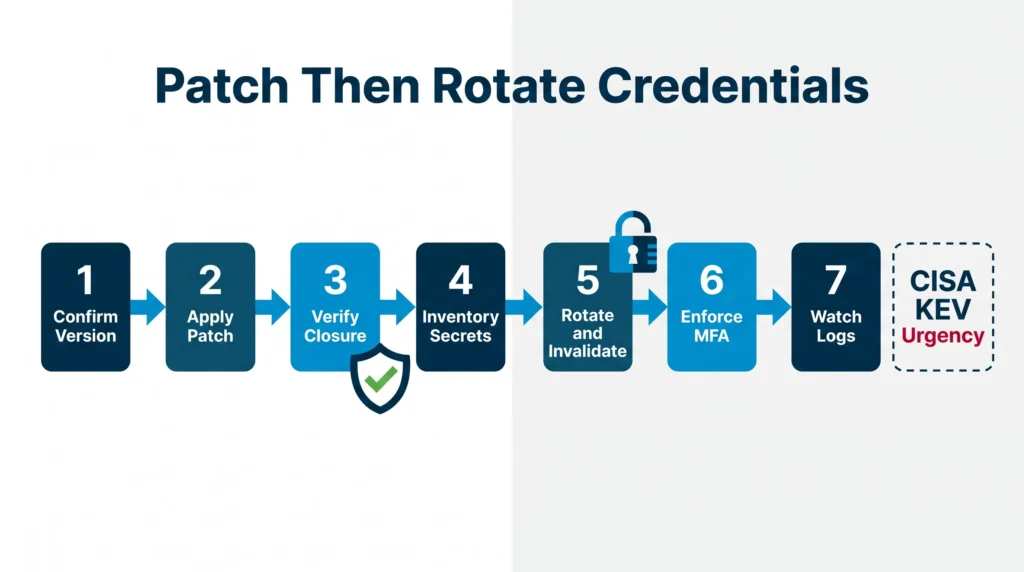
For a business, keeping up means daily operations work: closing patches faster, rotating credentials, enforcing MFA everywhere, and moving key accounts to phishing-resistant security keys. The good news is that governed AI can take a lot of that repetitive work off your plate, safely.
Want to close the gap faster? Find out about BTI’s Governed AI Services and see how they can help your team keep up with patching and identity security.
Staying on top of patching when attackers move faster
Most small teams know what needs to happen. The problem is time. Checking releases, finding affected systems, testing, deploying, and confirming each fix is manual work, and every hour a known weakness stays open is an hour an automated attacker can use it.
Practical steps that shrink time-to-patch:
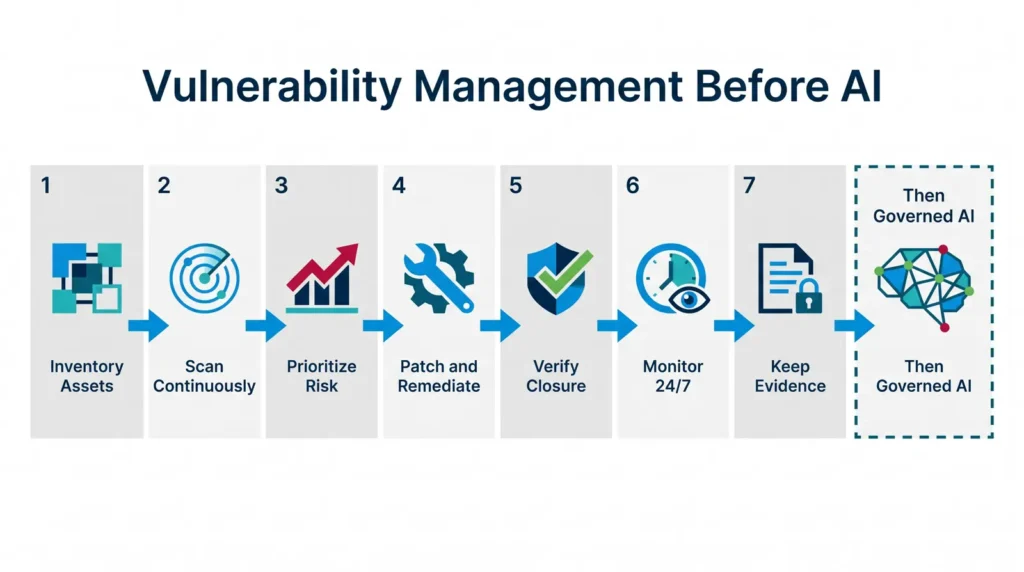
- Know what you own. Keep a current list of laptops, servers, firewalls, routers, cloud apps, and anything facing the internet. You cannot patch what you do not know exists.
- Patch by real risk, not just severity score. Put internet-facing systems and vulnerabilities that are actively being exploited at the top of the list.
- Set target windows and track them. For example, a short window for critical internet-facing fixes and a longer one for lower-risk internal systems.
- Verify closure. A patch is not done until a rescan confirms it.
- Remove what you do not use. Old apps, retired devices, and forgotten test servers are easy targets. Fewer things to patch means less exposure.
Not sure where you stand today? Start with a free cybersecurity assessment to see your patching gaps and the fastest ways to reduce risk.
Passwords, MFA, and security keys: the identity basics
Attackers do not always break in. Often they log in. Stolen, reused, or guessed passwords remain one of the easiest paths into a business, and AI makes phishing messages more convincing than ever.
- Stop password reuse. Use a business password manager so every account has a unique, strong password, and staff do not need to remember them.
- Rotate credentials that matter. Prioritize admin accounts, service accounts, shared logins, and any credential that may have been exposed. Rotate promptly when someone leaves the company.
- Turn on MFA everywhere. Email, remote access, VPN, cloud apps, banking portals, and admin consoles should all require a second factor. Partial coverage leaves the door open.
- Move high-value accounts to security keys. Phishing-resistant hardware security keys are much harder to trick than text-message codes. Start with administrators, finance, and executives, then expand.
- Watch for MFA fatigue and scam codes. Train staff never to approve a login prompt they did not start and never to read a code to someone who calls or texts them.
How governed AI helps lean IT teams do more, safely
AI tools can speed up a lot of this work. But dropping an unmanaged AI tool into your environment, with access to your systems and data, creates a new risk of its own. That is why governance comes first.
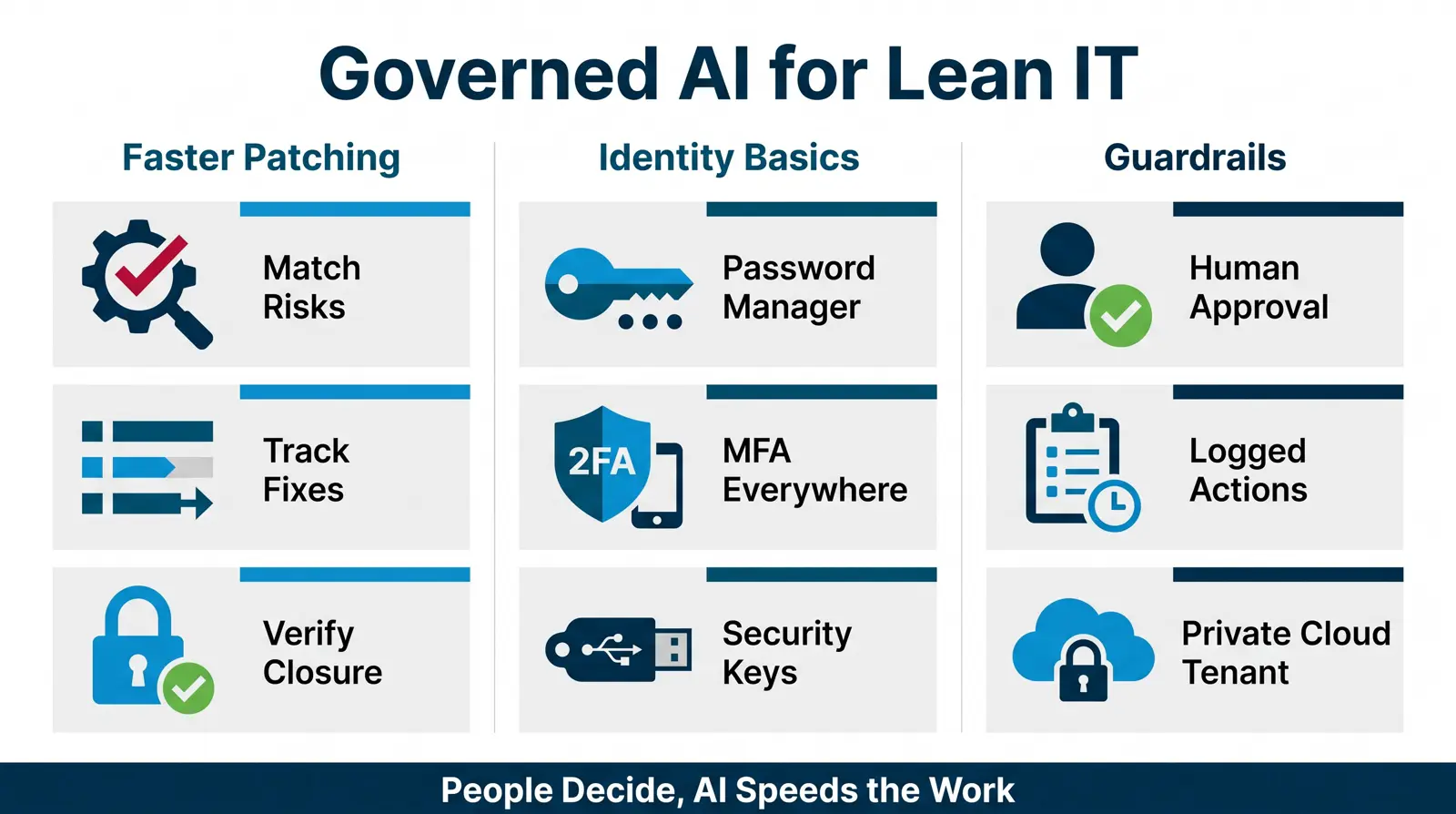
Governed AI means the AI works inside clear guardrails: defined permissions, human approval for changes that matter, logging of every action, and data that stays under your control. At BTI, each AI client gets its own hosted Azure tenant, so your data is not mixed with anyone else’s.
With those guardrails in place, governed AI can help your team:
- Triage patches faster by matching new vulnerability disclosures to the systems you actually run and ranking what to fix first.
- Prepare and track patch work so deployments, exceptions, and rescans do not fall through the cracks.
- Flag identity gaps such as accounts without MFA, stale admin accounts, shared logins, and passwords overdue for rotation.
- Draft rollout plans for MFA and security keys, including user communications and step-by-step instructions.
- Summarize alerts and reports in plain language so a small team can act quickly.
People stay in charge of decisions. AI handles the sorting, matching, drafting, and tracking that eats up the day.
Ready to see what this looks like for your business? Find out about BTI’s Governed AI Services.
Lower cost and better security at the same time
For small businesses, security spending often feels like a trade-off: hire more people or accept more risk. Governed AI changes that math by reducing the manual hours spent on routine tasks, so your existing team can focus on the work that needs human judgment.
It also improves security directly. Faster patching shrinks the window attackers can use. Consistent MFA and security keys block many account takeover attempts. Regular credential rotation limits the damage if a password leaks. Doing these basics reliably is far less expensive than recovering from a breach.
BTI brings over 40 years of experience helping businesses with technology, backed by a SOC 2 Certified NOC/SOC and ISO 27001 compliant practices. Our cybersecurity services and broader IT services can work alongside your team or fill gaps where you need extra hands. For a leadership-level view of why the basics come first, read our companion post, Vulnerability Management Before AI.
FAQ
Is AI safe to use for IT security tasks?
It can be, when it is governed. That means limited permissions, human approval for important changes, full logging, and data kept in an environment you control. Unmanaged AI tools with broad access can add risk instead of reducing it.
We are a small business. Do we really need security keys?
For your most important accounts, yes, they are worth considering. Administrators, finance staff, and owners are common targets, and phishing-resistant security keys are much harder to bypass than text-message codes. You can start small and expand over time.
Will governed AI replace my IT staff?
No. It is designed to take repetitive work off their plate, such as sorting patches, tracking rollouts, and flagging identity gaps, so they can focus on decisions and higher-value work.
Find Out About BTI’s Governed AI Services
Attackers are using AI to move faster. Your team can too, with the right guardrails. BTI’s governed AI services help IT departments and small business owners stay on top of patching, password rotation, MFA, and security keys, faster, more securely, and at lower cost.
Find out about BTI’s Governed AI Services or start with a free cybersecurity assessment to see where your biggest gaps are today.