




Overview
Private cloud gives businesses a dedicated cloud environment for running applications, storing data, and managing IT operations with more control. Whether you need to protect sensitive information, support compliance requirements, or improve performance for critical workloads, private cloud helps you build infrastructure around your business needs instead of sharing resources with other organizations.
Key Takeaways
Private cloud services give businesses a dedicated cloud environment instead of shared public cloud resources.
Private cloud can be hostedon-premises, in a third-party data center, or managed by a cloud provider.
Virtualization allows private cloud environments to turnphysical servers, storage, and networking into flexible computing resources.
Businesses use private cloud to run critical applications, store sensitive data, support compliance needs, and improve control over IT infrastructure.
Virtualization allows private cloud environments to turnphysical servers, storage, and networking into flexible computing resources.
The main types of private cloud include on-premises private cloud, hosted private cloud, managed private cloud, and virtual private cloud.
Private cloud is often a strong fit for organizations that need more security, customization, predictable performance, and control than a standard public cloud environment can provide.
What is Private Cloud?
Private cloud is a dedicated cloud computing environment designed for a single organization. Instead of sharing computing resources with other companies, a business uses private cloud to run applications, store data, manage users, and support IT operations in an environment built around its own security, performance, and compliance needs.
How Does a Private Cloud Environment Work?
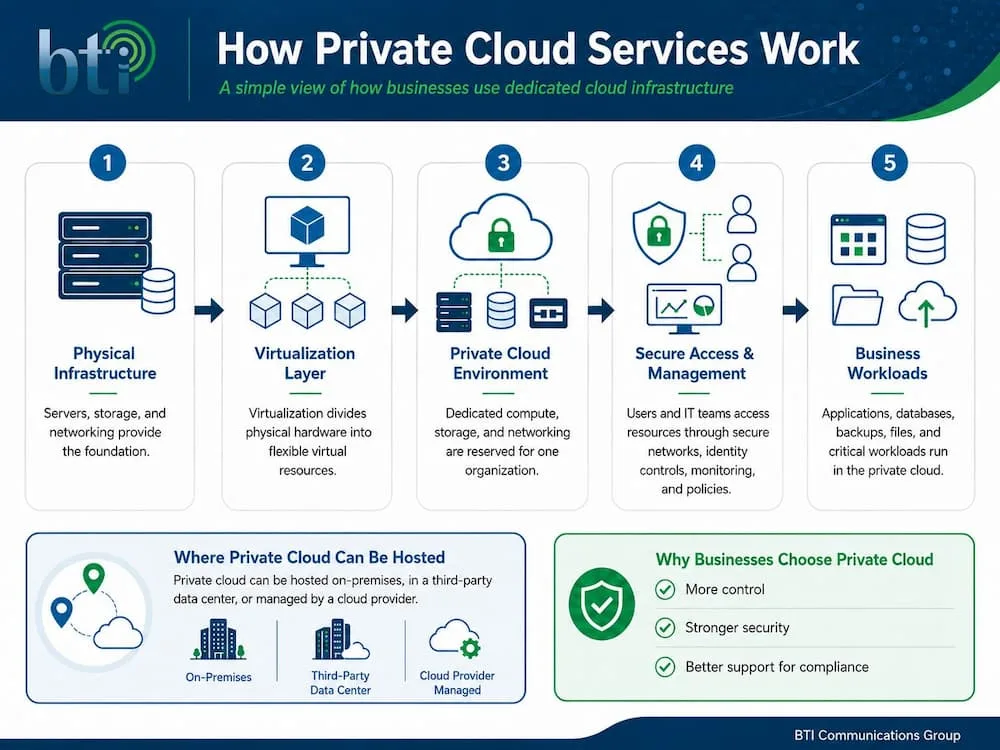
Private cloud is a dedicated cloud computing environment designed for a single organization. Instead of sharing computing resources with other companies, a business uses private cloud to run applications, store data, manage users, and support IT operations in an environment built around its own security, performance, and compliance needs.
Cloud computing works by using physical servers to create virtual resources that businesses can access when they need them. Instead of relying on one local computer or one physical server, cloud environments use virtualization to divide computing power, storage, and networking into flexible resources that can support applications, data, users, and business systems.
These cloud resources can be hosted on the company’s own premises, in a third-party provider’s data center, or through a managed cloud provider. Users connect to the environment through a secure network or internet connection, while the cloud infrastructure handles the processing, storage, backups, and application delivery behind the scenes.
Types of Private Cloud
Private cloud can be built in different ways depending on where the infrastructure is hosted, who manages it, and how much control the business wants to keep. The main types of private cloud are on-premises private cloud, hosted private cloud, managed private cloud, and virtual private cloud.
On-Premises Private Cloud
An on-premises private cloud is hosted inside the company’s own facility or data center.
The business owns or controls the physical servers, storage, networking equipment, and security systems used to run the cloud environment.
Hosted Private Cloud
A hosted private cloud is dedicated to one organization but hosted in a third-party provider’s data center.
The business still gets a private environment, but the physical infrastructure is located outside its own office or facility.
Managed Private Cloud
A managed private cloud is a private cloud environment operated or supported by a third-party provider.
The infrastructure may be hosted on-premises, in a provider’s data center, or in another dedicated environment, but the provider helps manage tasks such as monitoring, maintenance, updates, backups, and security.
Virtual Private Cloud
A virtual private cloud is a private section of a larger public cloud environment.
The physical infrastructure may still be shared at the provider level, but the business receives an isolated virtual environment with its own network settings, access controls, and security configurations.
Which Type of Private Cloud Is Best?
The best type of private cloud depends on how much control, support, scalability, and infrastructure responsibility a business wants. Some organizations need full control over their own environment, while others prefer a provider to host, manage, or support the infrastructure.
Types of private cloud — comparison
| Type of Private Cloud | Best For | Main Advantage | Main Consideration |
|---|---|---|---|
| On-Premises Private Cloud | ✓Businesses that need maximum control over infrastructure, data, and security | ✓The organization keeps the cloud environment inside its own facility or data center | ✓Requires more internal IT resources to manage, maintain, secure, and upgrade the system |
| Hosted Private Cloud | ✓Businesses that want dedicated cloud resources without maintaining their own data center | ✓The cloud environment is private to one organization but hosted in a third-party provider’s data center | ✓The business depends on the provider’s infrastructure, facilities, and service model |
| Managed Private Cloud | ✓Businesses that want private cloud benefits without managing every technical detail internally | ✓A third-party provider can help with monitoring, maintenance, updates, backups, and security | ✓Less direct day-to-day management compared to a fully self-managed private cloud |
| Virtual Private Cloud | ✓Businesses that want a more isolated cloud environment within a public cloud platform | ✓Provides private networking, access controls, and segmentation inside a larger cloud environment | ✓It is not the same as having fully dedicated physical infrastructure |
← Swipe to compare →
What are The Benefits of Private Cloud?
The benefits of private cloud services go beyond simple data storage. For many businesses, private cloud provides a more secure, controlled, and customizable way to run critical applications, protect sensitive data, and support long-term IT growth.
- Better Support for Compliance Requirements: Private cloud can help businesses meet stricter regulatory, contractual, or internal compliance requirements.
- Stronger security and data protection: Because private cloud resources are dedicated to one organization, businesses can design more restrictive security policies around access, segmentation, monitoring, encryption, backups, and user permissions.
- Greater control over infrastructure: Businesses can decide how their servers, storage, applications, security policies, and network resources are configured. This is different from public cloud, where the infrastructure is shared, and the provider controls many parts of the environment.
- Customization for business needs: Private cloud environments can be customized around the company’s applications, workflows, users, security policies, and growth plans.
For example, a business can build a private cloud around, specific storage requirements, legacy applications, custom backup policies, and more. This makes private cloud useful for businesses that cannot easily fit into a standard public cloud setup.
- Easier integration with existing IT systems: Many businesses still use a mix of on-premises infrastructure, legacy applications, cloud services, security systems, and remote work tools. Private cloud can make it easier to connect these environments in a controlled way.
What is The Future of Private Cloud?
Private cloud services are no longer just an alternative to public cloud; it’s becoming a strategic part of modern IT infrastructure.
As organizations adopt artificial intelligence, expand cloud applications, strengthen cybersecurity, and manage growing amounts of data, many are finding that a one-size-fits-all cloud strategy no longer meets their needs.
Instead, businesses are building hybrid environments that combine private cloud, public cloud, and on-premises infrastructure to support different workloads.
The future of private cloud is centered on greater flexibility, automation, and integration. Organizations want the scalability and efficiency of cloud computing while maintaining control over sensitive applications, regulated data, and mission-critical systems.
Several trends are shaping the future of private cloud:
- Hybrid cloud adoption that combines private and public cloud resources.
- AI-powered infrastructure management to improve performance, automate routine tasks, and identify potential issues before they impact operations.
- Zero Trust security and stronger cybersecurity controls to protect critical business data.
- Cloud-native applications that can run consistently across private and public cloud environments.
- Infrastructure as a Service (IaaS) and Private Cloud as a Service (PCaaS) models that reduce the burden of managing physical infrastructure.
For many organizations, the future isn’t choosing between private and public cloud. It’s building the right combination of technologies to meet business, security, compliance, and operational requirements.
Private Cloud Services Use Cases
Private cloud services are used by businesses that need a dedicated cloud environment for sensitive data, critical applications, compliance requirements, or performance-heavy workloads. Here are some common ways organizations use private cloud technology.
Healthcare and Patient Data Protection
Healthcare organizations use private cloud to support electronic health records, patient data, medical imaging, and secure internal systems. A dedicated environment can help protect sensitive healthcare information while giving authorized users reliable access to the systems they need.
Enterprise Applications and Databases
Businesses use private cloud to run critical applications such as ERP systems, CRM platforms, accounting software, databases, and internal business tools. These systems often require reliable performance, strong access control, secure data storage, and consistent availability to support daily operations.
Financial Services and Secure Transactions
Financial organizations use private cloud to support customer records, reporting platforms, secure transactions, accounting systems, and compliance-sensitive workloads. Private cloud gives these businesses more control over access, security policies, and data storage.
Legal and Professional Services
Law firms and professional services companies use private cloud to store confidential documents, manage client files, support secure collaboration, and control access to sensitive records. This can be especially useful when privacy, reliability, and document control are central to daily operations.
Manufacturing and Operational Systems
Manufacturing companies use private cloud to support ERP systems, inventory platforms, production data, quality control tools, and other operational applications. Private cloud can provide a more stable foundation for systems that need consistent performance and limited downtime.
AI, Analytics, and High-Performance Workloads
Businesses using AI models, data analytics, simulations, large databases, or other resource-heavy applications may use private cloud for dedicated computing power and predictable performance. This can help organizations process sensitive or high-volume data in a more controlled environment.
Hybrid Cloud and Disaster Recovery
Private cloud can serve as the foundation for a hybrid cloud strategy or disaster recovery plan. Businesses can keep sensitive workloads in a dedicated private environment while using public cloud services for scalability, backup, or less sensitive applications.
Build a Private Cloud Strategy That Fits Your Business
Private cloud can give businesses a more secure, controlled, and flexible way to run critical applications, protect sensitive data, support compliance requirements, and prepare for long-term growth. Whether your organization is evaluating private cloud, hybrid cloud, hosted infrastructure, or managed cloud support, BTI Communications Group can help you design an environment that supports your business without adding unnecessary complexity.