



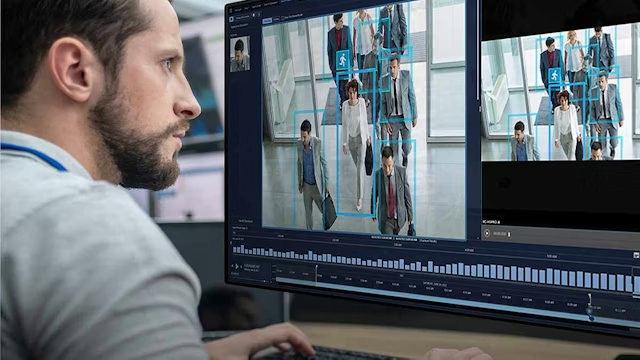
Among all applications of AI in physical environments, safety and compliance consistently deliver the most immediate value.
This is because these use cases do not require perfect accuracy or full automation. They enhance existing processes rather than replacing them.
They also align with requirements that organizations already prioritize, such as regulatory compliance, risk reduction, and incident response.
Recorded Video as a Compliance Tool
Most organizations already use video to review incidents. AI extends this capability by allowing video to be analyzed systematically rather than manually.
From a technical perspective, this involves applying models that detect events or patterns across large volumes of stored footage. Instead of reviewing hours of video, the system identifies segments that match specific criteria.
Healthcare Example: Post-Incident Analysis
In a hospital setting, reviewing a patient fall manually may require scanning hours of footage.
AI can analyze recorded video to identify the exact moment of the fall, track the patient’s movement leading up to the event, and evaluate response time.
This reduces the time required for investigation and provides more consistent analysis across incidents.
Food Processing Example: Audit Preparation
Regulatory audits often require demonstrating that procedures were followed consistently.
AI can analyze recorded video to verify that required actions occurred in the correct sequence. For example, it can confirm that cleaning steps were completed in the proper order and within required timeframes.
This transforms video from a passive record into a verifiable audit tool.
Real-Time Safety Monitoring
Real-time AI introduces the ability to detect and respond to risks as they occur.
Manufacturing Example: PPE Compliance
AI models can detect whether workers are wearing required safety equipment. The system evaluates each frame of video, identifying objects such as helmets or vests.
If a violation is detected, the system can trigger alerts or log the event.
The key here is that the detection criteria are well-defined, which makes the problem technically tractable.
Logistics Example: Restricted Area Monitoring
In warehouse environments, certain zones present higher risk. AI can monitor these areas continuously, detecting when unauthorized access occurs.
The system must track objects across frames and determine whether they cross defined boundaries.
This requires consistent camera placement and reliable video streams.
Municipal Example: Situational Awareness
In public environments, AI can assist operators by highlighting unusual patterns rather than making decisions autonomously.
For example, it may detect abnormal crowd movement or unexpected activity in restricted areas.
The goal is not automation, but enhanced visibility.
Why These Use Cases Work
Safety and compliance applications succeed because they operate within clearly defined parameters.
The system does not need to interpret complex behavior. It needs to detect specific conditions and provide timely information.
This makes them more resilient to variability and easier to integrate into existing workflows.
Cybersecurity Considerations
Every camera in an AI-enabled system is also a networked device. This introduces risk.
From a technical perspective, cameras can serve as entry points into a network if they are not properly secured. They run firmware, communicate over protocols, and often have default configurations that can be exploited.
An AI-enabled environment increases this risk because it expands the data pipeline and integration points.
Proper architecture includes segmentation, monitoring, and controlled access to ensure that the system remains secure.
Is Your Video Infrastructure Ready for AI-Driven Safety & Compliance?
AI delivers the fastest ROI when applied to safety and compliance—but only if your systems are connected, secure, and built to support it. Learn how to turn your video environment into a proactive risk and compliance tool.