


The 2026 SoCal IT Manifesto: Stabilizing Infrastructure to Enable the AI Revolution
This definitive guide incorporates 2026 middle-market benchmarks and reflects a fundamental shift happening across Southern California organizations.
The “middle market” is no longer defined by outdated revenue bands. In 2026, it spans $25M to $10B, driven by consolidation, digital complexity, and increasing demands across cybersecurity, compliance, and AI. But the most important shift isn’t financial. IT is no longer a support function. It is the last mile of AI execution. And right now, most organizations are failing at it.
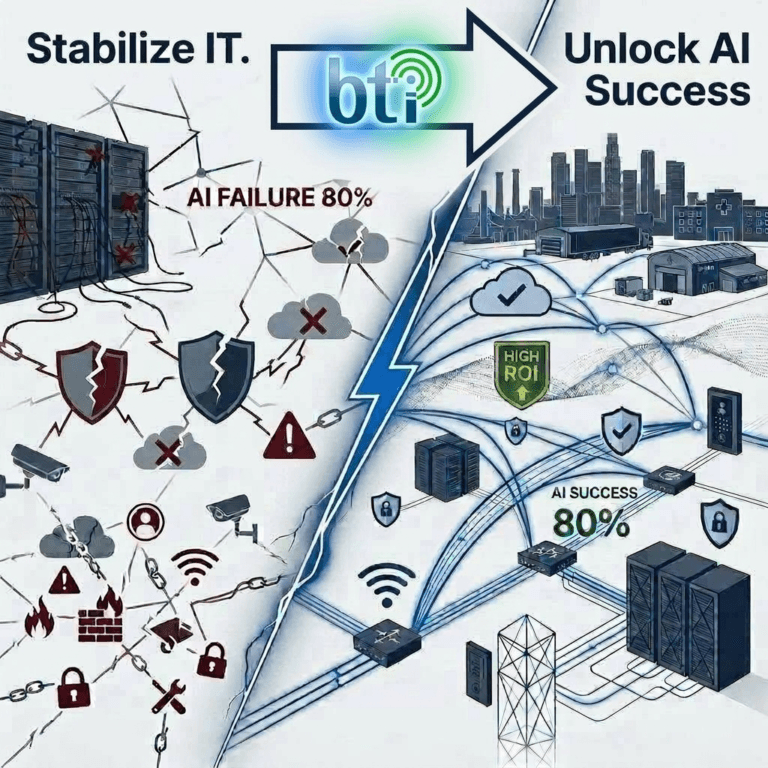
The Reality: Why 80% of AI Projects Fail
Nearly 80% of AI initiatives fail to deliver ROI¹
¹ Source: Gartner, McKinsey, and IBM studies consistently show that a majority of AI initiatives fail to scale or deliver expected ROI due to infrastructure, data, and operational challenges.
They fail because the infrastructure underneath them and the vendors and in-house IT implementation teams aren’t aligned or ready..
If your environment is fragmented across:
- IT providers
- Security vendors
- VoIP platforms
- Cloud tools
- Compliance systems
…then your AI initiative is sitting on operational debt.
That debt shows up as:
- Network instability
- Security vulnerabilities
- Compliance gaps
- System conflicts
- Internal IT burnout
AI doesn’t fix these problems. It amplifies them. This is why mid market firms are shifting toward an infrastructure-led co-managed IT approach, where stability is built first and everything else layers on top.
Post Covid, Post AI Southern California Mid-Market Revenue and Headcount Tiers (2026)
| Segment | Revenue Range | Headcount | IT Reality |
|---|---|---|---|
| Lower Mid-Market | $25M – $100M | 100 – 500 | One “hero” IT manager relying on vendors |
| Core Mid-Market | $100M – $1B | 500 – 2,000 | IT team struggling with GRC and AI execution |
| Upper Mid-Market | $1B – $10B | 2,000+ | Complex environment requiring architectural hardening |
Across all tiers:
Internal IT is overloaded
Vendors are disconnected
Accountability is unclear
And AI initiatives collapse under that weight.
Strategic Partner Models: The Real ROI Driver
The biggest decision organizations make in 2026 is not which AI platform to adopt.
It’s which operating model they build around IT.
Strategic IT and Security Partner Comparison & ROI Matrix
| Partner Category | DNA | Impact on IT | ROI Profile |
|---|---|---|---|
| Converged Technology Partner (BTI) | IT + Security + VoIP + Compliance | Empowers IT by owning infrastructure | Highest & Fastest ROI |
| IT-First Platform (Sourcepass, Electric, Integris) | Identity + software + MSP tooling | Augments IT with tools | Moderate ROI, higher OpEx |
| Global Integrator (Convergint, Johnson Controls, Siemens) | Scale + enterprise standards | Demands internal management | Long-term ROI |
| Cybersecurity & GRC Firms (Optiv, Arctic Wolf, eSentire) | Zero Trust + MDR + compliance | Protects environment | Risk-based ROI |
| Helpdesk-Focused MSPs | End-user support + ticketing | Distracts IT from strategy | Low ROI |
| Security Integrators (Red Hawk, Allied Universal Tech Services) | Cabling + cameras + access control | Fragments environment | Hidden cost + risk |
Why BTI Wins in This Model
- vs IT-First Platforms: BTI doesn’t just give your team tools — we own and stabilize the infrastructure those tools depend on, eliminating hidden failure points.
- vs Global Integrators: BTI delivers enterprise-grade outcomes without requiring a large internal team to manage complexity.
- vs Cybersecurity Firms: BTI doesn’t just secure the environment — we control the underlying systems where risk actually originates.
- vs Helpdesk MSPs: BTI moves beyond reactive support to architect, manage, and continuously improve the entire environment.
- vs Security Integrators: BTI doesn’t create siloed systems — we fully integrate physical security into IT, cybersecurity, and compliance operations.
The Internal IT Requirements Document for 2026
AI is not a strategic advantage for any business. It is a survival imperitive. However, for AI and digital transformation to succeed, four layers must be fully operational:
I. Infrastructure & WAN Sovereignty (The Foundation)
AI fails when the network fails.
Your infrastructure must support:
- AI helpdesk, agents, IT operations, cybersecurity, access control, video and analytics
- VoIP and contact centers
- Cloud applications
- Multi-site connectivity
Key requirements:
- Circuit accountability (ISP ownership and management)
- Traffic prioritization across systems
- Infrastructure resiliency at every site, server, switch, and IDF/MDF
This is one component of infrastructure-led managed IT, where network, Wi-Fi, switching, and firewall architecture are treated as the core system—not an afterthought.
II. Cyber-Physical Hardening (The GRC & Insurance Shield)
Security is no longer just cyber. Today’s biggest threats come through:
- IoT, SCADA, and IoMT devices
- VOIP and 3rd Party Managed Internet Applications
- Brittle or Insecure Identity
- Comprehensive Cyber Security
- Cameras
- Access control systems
- WiFi
- Unpatched Vulnerabilities In Any Application or System
If these are not secured:
- Insurance claims can be denied
- Compliance frameworks fail
- Breaches originate outside traditional IT controls
Required capabilities:
- VLAN segmentation for all security devices
- Automated firmware lifecycle management
- Integrated monitoring across IT + IoT and physical systems
All of this is where organizations benefit from a co-managed IT model, combining internal IT knowledge with external expertise to harden environments without overwhelming internal teams.
III. Identity & Legacy Bridging (Modernization Without Chaos)
Modern IT is identity-driven. Not device-driven.
Key capabilities:
- HRIS integration with access control
- Zero Trust MFA
- Least Priviledged Access
- Hybrid modernization (leveraging legacy systems with AI overlays)
This enables modernization without disruptive rip-and-replace costs.
IV. Day 2 Operations (The Stability Engine)
AI is not “deploy and walk away.” It requires:
- Continuous monitoring
- Alert triage
- Incident response
- Compliance reporting
A human-in-the-loop, AI assisted PSA, SOC, NOC, SIEM, and Compliance solution is required to filter noise before it hits internal IT.
This aligns with a continuous cybersecurity operating model, where security and compliance are integrated into daily operations—not treated as one-time projects. Without this:
- Alerts overwhelm teams
- Systems degrade
- ROI disappears
Real-World Outcomes
Organizations that stabilize infrastructure first consistently outperform.
Healthcare Organization — From Risk to Audit-Ready
- Unified IT, security, and compliance
- Automated evidence tracking
- Reduced downtime
- Stronger audit and insurance posture
Logistics Company — Scaling Without Breaking Systems
- Standardized infrastructure across sites
- Faster deployments
- Centralized visibility
- Technology became a growth driver
Manufacturing Firm — Eliminating Downtime
- Consolidated vendors into one model
- Reduced outages
- Clear accountability
- Predictable IT roadmap
Professional Services Firm — Turning IT Into Advantage
- Secure hybrid workforce
- Reliable communication systems
- Strong cybersecurity posture
- Scalable long-term infrastructure
The Strategic Conclusion: Stabilize IT to Enable AI
The organizations winning in 2026 are not chasing AI tools. They are investing in:
- Infrastructure stability
- Security convergence
- Operational maturity
Because once those are in place:
- AI works as planned
- IT and security efficiency improve
- Resource utilization improves
- ROI scales without scaling headcount
- Risk drops
- Growth accelerates
The CFO’s Litmus Test
Before approving any technology initiative, ask:
“If this system fails — or creates risk — who is accountable?”
If the answer is:
- Internal IT
- Multiple vendors
- Or unclear
You don’t have a solution. You have exposure.
About BTI Communications Group
BTI Communications Group is a converged technology partner helping mid-market organizations secure, scale, and modernize operations across IT, cybersecurity, physical security, VoIP, and compliance.
Unlike traditional providers, BTI unifies these domains into a single operational platform, eliminating vendor fragmentation and reducing risk.
Our clients are typically:
- 50–3,000 users
- Multi-site and growing
- Operating in regulated or high-risk environments
BTI delivers:
- Infrastructure-led managed IT
- Co-managed IT and cybersecurity
- Physical security systems
- VoIP and contact center solutions
- Compliance and governance programs
This approach:
- Eliminates integration gaps
- Reduces operational friction
- Improves compliance posture
- Enables internal IT to focus on strategy and AI implementation
AI + Human Expertise
This article was developed using Gemini-assisted research and drafting, then refined using BTI’s real-world experience across IT, security, and compliance environments.
At BTI, AI is used to:
- Accelerate insight
- Improve operations
- Enhance outcomes
- Cross correlate data between physical security, PSA and IT operations, cyber security, NOC, SOC, SIEM and GRC
But every recommendation is grounded in real deployments, real results, and real client environments.
Work With BTI
If your organization is:
- Expanding across locations
- Managing multiple vendors
- Facing cybersecurity or compliance pressure
- Preparing for AI-driven transformation
BTI can help you stabilize and scale.
Schedule a strategy call to evaluate your optoins and build a roadmap forward.