






























IP Camera Solution Partners
Partners
Video Management
Surveillance Video Management Partners
Partners
Key Features
Industries Served
Communication Systems
Partners
Key Features
Key Features
Key Features
Industries Served
Top Services
Cloud Solution Providers
Industries Served
Locations

Call
Serving the Chicago metropolitan area, BTI Communications Group delivers comprehensive solutions in:

Call
Serving the Greater Los Angeles area, BTI Communications Group delivers comprehensive solutions in:

Call
Serving the Phoenix & Tucson metropolitan areas, BTI Communications Group delivers comprehensive solutions in:
Let’s talk about how BTI Communications Group can help your business stay secure, connected, and supported.
In co-managed IT, success depends on knowing exactly who is responsible for what. BTI’s Shared Responsibility Model gives you total clarity — so nothing falls through the cracks, security stays strong, and your documented, standards compliant execution is audit ready.
35+
Years of Proven Expertise
15+
Industries Served
10,000+
Alerts Handled, Zero Missed
98%
Client Retention Year After Year
Most organizations believe they have a shared responsibility model — but in practice, responsibility is assumed rather than operationally defined. This fundamental disconnect creates dangerous operational gaps that expose enterprises to unnecessary risk and compliance failures.
This creates critical gaps where security alerts are acknowledged but never acted upon, patching exists in documentation but remains inconsistently enforced across the environment, compliance controls are meticulously documented yet never properly validated, and incidents occur without any clear owner to drive resolution.
In regulated environments where oversight is constant and accountability is mandatory, undefined responsibility is not a flexibility — it’s a direct liability that can result in failed audits, insurance denials, and regulatory penalties.
BTI’s co-managed IT model exists specifically to eliminate this critical failure point through explicit documentation and operational clarity.
No documented owner for critical security and infrastructure functions
Technology deployed without clear operational responsibility
Unclear escalation paths and decisionmaking frameworks
CORE FRAMEWORK
At BTI, shared responsibility is explicit, documented, and operational from day one. Every aspect of IT and security operations has a clearly defined owner, documented authority boundaries, and measurable accountability standards that survive audits, incidents, and leadership transitions.
There is always a single accountable operator for every covered control – with documented authority to act, not just observe. Responsibility boundaries are defined before incidents, audits, or insurance reviews — not during them.
Understanding who owns what is essential for operational success and audit readiness. This comprehensive breakdown eliminates ambiguity by mapping every critical IT and security capability to its designated owner, ensuring seamless execution and clear accountability at every layer of your technology stack.
| Capability | Internal IT | BTI (Execution Owner) |
|---|---|---|
| End-User Devices & OS | Strategic oversight | Monitoring, patching, remediation |
| Servers & Infrastructure | Architecture approval | Monitoring, maintenance, incident response |
| Network, Firewalls, Wi-Fi | Policy direction | Configuration, monitoring, firmware updates |
| RMM, NOC, SOC Tooling | Visibility requirements | Deployment, tuning, daily operation |
| SIEM & Threat Correlation | Strategic awareness | Ingestion, correlation, investigation |
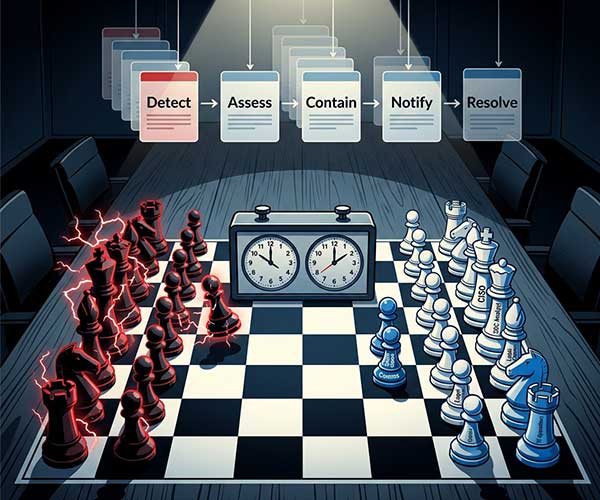
| Incident Response | Business decisions | Detection, containment, documentation |
| Compliance Controls & Evidence | Executive accountability | Continuous validation & evidence collection |
This clear delineation ensures that every technology layer has an unambiguous owner for execution, while internal IT maintains strategic control and business alignment. The result is faster incident response, cleaner audits, and dramatically reduced operational friction.
DECISION FRAMEWORK
Regulators, cyber insurance underwriters, and enterprise customers conducting third-party risk assessments do not evaluate good intentions or verbal commitments. They evaluate execution and evidence — and they expect both to be immediately available, consistently maintained, and independently verifiable.
BTI’s shared responsibility model ensures that controls are continuously monitored rather than manually assembled before audits, evidence exists in real-time systems before auditors schedule their reviews, incident response activities are documented automatically as they occur, and insurance questionnaires map directly to operating controls that are already in place
and provable.
This approach eliminates the most common and most damaging compliance failure mode: “We thought someone else was handling that.”
Evidence collected continuously, not
assembled reactively
Controls map directly to underwriter requirements
Vendor assessments completed with documented proof
“The difference between passing and failing a cyber insurance renewal often comes down to one question: Can you prove your controls are operating? Not planned. Not documented. Operating.”
One of the most persistent myths about co-managed IT is that it simply adds more work to already overwhelmed internal teams. BTI’s model operates on the opposite principle: internal IT should be strategic, not buried in operational execution.
Before BTI
Internal IT manages strategy, execution, monitoring, remediation,
and evidence — often after hours and on weekends
After BTI
Internal IT focuses on business alignment and strategy, while BTI handles operational load and after-hours coverage
BTI serves as an extension of your team, handling operational requests and execution work
Infrastructure upgrades, migrations, and security implementations managed end-to-end
24/7 monitoring, threat response, and incident management without internal IT burnout
Result: Internal teams stay focused on business-critical initiatives while BTI handles the operational load that traditionally causes turnover and burnout.
BTI’s shared responsibility model is purpose-built for regulated and security-conscious enterprises facing specific operational and compliance challenges. This approach delivers maximum value when your organization matches one or more of these critical profiles.
Your team understands the business and manages technology strategy, but lacks the specialized resources, 24/7 staffing, and security expertise required to operate a Security Operations Center.
You operate in a regulated industry where auditors, insurers, and customers demand continuous evidence of control effectiveness — not periodic self-assessments or documentation alone.
You’ve invested in RMM platforms, SIEM tools, endpoint detection, or other security technology, but lack the dedicated staff to tune, monitor, and operationalize these systems effectively.
Your leadership, board, or insurance carrier requires clear documentation of who owns what — and that accountability structure must hold up under regulatory scrutiny and post-incident reviews.
If your organization is navigating these challenges, BTI’s co-managed model provides the operational backbone and documented
accountability that transforms IT from a cost center into a strategic asset.
The time to establish clear accountability is before an incident occurs, before an audit is scheduled, and before an insurance renewal is denied. BTI’s shared responsibility model provides the operational clarity and documented proof that regulated enterprises require.
Whether you’re preparing for compliance reviews, managing cyber insurance requirements, or simply trying to reduce internal IT burnout, the next step is understanding how this model applies to your specific environment.
Governance & assurance
BTI maintains an internal ISO 27001-aligned governance program and continuously improves its information security, vendor management, and operational controls with third-party validation.
Certifications, attestations & compliance-aligned frameworks
Certifications, attestations, and compliance programs shown may apply to BTI, BTI’s internal governance practices, or BTI’s third-party service providers depending on the specific platform, service, data center, processor, monitoring provider, or vendor used.
Organizations operating in regulated or converged environments choose BTI for infrastructure-led execution that reduces risk and
operational burden.
Converged IT, cyber, VoIP, and physical security
Key Takeaways ✔ Co-managed IT reduces internal IT burnout by shifting operational execution to
Most IT organizations do not fail because they lack technology. They fail because their
Many organizations believe they are running a hybrid IT model some internal staff, some
Most audit failures do not happen because organizations lack security tools. They happen because
BTI’s co-managed IT shared responsibility model is built for organizations that cannot afford ambiguity in their IT and security operations. If your enterprise requires audit-defensible accountability, continuous compliance evidence, and operational reliability without internal team burnout, it’s time to explore how this framework can transform your technology operations.
24/7
IT Engineers
Continuous operations without internal staffing burden
100%
Control Documentation
Every capability has a defined owner and evidence trail
<15min
Incident Response
Average time to initial containment for critical threats