



Compliance pressure is changing, and it is changing in a way most organizations do not feel until it is too late.
In 2026, cybersecurity is no longer judged by the tools you own. It is judged by whether your controls are appropriate, enforced, and provable. That standard applies to regulated small businesses pursuing CMMC compliance, and it applies to all $25,000,000 in sales organizations that face scrutiny from customers, insurers, and boards after incidents.
This is where a common operating model starts to fail: siloed IT and siloed security.
Risky and expensive gaps form when managed IT services, cybersecurity services, physical security systems, and governance are handled by different vendors with different priorities. Those gaps do not show up as a line item, but they show up in audits, breach investigations, cyber insurance questionnaires, and business continuity failures.
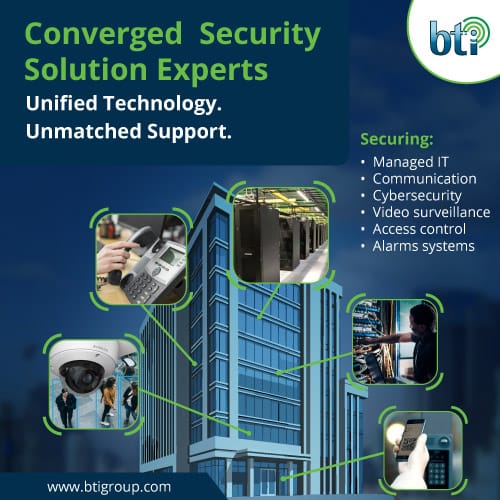
BTI’s position is straightforward: if your environment is connected, your accountability is connected. That is why converged security, meaning IT and physical security integration under one engineered strategy, is quickly becoming the standard.
What “Siloed IT and Security” Actually Means
Siloed security is not just an org chart issue. It is a visibility and accountability problem.
It usually looks like this:
- Your MSP manages endpoints, servers, cloud, and help desk, but does not manage cameras, badge readers, IoT devices, or smart building systems.
- Your security integrator installs cameras and access control, but is not responsible for patching, identity governance, centralized logging, or cyber compliance requirements.
- Your compliance effort relies on policies and checklists, but lacks continuous monitoring, evidence retention, and technical verification.
In regulated or high-revenue organizations, that separation becomes a liability because modern audit standards evaluate scope based on access paths and evidence, not vendor contracts.
Why This Is Getting Worse in 2026
Three forces are converging:
1) IoT and physical security devices now sit on business networks
Cameras, access control, intercoms, building systems, sensors, and “smart” devices are not isolated from the network any more. They are endpoints with credentials, firmware, remote access requirements, and network reach.
2) Compliance frameworks demand evidence, not intentions
CMMC and NIST 800-171 emphasize technical controls, documentation, and verification. California privacy obligations, including CCPA/CPRA expectations, continue to elevate security governance. The question becomes, “Can you prove enforcement,” not, “Do you have a policy.”
3) Attacks scale faster than most teams
Automation, credential abuse, and phishing-driven identity compromise reduce the time between exposure and exploitation. Organizations with fragmented ownership typically respond slower, and they struggle to demonstrate defensibility afterward.
The Four Failure Patterns Auditors Need to Focus on That Attackers Exploit
Most organizations do not fail because they lack technology. They fail because controls are fragmented, inconsistently enforced, and difficult to prove.
1) “It’s Out of Scope” Until It Is Not
Many providers try to reduce responsibility by labeling IoT or physical security devices as “out of scope.” That might simplify vendor statements, but it does not simplify audit reality.
Under CMMC compliance and NIST 800-171 expectations, if an IoT device has network reach to systems that touch sensitive or regulated data, it becomes part of the risk conversation quickly. In practice, an unsecured camera on a production network can create audit findings and real access risk.
2) Physical Security Vendors Are Rarely Built for Cyber Governance
Physical security installers often do excellent work with doors and cameras, but compliance risk typically lives elsewhere:
- Default or shared credentials
- Undocumented remote access methods
- Firmware drift and unsupported lifecycle
- Lack of centralized logging and retention
- No defined ownership for patching and access review
When these systems are not managed like IT assets, they become the easiest entry points and the hardest to defend after the fact.
This is also where Federal and state law provisions such as California’s SB-327’s “reasonable security” standard are used by plaintiff attorneys and insurance carriers for lawsuits and insurance coverage denial. A compromised device that is deployed without provable evidence of that “reasonable security” may become a basis for both liability and insurance claim denial.
3) vLAN Segmentation Without Monitoring Creates a False Sense of Safety
Segmentation is necessary. It is not sufficient. A common mid-market IT approach is to put IoT devices on a vLAN and consider the job finished. In theory, this is secure. In practice, when an unexpected breach occurs, liability may exist without corresponding insurance protection.
4) Checklist Compliance Breaks Under Verification
Some organizations rely on self-assessment checklists without technical validation, evidence retention, and operational enforcement. That approach creates exposure when contracts, insurance, or regulated obligations require proof after a claim is made.
The business risk is not theoretical. Misalignment between documented posture and actual posture can create serious contractual and legal exposure, especially when compliance claims are tied to eligibility for regulated work and official reporting.
The BTI View: Converged Security Is an Operating Model
At BTI, converged security means your cyber and physical security systems are engineered to operate as one accountable environment.
That includes:
- Infrastructure-led segmentation aligned to real data flows
- Identity and credential governance across users, devices, and administrators
- MDR cybersecurity coverage designed to reduce endpoint and credential risk across the environment
- SIEM logging and correlation that creates audit-ready evidence
- Operational playbooks, response workflows, and governance routines that stay active
- For regulated organizations, this supports a single, evidence-ready security posture, including a System Security Plan approach that reduces audit friction and eliminates “vendor gaps.”
The goal is straightforward: eliminate blind spots, reduce vendor sprawl, improve response speed, and make compliance defensible.
What Regulated and High-Revenue Organizations Must Be Able to Prove
If you want to pressure-test whether your current model is defensible, focus on proof.
Identity and access
Can you show MFA enforcement, privileged access oversight, and disciplined offboarding?
Patch and lifecycle control
Can you show patch status and vulnerability closure tracking across endpoints, servers, network devices, and IoT device security systems?
Monitoring and retention
Can you show centralized logging, meaningful alerts, and retention appropriate to your obligations?
Backup and recovery readiness
Can you show restore testing results, not just backup status?
Incident response maturity
Can you show a real plan, real roles, and evidence of tabletop exercises or response validation?
When auditors or insurers ask, “Show us,” you should not have to assemble proof from five vendors and three dashboards.
Why Organizations Choose BTI
BTI is built for organizations that need outcomes, not tool sprawl.
We deliver:
- Managed IT services that are infrastructure-led and engineered for resilience
- Cybersecurity services designed around enforcement, monitoring, and audit defensibility
- Converged security that unifies physical and cyber systems under one accountable model
- Local execution capability and operational maturity, including escalation and governance cadence
- The result is reduced risk, reduced operational friction, and a compliance posture you can prove.
BTI’s Infrastructure-Led Method for Converged Compliance Readiness
BTI’s approach is designed to be practical for mid-market and lower-enterprise organizations, including regulated environments.
Step 1: Discovery and scope mapping
We identify regulated data paths, critical systems, and the devices that create network reach, including IoT devices and physical security systems.
Step 2: Segmentation engineered for containment
We design segmentation around risk, not convenience, and we validate that segmentation reduces lateral movement opportunities.
Step 3: Unified monitoring with SIEM correlation
We integrate logging and monitoring so security events can be correlated across endpoints, identity, cloud, and IoT zones.
Step 4: MDR and response operations
We align detection and response, so alerts become containment workflows, not just notifications.
Step 5: Evidence-ready governance
We operate reporting, access reviews, patch evidence, training metrics, and incident readiness, so compliance stays continuously defensible.
Executive Checklist: Five Questions That Reveal Silo Risk Fast
- Are cameras, badge readers, and IoT systems managed like IT assets, including patching, credentials, and access review?
- Are IoT and physical systems truly isolated from regulated data paths, with controls enforced and documented?
- Do your IoT zones feed logs into centralized monitoring, and are those logs retained and reviewed?
- Can you produce compliance evidence within 24 hours, including MFA enforcement, access reviews, restore tests, and incident response readiness?
- When something breaks, is there one accountable partner, or do vendors point fingers?
If any of these answers are unclear, the risk already exists.
Identify Blind Spots Before an Audit or Incident Finds Them
If you are preparing for CMMC, dealing with customer security requirements, managing California privacy exposure, or simply trying to reduce liability, BTI can help you evaluate whether siloed delivery is creating compliance risk.
If You Can’t Prove Control, You Carry the Risk.
Siloed IT, cybersecurity, and physical security create gaps auditors, insurers, and attackers exploit. BTI evaluates where accountability breaks down and delivers an evidence-ready, converged security strategy built to stand up to audits and incidents.