



Software House C•CURE by Johnson Controls: The Enterprise Standard for High-Security, Global Access Control (ISC West 2026 Update)
In today’s security market, many platforms are evolving toward simplicity, cloud-first deployment, and ease of use.
But for a different class of organization—global enterprises, massive critical infrastructure operators, ultra high security government agencies, high tech operations with extremely high value data center assets, and highly regulated industries—the requirements are fundamentally different.
These environments demand:
Extreme scalability across distributed operations
Deep integration across systems and security application and device types
Alignment with the highest level of cybersecurity and site security compliance frameworks
Long-term stability and control
At ISC West 2026, Johnson Controls and Software House reinforced their position as the leading platform for these high-security, mission-critical environments through continued evolution of the C•CURE ecosystem.
This is not a platform optimized for simplicity. It is engineered for control, resilience, and operational precision at scale.
Built Over Decades: A Platform Refined Through Real-World Deployment
One of the defining characteristics of Software House C•CURE is the amount of time and operational experience behind it.
Over decades of deployment across the largest and most demanding environments in the world, the platform has been:
Continuously refined
Hardened against both physical and cyber threats
Adapted to evolving compliance and regulatory requirements
Proven across global military, pharmaceutical, critical industry, and data center high-security installations
This represents tens of millions of operational hours across environments where the cost of failure is extreme.
That level of maturity is difficult to replicate, and it shows in how the platform performs in real-world national and global organizations.
Ownership and Platform Stability: Backed by Johnson Controls
As part of Johnson Controls, Software House benefits from:
Long-term investment and research and development
Integration across security, building systems, and infrastructure
Global deployment and support capabilities
A consistent presence in the largest enterprise and government markets
For organizations operating critical environments, this level of stability matters.
These are systems expected to operate for decades, not short-lifecycle deployments. Software House scale deployments span decades of growth and maturity for their largest customers and there’s no turning back for these clients.
Software House C•CURE: Engineered for Extreme Scale and Control
Software House C•CURE, including C•CURE 9000 and the evolving IQ platform, is designed for environments that require massive scale, granular control, complex policy enforcement, and distributed global operations.
Its architecture supports:
Up to 5,000 readers per single server
Up to 1,000,000 credentials natively
A master application server plus up to 60 satellite application servers
Distributed systems with centralized oversight and localized control
Multi-layered security zones, policies, and workflows
This architecture enables deployments that can support:
Global enterprises and campuses
National infrastructure systems
Multi-region government operations
Extremely large estates spanning thousands to hundreds of thousands of access-controlled doors
Unlike simplified systems, this platform is built for environments where complexity is inherent, not optional.
ISC West 2026: Expanding Into a Unified Security Operations Platform
These updates reflect a broader industry shift from access control systems to integrated security operations environments.
C•CURE IQ 3.2: Browser-Based Unified Control
C•CURE IQ 3.2 introduces a more streamlined, browser-based interface that brings together:
Access control
Video surveillance
Event monitoring
Real-time response
This improves how organizations:
Monitor events at scale
Investigate incidents
Coordinate response across locations
The result is a system that supports both security control and operational awareness.
C•CURE IQ VMS: Native Video Integration
The introduction of C•CURE IQ VMS embeds video directly into the platform.
This enables:
Unified access and video workflows
Simplified operator experience
Consolidation of monitoring environments
At the same time, Software House continues to support:
Third-party video systems
Open integration with existing infrastructure
This balance between native capability and integration flexibility is critical in large environments.
C•CURE IQ Incident Management: Structured Response at Scale
C•CURE IQ Incident Management introduces workflow-driven response capabilities, including:
Automated incident creation
Decision trees and escalation paths
Standardized response procedures
Enhanced audit and reporting capabilities
This represents a shift from event monitoring to managed operational response.
In high-security environments, this directly improves:
Response speed
Consistency across teams
Compliance and audit readiness
Integration Depth: Access Control as a Core System
Software House is not designed to operate in isolation.
It integrates deeply with:
Video surveillance systems
Intrusion detection platforms
Identity and credentialing systems, including HID and converged credentials
Building management systems
Enterprise IT and cybersecurity infrastructure
This enables access control to function as a central system within a broader converged security architecture.
For many large organizations, that level of integration is not a convenience. It is a requirement.
Cybersecurity, Data Control, and Infrastructure Alignment
In high-security environments, physical security cannot be separated from cybersecurity.
Software House supports:
Segmented, controlled system architectures
Alignment with enterprise cybersecurity frameworks
Detailed logging and auditability
Integration with identity and access management systems
In many deployments, this aligns with broader infrastructure strategies that include:
Hardened hosting and data center environments
Controlled operational models
High-security cyber practices
Tight oversight of data, credentials, and system availability
This is particularly relevant for organizations operating under:
Government standards
Regulatory compliance requirements
Internal security governance frameworks
Identity-Driven Security and the Role of HID Converged Credentials
As identity becomes central to security, Software House continues to align with:
Enterprise identity systems
Advanced credential technologies such as HID’s converged credentials
Role-based and policy-driven access control
This supports the broader shift toward identity-driven, converged security models across physical and digital environments.
For regulated and security-sensitive environments, this is a major strategic advantage.
AI and Operational Intelligence
With the introduction of unified video and incident workflows, the platform is also evolving toward:
AI-assisted monitoring and detection
Cross-system event correlation
Operational decision support
This reflects a broader trend: security systems becoming intelligent operational platforms, not just monitoring tools.
The addition of incident management workflows and unified video integration reinforces the platform’s evolution toward operational intelligence, where systems support decision-making rather than simply recording activity.
Where Software House Fits in the Modern Security Landscape
Different platforms serve different needs.
Software House is typically selected for environments that require:
Maximum control and customization
Deep integration across systems
On-premise or hybrid deployment models
Alignment with IT, cybersecurity, and compliance
Other platforms may be better suited for:
Simpler environments
Rapid deployment scenarios
Fully cloud-managed systems
The key is understanding which platform aligns with the organization’s operational reality, security posture, and long-term obligations.
Operational Execution: From Design to Long-Term Performance
Platforms at this level require:
Detailed architectural design
Integration planning across systems
Coordination between security, IT, and operations teams
Ongoing management and optimization
This often involves:
Centralized engineering and design
National or global deployment strategies
Remote monitoring and support
On-site service and field operations
In complex environments, success is not determined by the platform alone, but by how it is designed, implemented, and operated over time.
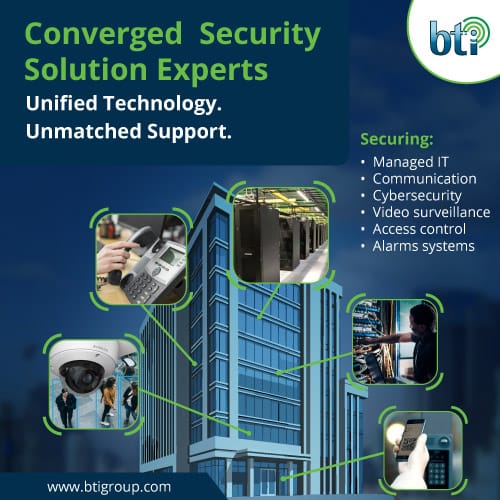
BTI’s Role: Converged Security, Infrastructure-led Managed IT, and proactive remote and field service support
For organizations deploying or supporting platforms like Software House, the access control system is only one part of the operating environment.
What often determines long-term success is the ability to coordinate:
Physical security architecture
IT infrastructure
Cybersecurity operations
Identity and access governance
Field deployment and support operations
BTI’s model is built around that reality.
This includes capabilities across:
- Software House Solutions
National field operations, installation, service, and support
Hardened data center operations in our co-located Iron Mountain Phoenix Data Center
That blend is particularly relevant in environments where Software House is typically deployed, because these systems often depend on the surrounding IT, cyber, and operational ecosystem just as much as on the access control software itself.
A Vendor-Neutral, Converged Security Approach
Most large organizations operate across multiple platforms, legacy systems, and technologies.
That requires:
Vendor-neutral evaluation of solutions
Cross-platform expertise
Alignment between physical security, IT infrastructure, and cybersecurity
This is where converged security and co-managed IT models play an important role, helping ensure systems operate cohesively rather than in silos.
In practice, that often means evaluating Software House alongside other enterprise, cloud, and open-architecture platforms based on the environment, not ideology.
Final Takeaway: When Security Requirements Are Highest, Depth Matters
As the industry continues to evolve, Software House C•CURE remains a critical platform for environments where:
Security requirements are highest
Compliance and auditability are essential
Integration across systems is required
Long-term stability is a priority
Large-scale distributed operations must be managed reliably
While other platforms emphasize simplicity and speed, Software House continues to represent depth, control, and enterprise-grade capability at global scale.
Next Step
Organizations evaluating enterprise access control platforms may benefit from:
Assessing operational and regulatory requirements
Evaluating integration and infrastructure strategies
Comparing deployment models across platforms
Determining how access control, IT, cybersecurity, and field operations will be supported over time
Ready to Evaluate Enterprise-Grade Access Control?
BTI Communications Group works with organizations across the United States to design, deploy, support, and optimize security systems aligned with infrastructure, cybersecurity, compliance, and long-term operational requirements.