


Cybersecurity in 2026 is no longer a set of tools or annual projects. It is a continuous operating model that combines SIEM, SOC, vulnerability management, GRC, AI governance, privacy protection, incident readiness, and co-managed IT to reduce risk, improve resilience, and meet rising insurance and compliance requirements.
In This Guide
What cybersecurity actually requires in 2026
Why SIEM, SOC, GRC, AI governance, and co-managed IT now work together
How mid-market organizations (50–300 users) can meet these requirements without overbuilding internally
Cybersecurity in 2026: A New Operating Reality
Cybersecurity has crossed a critical threshold.
It is no longer a perimeter or a project. It is a continuous, converged operating system spanning:
endpoints and identity
cloud and SaaS platforms
networks and infrastructure
communications (VoIP and collaboration tools)
physical security systems
vendors and third parties
AI usage and automation
regulatory and compliance frameworks
For mid-market organizations, this shift is not theoretical. It directly impacts:
cyber insurance eligibility and claims approval
audit outcomes and customer requirements
legal exposure across multiple states
operational continuity and downtime risk
Organizations with fragmented tools and reactive processes are increasingly exposed.
The Core Components of Modern Cybersecurity (and What Happens Without Them)
Cybersecurity in 2026 must function as an integrated system. Each component plays a critical role—and each introduces real risk if missing.
Endpoint Detection & Response (EDR)
If it’s in place:
Threats are detected, isolated, and contained quickly.
If it’s missing:
Malware spreads silently, often leading to full ransomware events.
SIEM (Security Information & Event Management)
If it’s in place:
Logs are centralized and correlated, enabling early detection.
If it’s missing:
Critical events remain isolated and unnoticed across systems.
24/7 SOC (Security Operations Center)
If it’s in place:
Alerts are triaged immediately and incidents are investigated in real time.
If it’s missing:
Threats sit unresolved, giving attackers time to escalate.
Vulnerability Management & Patching
If it’s in place:
Known weaknesses are identified and remediated continuously.
If it’s missing:
Attackers exploit known vulnerabilities that could have been prevented.
Identity & Access Control (MFA, Zero Trust)
If it’s missing:
Stolen credentials become the easiest path into the organization.
Email & SaaS Security
If it’s missing:
Phishing and account compromise drive financial loss and breaches.
Security Awareness Training
If it’s missing:
Employees unintentionally become the primary attack vector.
Log Visibility & Retention
If it’s missing:
Incidents cannot be reconstructed, and organizations cannot prove control effectiveness.
Governance, Risk & Compliance (GRC): From Policy to Proof
Cybersecurity is no longer judged by policies—it is judged by evidence.
A mature GRC system provides:
control mapping (NIST, CIS, HIPAA, CMMC, ISO)
policy governance and ownership
risk tracking and remediation (POA&M)
vendor risk management
audit-ready reporting
continuous evidence collection
If GRC is in place:
Audits, insurance reviews, and customer assessments become routine.
If it’s missing:
Organizations scramble for documentation and fail to demonstrate control maturity.
Explore how structured compliance IT services support this model.
Continuous Validation: Penetration Testing, Remediation, and Incident Readiness
Cybersecurity has evolved from assumed protection to verified protection.
Penetration Testing
If it’s in place:
Real-world attack paths are identified before attackers find them.
If it’s missing:
Hidden vulnerabilities persist undetected.
Remediation & Retesting
If it’s in place:
Issues are tracked, fixed, and validated.
If it’s missing:
Security gaps accumulate over time.
Incident Response Planning
If it’s in place:
Teams respond quickly and effectively under pressure.
If it’s missing:
Confusion and delays increase the impact of incidents.
Continuous Evidence Collection
If it’s in place:
Organizations can prove compliance and support insurance claims.
If it’s missing:
Claims may be denied, and legal exposure increases.
AI Governance & PII Protection: The New Cybersecurity Frontier
AI is now part of cybersecurity.
Organizations must control how data is used, processed, and exposed through AI tools.
Why This Matters More Than Ever
Organizations over ~$25M in revenue—or operating across multiple states—face:
20+ state privacy laws in 2026
enforcement based on where the individual resides
overlapping legal obligations and exposure
Risks Without AI Governance
sensitive data leakage through AI tools
unauthorized data processing
lack of auditability
compliance violations
Risks Without PII Protection
regulatory fines
lawsuits
reputational damage
cyber insurance complications
Required Controls
data classification
least-privilege access
AI usage policies
monitoring and logging
vendor governance
data loss prevention (DLP)
continuous evidence
The Financial Reality: Internal IT vs. Co-Managed Cybersecurity
The biggest challenge is not understanding cybersecurity requirements.
It is operating them effectively and affordably.
Option 1: Build Internally
Typical requirements:
IT leadership
systems/network admin
security engineer
helpdesk staff
compliance support
Estimated annual cost:
50 users: often under-resourced
100 users: $300K–$500K+
200 users: $450K–$700K+
300 users: $600K–$900K+
Plus tooling:
$50K–$250K+ annually
Even at this level, many organizations still lack:
24/7 monitoring
integrated GRC
continuous validation
executive reporting
Option 2: Multiple Vendors
This creates:
fragmented accountability
duplicated costs
inconsistent reporting
security gaps
Option 3: Converged Co-Managed Model
This is where the market is shifting.
A co-managed model combines internal IT with an integrated external operating system.
How Co-Managed IT Works in 2026
A modern co-managed model includes:
PSA (ticketing & workflow)
RMM (endpoint management)
SIEM + SOC (security monitoring)
NOC (infrastructure monitoring)
helpdesk support
vulnerability management
compliance and reporting
This creates a shared responsibility model where:
internal IT retains control and business context
the provider supplies tools, monitoring, and depth
Explore BTI’s approach to managed IT services and cybersecurity services.
What This Looks Like at Different Sizes
50 Users
Enterprise-grade tools without enterprise payroll.
100 Users
Internal IT augmented with continuous monitoring and compliance support.
200 Users
Stronger governance, reporting, and operational maturity.
300 Users
Enterprise-level visibility and resilience without enterprise overhead.
How BTI Changes the Equation
BTI delivers a converged operating system, not just services.
This includes:
always-on PSA, RMM, SOC, NOC, SIEM
vulnerability management and patching
GRC and evidence systems
penetration testing coordination
AI governance frameworks
compliance and reporting
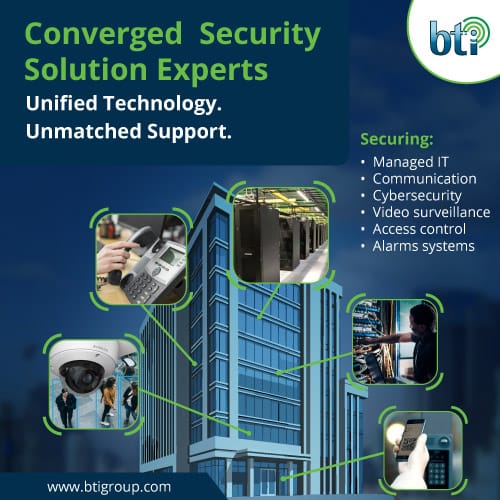
converged IT + cyber + physical security
This model:
extends internal IT
improves visibility and reporting
strengthens compliance posture
reduces cost through scale and automation
Explore the converged security model.
What Mid-Market Leaders Are Realizing in 2026
The challenge is no longer identifying risks.
It is operating cybersecurity in a way that is:
continuous
affordable
defensible
visible
This is why organizations are moving toward converged, co-managed, always-on models.
Key Takeaways
Cybersecurity is now a continuous operating system
Missing controls create real business risk
SIEM + SOC provide visibility and response
GRC provides proof and defensibility
Penetration testing validates security
AI governance and PII protection are now required
Multi-state privacy laws increase exposure
Co-managed IT is the dominant model
Scale improves both outcomes and cost
Frequently Asked Questions
What does cybersecurity include in 2026?
Cybersecurity includes endpoint protection, SIEM, SOC, vulnerability management, MFA, email security, awareness training, GRC, vendor risk management, AI governance, PII protection, incident response, and continuous evidence collection.
What is co-managed IT?
A shared model where internal IT works alongside an external provider that delivers tools, monitoring, security operations, and specialized expertise.
Why is AI governance part of cybersecurity?
Because AI systems can expose or misuse sensitive data, requiring controls, monitoring, and policy enforcement.
Why are privacy laws important?
Because breaches and poor controls can trigger regulatory action, lawsuits, and insurance issues across multiple states.
Why do mid-market companies struggle with cybersecurity?
Because they often lack the staff, tools, and continuous monitoring required to operate a modern cybersecurity program internally.
Final Perspective
Cybersecurity in 2026 requires more than point solutions.
It requires:
visibility
governance
validation
accountability
continuous operation
For mid-market organizations, the real challenge is delivering all of that without building an oversized internal organization.
That is why the market is shifting toward converged, co-managed models.
Final Recommendations
If your organization is ready to move from fragmented tools and reactive support to a continuous, evidence-driven operating model, explore BTI’s cybersecurity services, managed IT services, compliance IT services, and unified converged security approach.
Need Help Navigating Security Compliance Requirements
BTI helps organizations simplify cybersecurity, compliance, and physical security into a unified protection strategy.