



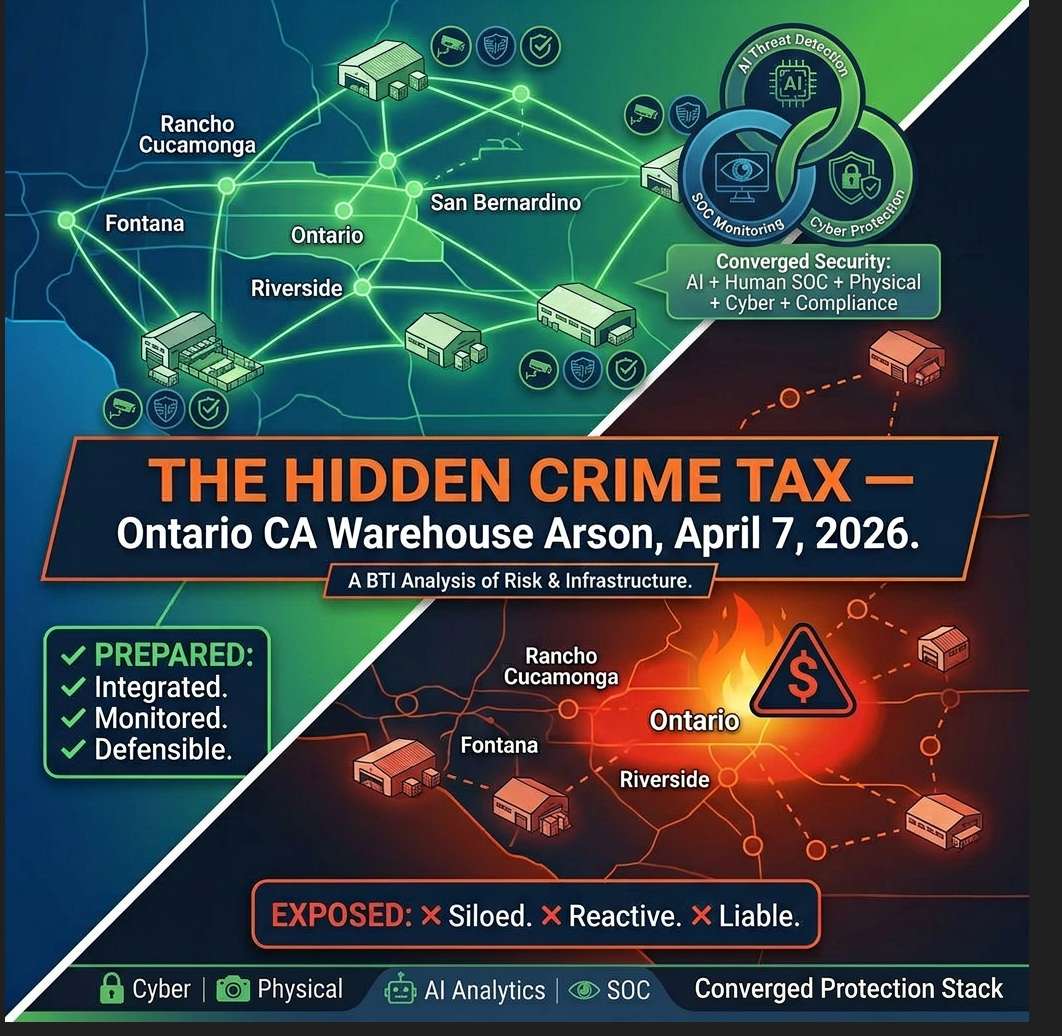
Key Takeaways
- ✅ Arson incidents are rising in commercial areas, creating significant financial and operational risks for businesses in regions like Ontario, CA.
- ✅ Small and mid-sized businesses are especially vulnerable due to limited security infrastructure and disaster recovery planning.
- ✅ Insurance alone is not enough, many policies have gaps, delays, or exclusions that can leave businesses exposed after an incident.
- ✅ Proactive security measures such as surveillance systems, access control, and monitoring can significantly reduce risk and improve claim outcomes.
- ✅ Business continuity planning is critical to minimize downtime, protect assets, and maintain operations after a fire-related event.
- ✅ Partnering with a security provider like BTI helps businesses integrate physical security, risk mitigation, and compliance into a unified strategy.
Introduction: It’s Not About Prevention, It’s About Preparedness
The April 7, 2026 arson at the Kimberly-Clark distribution center in Ontario, California wasn’t random. An employee of third-party operator NFI Industries allegedly live-streamed himself igniting pallets of paper goods, complaining about wages, before the 1.2 million square foot facility was largely destroyed. No one was injured, but the financial and operational fallout will be measured in hundreds of millions.
This incident is a stark reminder for logistics, manufacturing, and distribution businesses across the Inland Empire: Not every event can be prevented. What you can control is how early risks are identified, how quickly you respond, and whether your organization is protected—or exposed—after it happens.
This is where the Hidden Crime Tax becomes painfully real. It’s not just the flames or the physical damage. It’s the delays, downtime, insurance disputes, operational chaos, and long-term cost escalation that follow.
The Hidden Crime Tax: Where Businesses Really Lose Money
In events like the Ontario warehouse arson, the visible destruction is only part of the story. The larger exposure comes from:
- Incomplete or missing footage and logs
- No clear timeline of events or access records
- Inability to prove that security controls were in place and functioning
- Gaps between IT, cybersecurity, physical security, and operations
- Insurance carriers questioning due diligence
Many organizations end up with denied or severely reduced claims due to perceived negligence or lack of documented controls. Modern insurers and compliance frameworks (especially in high-risk California logistics hubs) expect proof of active monitoring, maintained systems, and consistent oversight—not assumptions.
As we outlined after the copper theft and vandalism wave at Los Angeles’ 6th Street Bridge, the Hidden Crime Tax hits Southern California businesses through higher insurance premiums, unplanned downtime, emergency repairs, and reputational damage.
What Actually Matters: Detection, Mitigation, and Defensibility
The smarter question isn’t “How do we stop every incident?” It’s “How do we identify suspicious behavior and reduce impact so that we can prove we did everything reasonably expected?”
Three critical capabilities make the difference:
-
Early Signal Detection (Before an Event)
Most incidents, including insider threats, show warning signs: repeated after-hours activity, access anomalies, perimeter issues, or network irregularities. Integrated systems let you correlate access control, video surveillance, and IT/network logs to spot patterns and elevate readiness. This doesn’t eliminate risk but dramatically improves awareness and response time.
-
Impact Mitigation (During an Event)
Speed matters. In a converged environment, alerts trigger automated workflows across IT, security, and operations—reducing damage scope, downtime, and safety risks. Fragmented silos lead to missed alerts and manual delays.
-
Defensibility (After an Event)
This is where most organizations falter and the Hidden Crime Tax balloons. Post-incident, you must clearly show what happened, when, which controls were active, how systems were maintained, and what response actions were taken. This documentation is now essential for insurance claims, compliance audits, legal protection, and executive accountability.
Why Fragmentation Increases Risk and Liability in the Inland Empire
Logistics and warehouse operations in Ontario, Fontana, Rancho Cucamonga, Riverside, and San Bernardino often run in silos: IT handles networks, security manages cameras and access, facilities oversees physical sites. The result? Blind spots, unclear ownership, inconsistent records, and heightened liability when something goes wrong—like the Ontario arson.
The Role of Converged, Infrastructure-Led Managed Services
Across Southern California, forward-thinking organizations are shifting from “more security tools” to better operational alignment. This means:
- Security Systems Integrated with Co-Managed IT Services
- Converged Security Operations (cyber + physical)
- Infrastructure-led continuous lifecycle management
BTI’s model integrates IT systems, cybersecurity (SIEM, MDR, SOC), physical security (cameras, access control, gunshot/flood detection), communications, and compliance/GRC into a unified, defensible environment. The goal: reduce impact, increase visibility, and ensure you can prove controls were working.
The AI Trap: Why Technology Alone Isn’t Enough
Many turn to AI video analytics or automation for warehouse security. Without clean infrastructure, integrated systems, defined workflows, and governance, AI creates alert fatigue, false positives, and team burnout. AI works best layered on top of stable, converged foundations.
Burnout: The Silent Risk Multiplier
Disconnected systems and constant manual alerts wear down IT and security teams. When capacity is stretched, response slows during critical moments. BTI’s co-managed and infrastructure-led frameworks specifically address human capacity limits to maintain consistent service quality and resilience.
The Shift in Thinking: Prevention + Preparedness
The most effective Inland Empire businesses focus on spotting risk early, mitigating impact, and proving due diligence. Resilience beats perfection. As detailed in BTI’s 2026 SoCal IT Manifesto, the future is infrastructure-led, converged signals and response, continuously managed, and aligned to real business and compliance risks—not project-based or point solutions.
The BTI Perspective: A Practical Model for Southern California
BTI’s compliance and GRC approach makes controls visible, trackable, and provable. We help logistics and distribution clients in the Greater Los Angeles area—including the Inland Empire—unify systems, close operational gaps, and create environments that deliver predictable outcomes.
Conclusion: The Risk Is the Event And the Aftermath
Incidents like the Ontario Kimberly-Clark warehouse arson will continue in high-volume logistics corridors. The difference between manageable disruption and catastrophic loss comes down to visibility, rapid response, documentation, and operational alignment.
The Hidden Crime Tax isn’t inevitable. It’s what happens when preparation falls short.
Ready to Strengthen Your Defensibility?
BTI serves businesses across Los Angeles County, the Inland Empire, and Southern California with converged technology solutions tailored to regulated and high-risk environments.
About BTI BTI is a Southern California-based Converged Technology Partner delivering:
-
Physical Security Systems (cameras, access control, AI analytics)
We help organizations reduce risk, mitigate impact, and operate with systems that are not only secure but defensible.
FAQ Section
What was the Ontario Kimberly-Clark warehouse arson?
On April 7, 2026, a fire—allegedly set by an insider—destroyed much of a 1.2 million sq ft distribution center in Ontario, CA, causing massive property and business interruption losses.
How can businesses avoid insurance claim denials after an arson or vandalism incident?
By maintaining integrated logs, video, access records, and documented controls that prove due diligence. Insurers increasingly require this evidence.
What is the Hidden Crime Tax?
The indirect costs of crime—higher premiums, downtime, repairs, and liability—that often exceed the direct damage. See our earlier post on the 6th Street Bridge vandalism for more examples.
How does converged security help warehouses in the Inland Empire?
It unifies IT, cyber, physical security, and operations for faster detection, automated response, and provable compliance.