
The Complete 2026 Cybersecurity Guide for SIEM, SOC, GRC, Co-Managed IT, AI Governance & Compliance
Cybersecurity in 2026 is no longer a set of tools or annual projects. It is a continuous operating model that combines SIEM, SOC, vulnerability management, GRC, AI governance, privacy protection, incident readiness, and co-managed IT to reduce risk, improve resilience, and meet rising insurance and compliance requirements.
Downloadable Resource Guide to Managed and Co-Managed IT
Video Companion to the Downloadable Resource Guide to Managed IT
Full Video Transcript
Video Transcript
Welcome to the 2026 Strategic Advisory Guide by BTI Communications Group. This executive guide focuses on managed IT, cybersecurity, and operational scalability for organizations over 50 people or those in particular industries like healthcare, manufacturing, financial services, or logistics.
This publication addresses the IT management concerns of ownership, C-level executives, IT Directors, and operations leaders in healthcare, manufacturing, logistics, and regulated industries. The content is advisory and not legal counsel.
Fast-growing and multi-site organizations in regulated industries like healthcare, financial services, manufacturing, and logistics with IT-related operational issues, or those struggling to understand new regulations or contracts with IT dependencies, will want to listen to what we have to offer.
Our goal in this document is to explain what quality and operational excellence look like in 2026 managed IT services. The sections we will cover in this highlight video include managed infrastructure and IT, cybersecurity, converged security, identity, compliance, and AI-ready infrastructure. Let’s explore how unified infrastructure support can transform your organization.
Welcome to our discussion on the case for unified infrastructure. We’ll explore how integrating IT, cybersecurity, VoIP, physical security, and compliance management under a phased-in managed or co-managed partner like BTI enhances performance and reduces risks for modern organizations.
Organizations benefit greatly over time from BTI’s unified infrastructure project and support performance. With over 40 years of experience, vendor and customer relationships, BTI offers best-of-breed products, pricing, design, engineering excellence, and support, plus low-cost managed or co-managed service tailored to each client’s needs. BTI’s approach prevents problems across several otherwise disconnected technology domains, ensuring reliability and accountability across all covered technology layers for significantly less than the cost of trying to manage all that in-house.
Growing organizations outgrow small IT managed service providers when operational failures impact the business. During growth stages, any weakness becomes a slowdown or a stoppage at the worst times. What was once acceptable Wi-Fi, network, phone, cybersecurity, or compliance work can quickly become unacceptable during growth. BTI’s unified support model addresses these challenges with comprehensive field assessments, infrastructure expertise, and proactive support to help your company avoid unnecessary pitfalls.
Organizations often miss the gradual signs of outgrowing their IT provider. Issues like Wi-Fi disconnects, VoIP degradation, and unmanaged switches indicate a support model lagging behind business needs. These are not just IT problems, but business continuity challenges requiring a support model designed for current complexities to ensure reliability and scalability.
Organizations often outgrow their managed service provider gradually. Key signs include a vendor unable to meet growing demands on time, issues closed without root-cause resolution, or inconsistent support quality. Transitioning to a more capable partner can eliminate these challenges.
Siloed IT, security, and VoIP vendors create significant risks as well. Documentation failures and escalation delays compound issues, leading to costly business disruptions. Consolidating vendors can mitigate these risks effectively.
An operationally mature managed IT partner excels in six key areas: structured documentation, proactive monitoring, layered cybersecurity, consistent multi-site execution, defined escalation paths, and compliance-ready reporting. These capabilities ensure reliable service, security integration, and governance support. Always request evidence of these capabilities when evaluating potential partners to ensure true operational maturity.
Modernization should be incremental, not all-or-nothing. Start by addressing immediate disruptions, stabilize the environment, and document progress. Add targeted support to ease burdens, then expand as trust builds. This phased approach reduces risk and ensures each improvement is validated before moving forward, enhancing reliability and productivity across operations.
Unified infrastructure support can include networking, cybersecurity, VoIP, cloud, and endpoints in one cohesive model. Unlike traditional managed service providers, BTI’s model ensures recommendations enhance performance and reduce risk with itemized, fixed-cost work and consistent quality standards. This leads to clearer ownership, deeper visibility, and consistent outcomes, ultimately improving business operations and accountability.
Achieving the lowest qualified price requires transparency. Without visibility into provider operations, costs from downtime and rework can outweigh savings. BTI offers both line-item price and quality transparency. BrightGauge dashboards and structured reporting are included, enabling informed client decisions. ISO 27001 compliance, transparent pricing, and fixed-cost sole-source scoping support dependable delivery and project outcomes with shared support responsibility roles clearly defined.
Infrastructure partnerships grow by solving real problems, proving value, and earning trust. Start with specific issues like Wi-Fi application performance improvement, network projects, or security projects. Expand into VoIP or other areas as your needs evolve. Our goal is to deliver measurable value at each stage, avoiding overspend or overcommitment while fostering a coherent operating model and trusted partnership.
Converged security operations integrate cybersecurity, physical security, identity, and operational monitoring into a unified, secure framework. This approach ensures access control, cameras, VoIP, and connected devices are managed cohesively, reducing risk and maintaining uptime. Without clear ownership, gaps form, leading to disruptions. BTI’s scope may include addressing these challenges while simultaneously improving physical security system performance.
Modern security systems require IT infrastructure expertise because they operate on the same networks as business operations. Most security industry agreements disown responsibility for privacy, cyber, liability, or compliance requirements. BTI is a nationally recognized leader in security, access control, and surveillance systems because we are moving in the opposite direction. Unified ownership ensures control, visibility, and accountability, preventing outages and maintaining real security and compliance.
Enterprise identity and credential management is increasingly a compliance and operational requirement for any business that is subject to state and federal privacy laws or regulations, and for customers who inherit liability in contracts. BTI’s approach integrates effective identity governance whenever identity management is in scope.
Access control, visitor management, and structured oversight are vital for enterprise readiness. Effective organizations maintain documented access policies, manage badge lifecycles, and ensure visitor access is tracked and auditable. Consistency across sites is crucial, with uniform governance standards applied to all locations, supporting compliance and security oversight. Structured management prevents access control gaps, ensuring robust enterprise security.
Emergency communication systems must be integrated with a robust network and power infrastructure to ensure operational continuity. Mapping dependencies, integrating VoIP and paging, and validating wireless coverage are crucial. Redundancy and failover planning are essential to maintain communication during emergencies, ensuring resilience across all sites.
Security system cybersecurity and OT/IoT segmentation are crucial as devices like cameras and controllers join corporate networks. Often, these systems run outdated firmware and lack segmentation, posing risks. Addressing these gaps involves VLAN segmentation, device inventory, and lifecycle management integrated into broader IT services, ensuring secure operations and visibility across the network.
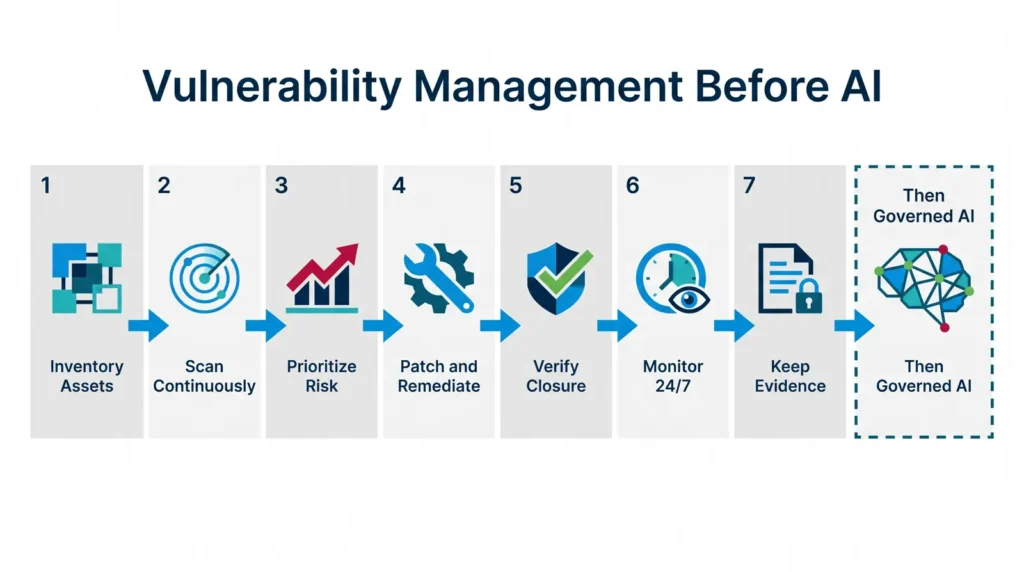
Vulnerability management and third-party validation are essential for cybersecurity operations and compliance. Effective programs require continuous scanning, prioritized remediation, and structured reporting. BTI strongly recommends quarterly third-party penetration testing, and we coordinate that for our clients at a significant discount due to volume. BTI’s structured vulnerability management and pen-test remediation services provide ongoing evidence of compliance with laws and contracts when in scope, eliminating risk and liability that otherwise may have been found too late.
Regulated entity agreements are reshaping infrastructure expectations, turning compliance into a commercial risk. Organizations face demands for documented IT posture from customers, banks, insurers, and suppliers. Failure to demonstrate operational maturity risks losing deals and insurance coverage. BTI supports readiness with structured oversight, vulnerability management, and compliance monitoring, ensuring organizations meet these evolving expectations.
AI-ready infrastructure is essential for deploying AI-enabled workflows without risking performance or security. CEOs and COOs must ensure their networks, wireless, identity, and cloud systems can handle AI workloads. Proper wireless coverage, switching capacity, network segmentation, and continuous monitoring are crucial to avoid costly disruptions and ensure operational maturity.
AI-enabled workflows fail due to inadequate infrastructure, not AI itself. Key requirements include high-density, low-latency wireless, adequate switching capacity, reliable WAN connectivity, identity governance, and continuous monitoring. These elements ensure AI initiatives deliver reliable, scalable results. BTI’s assessment process identifies infrastructure gaps to prevent deployment failures.
Sophisticated operational readiness involves a documented, managed, and auditable IT environment. Key indicators include a fully documented network, enforced multi-factor authentication, tested backup and recovery plans, and regular vulnerability scanning to prevent outages. Organizations meeting these standards are better positioned for compliance, customer trust, and AI-enabled operations. This is not just a checklist, but a reflection of operational maturity expected by customers, insurers, and auditors.
Modern operations demand systems that are reliable, secure, and scalable. Unified infrastructure support and converged security operations reduce disruptions and enhance service delivery while driving down support costs from multiple providers. Enterprise identity management and OT/IoT cybersecurity ensure robust access control and system monitoring. Compliance readiness and an AI-ready foundation support growth and governance, making organizations resilient and audit-ready.
Operational fragmentation arises when IT responsibilities drift apart, leading to lost productivity and slower recovery. Disconnected ownership across systems results in missed handoffs, compliance gaps, and team burnout. Unified governance under one accountable partner reduces friction, improves recovery, and lowers costs, creating a stronger operational foundation.
Vendor siloing in IT services creates operational risk by fragmenting ownership. Each provider manages a piece, but no one owns the outcome. This leads to slower recovery, blame-shifting, and scattered compliance evidence. A unified governance model accelerates resolution, aligns ownership, and provides leadership with clearer control.
Reactive IT operations incur hidden costs through lost throughput, delayed projects, and compliance gaps. Recurring service failures, like scanner disconnects, system failures, and VoIP issues, consume IT resources and erode confidence. Proactive management addresses root causes, reducing incidents and improving governance. BTI’s structured service delivery enhances accountability and prevents reactive cycles, fostering consistency and control.
Internal IT teams often face overwhelming demands due to scale, not talent. They juggle cybersecurity, cloud, compliance, and more, leading to slower responses and burnout. BTI’s co-managed IT model enhances internal capabilities, offering Network Operations Center monitoring, Security Operations Center support, structured documentation, 24-hour coverage, and skills augmentation, allowing teams to focus on strategic priorities without burnout.
Operational accountability is a competitive advantage, judged by buyers, insurers, and auditors. It shapes vendor selection and customer confidence. Documented IT functions enable faster recovery and smoother audits. Structured oversight strengthens resilience and supports consistent performance. Execution maturity signals trust and readiness, enhancing credibility and differentiation across the business.
Operational scalability allows technology and support models to grow without outages or hidden risks. Converged operations reduce vendor confusion and costs, enabling faster onboarding and consistent execution. Unified models lower growth costs, improve risk control, and ensure predictable service. They eliminate vendor blame, duplicate tools, and compliance gaps, delivering streamlined escalation and integrated monitoring.
A unified operational model integrates managed IT, network services, cloud operations, security, and compliance under one partner. This eliminates coordination overhead, providing cleaner escalation, sharper visibility, and a predictable operating model. Each capability is organized within a single system, ensuring seamless issue resolution and reducing the need for multiple vendor management.
BTI ensures enterprise stability, visibility, and governance, minimizing internal coordination and disruptions. Through converged technology and clear ownership, we deliver infrastructure discipline, cybersecurity, and compliance governance. This results in fewer disruptions, faster escalation, and clearer reporting, enhancing uptime and predictability across sites. Leadership should demand these controls before signing contracts to avoid future risks.
After 40 years, we’ve learned that successful organizations treat technology, security, and governance as integral, not as costs. Key traits include clear accountability, reality-based decisions, scalable standards, visibility, continuous compliance, and compounding advantages. These elements ensure growth without losing control or facing disruptions.
This guide references key frameworks like the NIST Cybersecurity Framework, CIS Controls, CMMC, HIPAA Security Rule, and more. Each provides structured guidance for cybersecurity, compliance, and governance. Organizations should consult professionals for specific implementation. Cyber insurance and AI governance are also crucial, requiring documented controls and responsible AI adoption strategies.
When selecting a managed IT or cybersecurity provider, ask about documentation ownership, escalation paths, and comprehensive cybersecurity measures. Inquire about multi-site support, compliance readiness, and leadership reporting. Understand how client relationships grow through value. These questions reveal a provider’s operational maturity beyond sales pitches.
Ready to evaluate your infrastructure and operational readiness? BTI Communications Group offers consultations to assess IT, cybersecurity, VoIP, and physical security operations. Identify gaps, risks, and consolidation opportunities for a unified infrastructure partnership. Schedule your consultation today to explore modernization and scalability solutions.
Explore BTI’s resources for detailed insights into managed IT services, cybersecurity, Cisco Meraki consulting, business security systems, VoIP installations, and compliance readiness. Each service is designed to enhance operational efficiency and security. Visit btigroup.com for more information and to schedule a consultation.
This guide offers strategic insights into cybersecurity, infrastructure, and compliance, tailored for mid-market and multi-site organizations. Recommendations should be evaluated within each organization’s unique context. Requirements for compliance vary, necessitating formal assessments. BTI’s philosophy emphasizes long-term partnerships and continuous improvement, aiming to create measurable value at every engagement stage.
In This Guide
-
What cybersecurity actually requires in 2026
-
Why SIEM, SOC, GRC, AI governance, and co-managed IT now work together
-
How mid-market organizations (50–300 users) can meet these requirements without overbuilding internally
Cybersecurity in 2026: A New Operating Reality
Cybersecurity has crossed a critical threshold.
It is no longer a perimeter or a project. It is a continuous, converged operating system spanning:
-
endpoints and identity
-
cloud and SaaS platforms
-
networks and infrastructure
-
communications (VoIP and collaboration tools)
-
physical security systems
-
vendors and third parties
-
AI usage and automation
-
regulatory and compliance frameworks
For mid-market organizations, this shift is not theoretical. It directly impacts:
-
cyber insurance eligibility and claims approval
-
audit outcomes and customer requirements
-
legal exposure across multiple states
-
operational continuity and downtime risk
Organizations with fragmented tools and reactive processes are increasingly exposed.
The Core Components of Modern Cybersecurity (and What Happens Without Them)
Cybersecurity in 2026 must function as an integrated system. Each component plays a critical role—and each introduces real risk if missing.
Endpoint Detection & Response (EDR)
If it’s in place:
Threats are detected, isolated, and contained quickly.
If it’s missing:
Malware spreads silently, often leading to full ransomware events.
SIEM (Security Information & Event Management)
If it’s in place:
Logs are centralized and correlated, enabling early detection.
If it’s missing:
Critical events remain isolated and unnoticed across systems.
24/7 SOC (Security Operations Center)
If it’s in place:
Alerts are triaged immediately and incidents are investigated in real time.
If it’s missing:
Threats sit unresolved, giving attackers time to escalate.
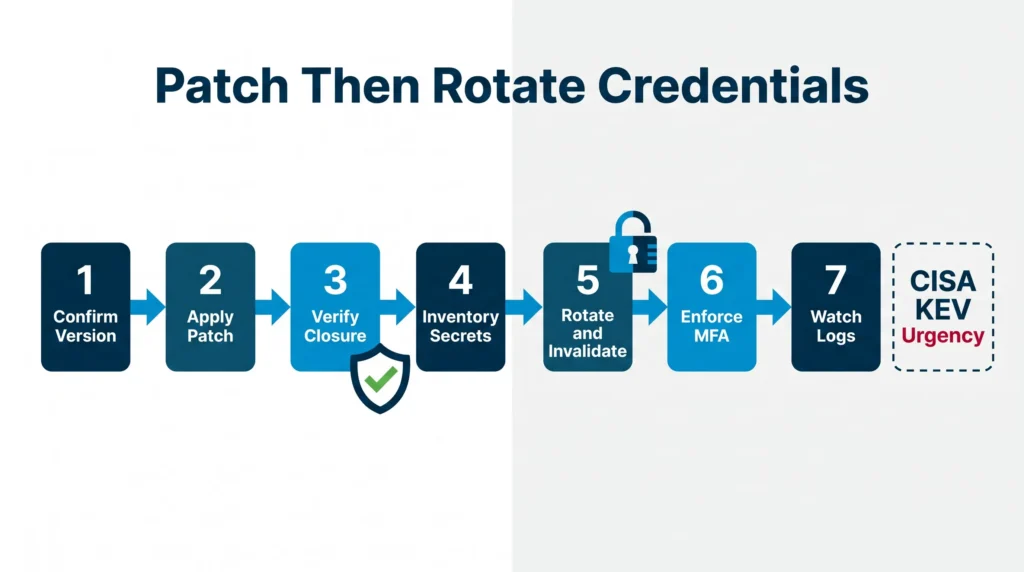
Vulnerability Management & Patching
If it’s in place:
Known weaknesses are identified and remediated continuously.
If it’s missing:
Attackers exploit known vulnerabilities that could have been prevented.
Identity & Access Control (MFA, Zero Trust)
If it’s missing:
Stolen credentials become the easiest path into the organization.
Email & SaaS Security
If it’s missing:
Phishing and account compromise drive financial loss and breaches.
Security Awareness Training
If it’s missing:
Employees unintentionally become the primary attack vector.
Log Visibility & Retention
If it’s missing:
Incidents cannot be reconstructed, and organizations cannot prove control effectiveness.
Governance, Risk & Compliance (GRC): From Policy to Proof
Cybersecurity is no longer judged by policies—it is judged by evidence.
A mature GRC system provides:
-
control mapping (NIST, CIS, HIPAA, CMMC, ISO)
-
policy governance and ownership
-
risk tracking and remediation (POA&M)
-
vendor risk management
-
audit-ready reporting
-
continuous evidence collection
If GRC is in place:
Audits, insurance reviews, and customer assessments become routine.
If it’s missing:
Organizations scramble for documentation and fail to demonstrate control maturity.
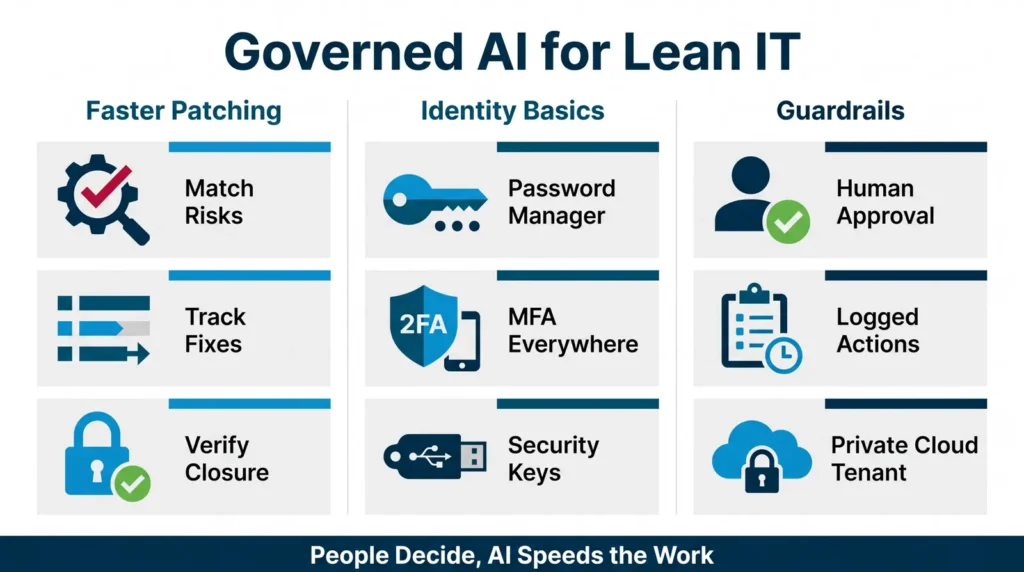
Explore how structured compliance IT services and Governed AI Solutions and Services support this model.
Continuous Validation: Penetration Testing, Remediation, and Incident Readiness
Cybersecurity has evolved from assumed protection to verified protection.
Penetration Testing
If it’s in place:
Real-world attack paths are identified before attackers find them.
If it’s missing:
Hidden vulnerabilities persist undetected.
Remediation & Retesting
If it’s in place:
Issues are tracked, fixed, and validated.
If it’s missing:
Security gaps accumulate over time.
Incident Response Planning
If it’s in place:
Teams respond quickly and effectively under pressure.
If it’s missing:
Confusion and delays increase the impact of incidents.
Continuous Evidence Collection
If it’s in place:
Organizations can prove compliance and support insurance claims.
If it’s missing:
Claims may be denied, and legal exposure increases.
AI Governance & PII Protection: The New Cybersecurity Frontier
AI is now part of cybersecurity.
Organizations must control how data is used, processed, and exposed through AI tools.
Why This Matters More Than Ever
Organizations over ~$25M in revenue—or operating across multiple states—face:
-
20+ state privacy laws in 2026
-
enforcement based on where the individual resides
-
overlapping legal obligations and exposure
Risks Without AI Governance
-
sensitive data leakage through AI tools
-
unauthorized data processing
-
lack of auditability
-
compliance violations
Risks Without PII Protection
-
regulatory fines
-
lawsuits
-
reputational damage
-
cyber insurance complications
Required Controls
-
data classification
-
least-privilege access
-
AI usage policies
-
monitoring and logging
-
vendor governance
-
data loss prevention (DLP)
-
continuous evidence
The Financial Reality: Internal IT vs. Co-Managed Cybersecurity
The biggest challenge is not understanding cybersecurity requirements.
It is operating them effectively and affordably.
Option 1: Build Internally
Typical requirements:
-
IT leadership
-
systems/network admin
-
security engineer
-
helpdesk staff
-
compliance support
Estimated annual cost:
-
50 users: often under-resourced
-
100 users: $300K–$500K+
-
200 users: $450K–$700K+
-
300 users: $600K–$900K+
Plus tooling:
-
$50K–$250K+ annually
Even at this level, many organizations still lack:
-
24/7 monitoring
-
integrated GRC
-
continuous validation
-
executive reporting
Option 2: Multiple Vendors
This creates:
-
fragmented accountability
-
duplicated costs
-
inconsistent reporting
-
security gaps
Option 3: Converged Co-Managed Model
This is where the market is shifting.
A co-managed model combines internal IT with an integrated external operating system.
How Co-Managed IT Works in 2026
A modern co-managed model includes:
-
PSA (ticketing & workflow)
-
RMM (endpoint management)
-
SIEM + SOC (security monitoring)
-
NOC (infrastructure monitoring)
-
helpdesk support
-
vulnerability management
-
compliance and reporting
This creates a shared responsibility model where:
-
internal IT retains control and business context
-
the provider supplies tools, monitoring, and depth
Explore BTI’s approach to AI Services and Solutions, managed IT services, and cybersecurity services.
What This Looks Like at Different Sizes
50 Users
Enterprise-grade tools without enterprise payroll.
100 Users
Internal IT augmented with continuous monitoring and compliance support.
200 Users
Stronger governance, reporting, and operational maturity.
300 Users
Enterprise-level visibility and resilience without enterprise overhead.
How BTI Changes the Equation
BTI delivers a converged operating system, not just services.
This includes:
-
always-on PSA, RMM, SOC, NOC, SIEM
-
vulnerability management and patching
-
GRC and evidence systems
-
penetration testing coordination
-
compliance and reporting
-
converged IT + cyber + physical security
This model:
-
extends internal IT
-
improves visibility and reporting
-
strengthens compliance posture
-
reduces cost through scale and automation
Explore the converged security model.
What Mid-Market Leaders Are Realizing in 2026
The challenge is no longer identifying risks.
It is operating cybersecurity in a way that is:
-
continuous
-
affordable
-
defensible
-
visible
This is why organizations are moving toward converged, co-managed, always-on models.
Key Takeaways
-
Cybersecurity is now a continuous operating system
-
Missing controls create real business risk
-
SIEM + SOC provide visibility and response
-
GRC provides proof and defensibility
-
Penetration testing validates security
-
AI governance and PII protection are now required
-
Multi-state privacy laws increase exposure
-
Co-managed IT is the dominant model
-
Scale improves both outcomes and cost
Frequently Asked Questions
What does cybersecurity include in 2026?
Cybersecurity includes endpoint protection, SIEM, SOC, vulnerability management, MFA, email security, awareness training, GRC, vendor risk management, AI governance, PII protection, incident response, and continuous evidence collection.
What is co-managed IT?
A shared model where internal IT works alongside an external provider that delivers tools, monitoring, security operations, and specialized expertise.
Why is AI governance part of cybersecurity?
Because AI systems can expose or misuse sensitive data, requiring controls, monitoring, and policy enforcement.
Why are privacy laws important?
Because breaches and poor controls can trigger regulatory action, lawsuits, and insurance issues across multiple states.
Why do mid-market companies struggle with cybersecurity?
Because they often lack the staff, tools, and continuous monitoring required to operate a modern cybersecurity program internally.
Final Perspective
Cybersecurity in 2026 requires more than point solutions.
It requires:
-
visibility
-
governance
-
validation
-
accountability
-
continuous operation
For mid-market organizations, the real challenge is delivering all of that without building an oversized internal organization.
That is why the market is shifting toward converged, co-managed models.
Final Recommendations
If your organization is ready to move from fragmented tools and reactive support to a continuous, evidence-driven operating model, explore BTI’s cybersecurity services, managed IT services, compliance IT services, and unified converged security approach.
Message from Eric Brackett, Founder of BTI On How BTI Helps with Cybersecurity and IT Efficiency and Productivity in Both Fully Managed and Co-Managed IT Services Plans
Need Help Navigating Security Compliance Requirements
BTI helps organizations simplify cybersecurity, compliance, and physical security into a unified protection strategy.