



Recent headlines like the LA Times article, (Why people in L.A. are strapping cameras on their bodies to do chores – Los Angeles Times), highlight the value of using video to train artificial intelligence systems.
These types of headlines have brought new attention to how AI learns from the physical world. The premise is straightforward: AI needs to observe how humans interact with real environments in order to understand how work is actually performed.
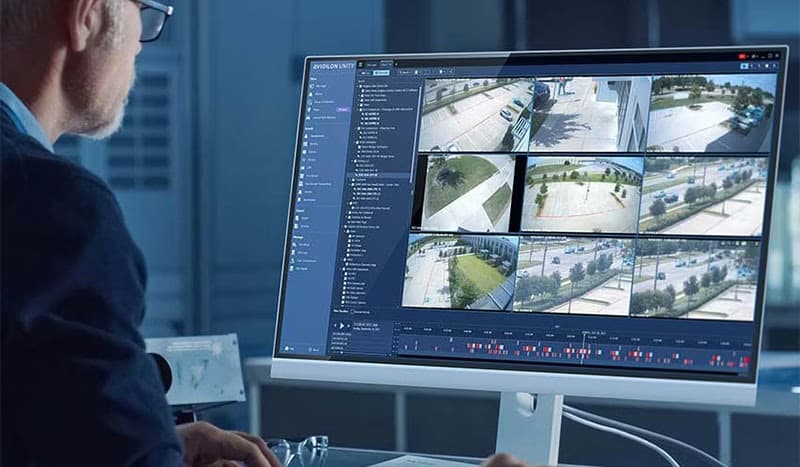
For most organizations, however, this concept is not new. Any company operating a warehouse, manufacturing facility, hospital, food production environment, or municipal system already has infrastructure that captures this exact type of data continuously.
That infrastructure is the security camera system.
What has changed is not the availability of data. What has changed is the ability—and increasingly the expectation—that organizations should be able to use that data for both AI training and real-time decision-making.
Whether that is possible depends almost entirely on how the camera environment is designed.
The Two Video Pipelines AI Actually Requires
To understand why some AI projects succeed while others fail, it is important to separate two fundamentally different technical requirements. These are often grouped together under “AI video,” but they operate very differently and place very different demands on infrastructure.
1. Recorded Video for AI Training
AI systems do not begin by making decisions. They begin by learning patterns. That learning process requires large volumes of recorded video that reflect real-world conditions over time.
What matters here is not just having video, but having video that is consistent, accessible, and complete enough to represent both normal operations and edge cases. The model needs to see variation—good outcomes, bad outcomes, and everything in between.
This is where many organizations already have a hidden advantage. Their camera systems have been capturing operational data for years. The challenge is that most of this data is locked inside systems that were designed for security review, not data extraction.
Manufacturing Example: How AI Actually Learns Defects
Consider a manufacturer trying to train an AI model to detect packaging defects. From a technical standpoint, the model is not “looking” for defects in a human sense. It is learning statistical differences between images.
To do that, it needs exposure to thousands—or more often tens of thousands—of frames that include both correct and incorrect outputs. Each frame becomes part of a dataset that is processed through a training pipeline, typically involving convolutional neural networks or similar architectures.
If the video system only retains 14–30 days of footage and limits export capability—as is common in cloud-only systems—the dataset becomes incomplete. The model may never see enough examples of rare defects to learn them properly.
In contrast, an on-prem or hybrid system with extended retention and API-level access allows engineers to extract large datasets programmatically. That data can then be fed into training pipelines running on GPU infrastructure, where the model iteratively improves its ability to distinguish acceptable from defective output.
This is often the point where organizations realize that the success of AI has less to do with the algorithm and more to do with whether they can access their own data.
Logistics Example: Turning Video Into Operational Intelligence
In a warehouse environment, the same principle applies, but the objective is different. Instead of detecting defects, the goal is often to understand movement patterns.
Recorded video allows AI systems to reconstruct how forklifts move through space over time. By analyzing trajectories across thousands of hours of footage, the system can identify patterns such as congestion zones, inefficient routing, or repeated delays at specific intersections.
What makes this powerful is that it does not require real-time AI. The analysis happens offline. The output is not an alert—it is a model of how the facility actually operates.
That model can then inform decisions about layout, staffing, and scheduling. In many cases, this produces measurable improvements without changing any physical infrastructure.
Healthcare Example: Why Video Becomes Operational Data
In healthcare environments, the value of recorded video is often tied to time rather than motion. AI systems can analyze how long patients spend at each stage of care, how quickly staff respond, and where delays occur.
Technically, this involves tracking objects (patients, staff) across frames and correlating those movements with timestamps. Over time, patterns emerge that are difficult to detect manually.
For example, a hospital may discover that delays are not caused by staffing shortages, but by room turnover inefficiencies or bottlenecks in triage processes. These insights come directly from analyzing recorded video as structured data.
Food Processing Example: From Compliance Recording to Compliance Intelligence
Food processing environments already rely heavily on video for compliance. However, most systems are used reactively—reviewing footage after an issue occurs.
When AI is introduced, the same footage can be analyzed proactively. The system can evaluate whether cleaning procedures are performed in the correct sequence, whether timing requirements are met, and whether deviations occur between shifts.
From a technical perspective, this involves recognizing sequences of actions rather than single events. The AI is not just detecting objects; it is interpreting workflows.
This shift—from recording compliance to analyzing compliance—is where AI begins to deliver operational value.
Municipal Example: Scaling Insight Across Infrastructure
Municipal systems present a different challenge: scale. Cities may have thousands of cameras distributed across intersections, transit systems, and facilities.
Recorded video allows AI systems to analyze patterns across this entire network. Instead of reviewing isolated incidents, municipalities can evaluate how traffic flows over time, how crowds move during events, and how infrastructure is used under different conditions.
This type of analysis requires not just storage, but the ability to aggregate and process video data across multiple locations. Again, the limiting factor is not the presence of cameras, but the accessibility of the data.
Key Insight
Most organizations already possess the raw material needed for AI. The determining factor is whether their infrastructure allows that material to be accessed, processed, and used effectively.
2. Live Video for Real-Time AI (Inference)
Once an AI model has been trained, it must operate on live video streams. This is where the system transitions from analysis to action.
Technically, this process is called inference. The trained model processes each frame of video and produces an output—such as detecting an object, identifying a condition, or triggering an event.
Unlike training, which can tolerate delays, inference is highly sensitive to latency.
Manufacturing Example: Why Latency Matters
In real-time quality control, the AI system must evaluate each product as it passes through the line. If detection occurs even a fraction of a second too late, the defective product may already have moved downstream.
When video is routed through cloud infrastructure, it introduces multiple stages of delay: encoding, transmission, processing, and return of results. Each stage adds latency.
Local processing—whether at the edge (camera) or on-site GPU servers—removes most of these delays. The model processes the video directly where it is generated, allowing for near-instantaneous response.
This is why real-time industrial AI systems are almost always built on local or hybrid architectures.
Warehouse Example: Continuous Risk Detection
In a warehouse, real-time AI is often used for safety. The system continuously evaluates the distance between forklifts and pedestrians, detects unsafe speeds, and identifies restricted area violations.
This is not a one-time calculation. It is a continuous stream of inference, frame by frame.
For this to work reliably, the system must maintain a consistent video feed with minimal interruption. It must also operate within defined parameters to avoid excessive false positives.
The technical challenge is not just detection—it is maintaining a stable, low-latency pipeline that can support continuous evaluation.
Healthcare Example: High-Sensitivity Environments
In healthcare, real-time AI often operates in environments where both accuracy and speed are critical. For example, fall detection systems must identify events quickly enough to trigger immediate response.
These systems rely on models trained to recognize posture changes, movement patterns, and anomalies. They process live video continuously, and any delay in detection can reduce effectiveness.
This is why these deployments typically require tightly controlled environments, high-quality video feeds, and local processing.
Municipal Example: Real-Time Decision Support
In municipal environments, real-time AI can support decision-making rather than direct automation. For example, analyzing traffic flow in real time can allow systems to adjust signal timing or alert operators to congestion.
Here, the goal is not zero latency, but predictable latency. The system must deliver insights within a time frame that is useful for decision-making.
Food Production Example: Immediate Risk Mitigation
In food production, real-time AI can detect anomalies in process flow or worker behavior that may introduce contamination risk.
The key requirement is immediate visibility. If a deviation is detected, the system must alert operators quickly enough to intervene before the issue escalates.
Why Most AI Camera Deployments Underperform
The gap between expectation and reality is almost always architectural.
Cloud-based platforms are designed for convenience and centralization. They excel at delivering alerts and simplifying management. However, they limit access to raw data and introduce latency that can constrain advanced AI use cases.
On-prem and hybrid systems, while more complex to deploy, provide the flexibility needed for AI. They allow organizations to retain control of their data, integrate with compute resources, and design pipelines that match their specific requirements.
Axis as an Example of AI-Ready Design
Axis has maintained an open architecture approach for over a decade, which aligns well with AI requirements.
The VAPIX API framework allows direct access to video streams and camera controls. This enables integration with external systems, including AI processing pipelines.
Dual stream capability allows one stream to be used for recording while another is routed to AI processing. This separation is critical for maintaining performance and flexibility.
Edge compute capabilities allow cameras to perform preprocessing tasks, reducing bandwidth requirements and enabling distributed processing models.
The Role of VMS Platforms
Video Management Systems are often treated as storage tools, but they function as the primary interface between video data and external systems.
They determine how video is indexed, how it can be accessed, and how it can be integrated with analytics platforms.
In AI deployments, the VMS effectively becomes the gateway through which data flows into training and inference pipelines.
Body Cameras and First-Person AI
Body cameras introduce a different type of data—first-person perspective. This is particularly valuable for training AI systems that need to understand human actions at a detailed level.
For example, a field technician performing maintenance provides a sequence of actions that can be used to train procedural models. These models can then assist in training new employees or guiding automated systems.
The Strategic Reality
Most organizations are closer to AI readiness than they realize. They already have the sensors, the data, and the operational context.
What they need is alignment between infrastructure, data access, and compute capability.
What an AI-Ready Camera Environment Requires
An effective AI-ready environment brings together four layers:
- a data layer where video is accessible and retained appropriately
- a compute layer capable of processing that data efficiently
- an integration layer that connects video systems to analytics and operations
- a security layer that protects the entire environment
Where This Is Working Today
AI is already delivering value in areas such as manufacturing quality analysis, warehouse optimization, safety monitoring, compliance auditing, and healthcare operations.
These are not experimental use cases. They are practical applications built on infrastructure that allows video data to be used effectively.
The Strategic Takeaway
The question organizations should be asking is not whether they have AI cameras.
The question is whether their infrastructure allows AI to learn from and act on their data.
What to Evaluate Next
Organizations should assess their current environment with a focus on:
- where video is stored and who controls it
- how easily video can be accessed and exported
- whether latency supports real-time use cases
- whether compute resources are available
Final Thought
The organizations that succeed with AI will not be those that adopt the most advanced tools first.
They will be the ones that build infrastructure capable of turning video into usable data, and data into actionable intelligence.
Is Your Camera Infrastructure Ready for AI?
Most organizations already have the data, few have the architecture to use it. Discover what a modern, AI-ready security environment actually requires.
FAQ
What is the difference between AI training and real-time inference?
AI training uses recorded video to build models, while inference uses live video streams to generate real-time outputs.
Why is on-prem or hybrid infrastructure better for AI?
It allows for lower latency, greater control over data, and deeper integration with processing systems.
Can existing camera systems support AI?
Yes, provided they allow access to video data and can integrate with compute and analytics platforms.