Healthcare Security Systems Guide 2026
Welcome to the Healthcare Security Systems Guide 2026.
This guide helps healthcare organizations modernize physical security, cybersecurity, compliance, and infrastructure without operational chaos.
It’s essential for Chief Information Officers, Information Technology Directors, Compliance Leaders, Facility Leaders, and Security or Environment of Care Leadership.
This guide explores the convergence of physical access control, video surveillance, network infrastructure, cybersecurity, compliance, and AI-enabled managed and co-managed IT, and converged cybersecurity and site safety operations.
Multi-site healthcare groups, ambulatory centers, and regional clinic networks will find strategies for managing security and compliance across distributed sites.
If you protect patients, data, or operations, this guide is for you.
Healthcare security in 2026 is shaped by ten strategic themes:
- Cyber-physical convergence treats physical security systems as cyber assets.
- AI-assisted cyber and physical event monitoring enhances detection and anomaly identification.
- Centralized governance and compliance automation streamline oversight and documentation.
- Operational resilience and infrastructure standardization ensure consistent security.
- Insurer-driven controls and Internet of Things governance set new standards.
- Zero-trust architecture reduces cyber risk and incident impact.
This self-assessment tool benchmarks your healthcare organization’s security posture across ten domains. Evaluate your multi-factor authentication deployment, virtual local area network segmentation, security information and event management integration, and more.
Progress from reactive to optimized levels, enhancing security and compliance. Optimized organizations excel in cyber insurance, Office for Civil Rights audits, and incident response.
Understanding the Threat Environment in Healthcare
We’ll explore the complexities of ransomware, workplace violence, regulatory pressures, and aging infrastructure.
Notably, healthcare data breaches cost an average of $10.9 million per incident in 2024, marking the highest across industries for the 14th year.
Healthcare faces interconnected physical and cyber threats. A propped door or unsecured network can be entry points.
Ransomware attacks rose 94% from 2021 to 2023, with recovery costs over $1.27 million per incident. Workplace violence rates are 5x higher than other industries.
Security strategies must handle both physical and digital defenses to address these vulnerabilities.
Traditional security models in healthcare often fail due to fragmented technology stacks, overwhelming security alerts, and the resulting operational and compliance risks.
A converged model offers the potential for improved system performance, IT staff efficiency, and risk reduction.
BTI’s goal is to assist clients in achieving lower cost security operations management AND improved security all at the same time.
Section Two: Converged Security Infrastructure
We’ll explore how integrating physical security, cybersecurity, information technology infrastructure, communications, and compliance into a unified framework enhances threat detection, response, and recovery in healthcare organizations.
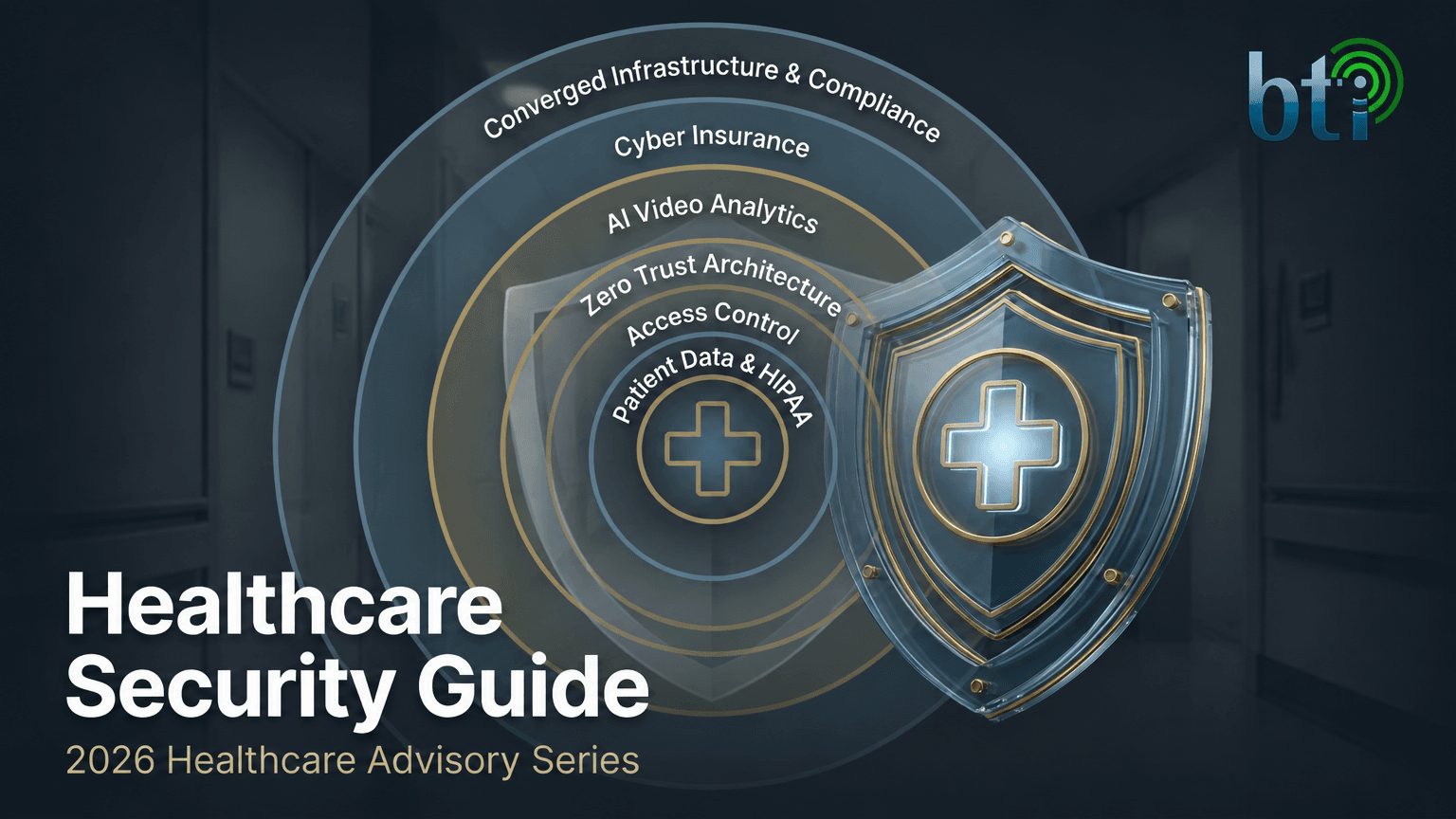
The BTI Converged Security Reference Architecture integrates five pillars: physical security, cybersecurity, IT infrastructure, communications, and compliance governance.
This unified framework enhances security, compliance, and resilience. It features AI-infused operations, collaboration between NOC, SOC, field engineers, and client IT resources to produce a single audit trail, compliance automation, operational resilience, and lifecycle governance.
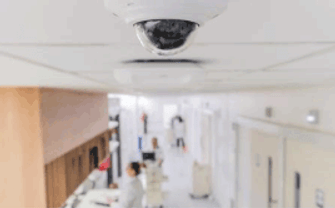
Healthcare video surveillance has evolved into an operational intelligence platform, offering real-time situational awareness and AI-enabled analytics. Modern systems detect anomalies and enhance perimeter safety.
Compliance requires aligning evidence retention with HIPAA and legal standards. Unmanaged cameras pose cybersecurity risks.
In healthcare, physical security systems are also cybersecurity assets. Ensure network segmentation by placing security devices on dedicated VLANs. Track firmware versions and patch regularly. Implement Multi-Factor Authentication and role-based access. Integrate converged physical and computer credentials and SIEM for the gold standard in physical and IS zero-trust credential security.
Cyber insurance underwriters now demand rigorous audits of healthcare security infrastructure.
Compliance, Operations, and Infrastructure Resilience
Compliance is an ongoing discipline, not a checkbox. HIPAA requires documented policies, technical controls, and audit trails.
For multi-site healthcare operations, centralized visibility is crucial. The BTI GlobalView Service Platform offers scalable, centralized visibility for multi-site healthcare security, IT, and compliance operations.
Network infrastructure is crucial for healthcare security. It supports all systems, and failures risk patient care and data. BTI manages and sells Cisco cloud-managed switching, Ekahau Wi-Fi, SD-WAN, and managed UPS systems.
Section Four: AI, Intelligence & the Future of Healthcare Security
In 2026, BTI is already deploying AI-infused NOC and SOC, vulnerability management, and GRC tools to improve efficiency and lower response times by more than 50%.
By 2027, AI-assisted monitoring and remediation will reduce detection times to near zero for security incidents in healthcare.
Client Success Stories
BTI supports many multi-site medical provider networks. One multi-site clinic network achieved a $180,000 annual vendor cost reduction and favorable cyber insurance renewal terms.
Another ASC and imaging group achieved zero Joint Commission findings and standardized locations.
BTI Solutions
BTI partners with top manufacturers including Avigilon, Axis, Brivo, Kantech, RS2, Software House, HID Global, and more. We offer AI-powered video surveillance, physical access control, converged credentials, cybersecurity tools, NOC, SOC, SIEM, and managed/co-managed services.
BTI offers vendor-neutral evaluations, executive advisory services, and tailored solutions from assessment through managed operations.
This guide is for informational purposes only and is not legal advice. Consult legal counsel for HIPAA obligations.
All content is current as of May 2026.