




Key Takeaways
Private cloud provides dedicated computing resources that can be configured
around an organization’s security, performance, and operational requirements.
The main benefits of private cloud computing include greater infrastructure control,
increased customization, more predictable performance, and better support for sensitive data. around an organization’s security, performance, and operational requirements.
A dedicated environment can also support legacy applications and integrate closely
with existing on-premises systems.
These advantages come with tradeoffs. Private cloud may require a higher initial
investment, more technical expertise, and greater management responsibility.
The benefits of using private cloud are strongest when workloads are stable,
applications require dedicated resources, or the organization has strict security and data-governance requirements.
Public or hybrid cloud may be more suitable when demand is unpredictable
or the organization needs to scale resources quickly.
What is Private Cloud ?
Private cloud is a cloud computing environment dedicated to a single organization. It uses technologies such as virtualization, centralized management, and resource automation to provide cloud-based computing, storage, and networking without placing the organization in a standard multi-tenant environment.
A private cloud may operate inside the organization’s own data center or be hosted in a third-party facility. It may also be managed internally, supported by an outside provider, or operated through a combination of both.
What makes the environment private is not simply where it is located. The defining characteristic is that the environment and its resources are reserved for one organization or logically isolated for its use.
Learn more about what are private cloud services, the technologies behind them, and their most common business use cases.
KEY TAKEAWAY
According to a Gartner forecast, the worldwide cloud-managed-services market would reach $130.4 billion in 2027, representing a 15.1% five-year compound annual growth rate in constant U.S. dollars.
Types of Private Cloud
Private clouds can be deployed and managed in several ways.
On-Premises Private Cloud
An on-premises private cloud operates inside the organization’s own facility or data center. The business controls the servers, storage, networking equipment, software, and physical environment.
Hosted Private Cloud
A hosted private cloud is dedicated to one organization but located in a third-party data center. The organization receives private computing resources without maintaining the physical data center facility itself.
Managed Private Cloud
A managed private cloud is operated or supported by an outside provider. The environment may be on the business’s premises or in a provider’s data center. This can reduce the internal workload, although the organization still needs appropriate governance and vendor oversight.
Virtual Private Cloud
A virtual private cloud, or VPC, is an isolated virtual environment created within a larger public cloud platform. It can provide private networking, access controls, segmentation, and customized security configurations.
A VPC offers more isolation than using standard public cloud resources without dedicated network controls, but it is not necessarily the same as having dedicated physical infrastructure. The underlying provider hardware may still support multiple customers.
Public, Private and Hybrid Cloud Comparison
Public, private, and hybrid cloud models can support applications, data, users, and business operations. The primary differences involve who uses the underlying infrastructure, who manages it, and how much control the organization retains.
| Factor | Public Cloud | Private Cloud | Hybrid Cloud |
|---|---|---|---|
| Resource Model | Provider infrastructure supports multiple customers. | The environment is dedicated to one organization. | Combines private, public, and sometimes on-premises resources. |
| Infrastructure Control | The provider controls most of the underlying infrastructure. | The organization or its chosen provider has greater control. | Control depends on where each workload operates. |
| Customization | Usually based on standardized provider services. | Can be customized around specific technical requirements. | Sensitive or specialized systems can remain private while other workloads use public cloud. |
| Scalability | Resources can generally be added quickly through the provider. | Scaling depends on available capacity or the provider agreement. | Public cloud capacity can supplement private infrastructure. |
| Initial Investment | Often lower because the provider supplies the infrastructure. | Can be higher, especially for self-hosted environments. | Varies according to the combination of services. |
| Management Responsibility | The provider manages the physical infrastructure. | The organization or private-cloud provider manages the environment. | Responsibilities are divided between internal teams and providers. |
| Common Fit | Variable workloads, rapid deployment, and standardized applications. | Sensitive, specialized, stable, or business-critical workloads. | Organizations with different requirements across multiple workloads. |
The decision isn’t always private cloud versus public cloud. Many organizations assign each workload to the environment that best meets its security, performance, integration, and financial requirements.
The Benefits of Private Cloud
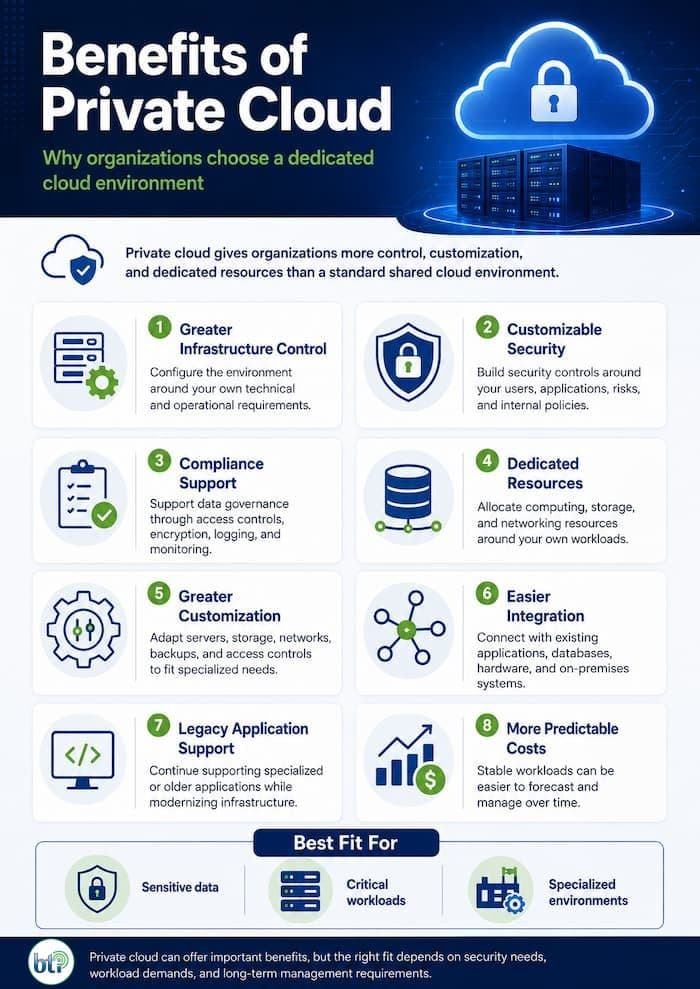
Private cloud provides organizations with greater authority over how their computing environment is designed and operated. This can be valuable when standard public cloud configurations do not adequately support the business’s applications, security requirements, performance expectations, or existing infrastructure.
The benefits are not automatic. They result from the organization’s ability to configure the environment around its needs and from effectively managing the infrastructure over time.
Greater Control Over IT Infrastructure
One of the primary benefits of private clouds is greater control over the underlying IT environment. In public cloud, the provider makes many decisions about the underlying infrastructure and offers customers a predefined catalog of services. Private cloud gives the organization more ability to adapt the environment to its own technical and operational requirements.
This does not necessarily mean the business must manage everything internally. A hosted or managed private-cloud provider can operate the infrastructure while still giving the customer more control than a standard shared environment.
Customizable Security Architecture
Private cloud allows a business to build security controls around its own users, applications, risks, and internal policies. Because the environment is dedicated to one organization, its security architecture does not need to follow a single standardized configuration intended to serve many unrelated customers.
Better Support for Compliance and Data Governance
Private cloud gives organizations greater control over where sensitive information is stored, who can access it, and how activity is monitored.
This helps organizations support compliance and data-governance requirements through configurable controls for access permissions, encryption, logging, segmentation, backups, retention, and security monitoring. Private cloud does not guarantee compliance, but it can provide the infrastructure needed to support frameworks such as HIPAA, PCI DSS, and SOC 2.
KEY TAKEAWAY
Flexera’s 2026 State of the Cloud survey covered 753 cloud decision-makers and users worldwide. It found:
- 60% of respondents currently use a managed service provider to manage public cloud.
- Adoption was 65% among enterprises and 39% among SMBs.
- A further 9% of respondents said they planned to use an MSP.
Dedicated Computing Resources
Private cloud gives organizations dedicated computing, storage, and networking resources that can be allocated around the needs of their applications, reducing resource contention while delivering more consistent performance.
Dedicated infrastructure is especially valuable when workloads require stable capacity and predictable processing power. However, the environment must still be properly sized and configured to deliver those benefits.
Greater Customization
Private cloud gives organizations more freedom to configure servers, storage, networks, security tools, operating systems, backups, and access controls around their specific requirements.
This is especially valuable for businesses running specialized software, legacy applications, or workloads that do not fit easily within standardized public cloud services.
Easier Integration With Existing IT Systems
Private cloud can be designed to connect with existing applications, databases, hardware, authentication systems, and other on-premises resources.
This makes it easier for organizations to modernize infrastructure without replacing every system at once, while maintaining greater control over how those connections are configured and secured.
Support for Legacy and Specialized Applications
Private cloud can provide a flexible environment for applications that require specific operating systems, hardware, databases, network configurations, or licensing models.
This allows organizations to modernize their infrastructure while continuing to support critical legacy or specialized applications that may not be well suited for a standard public cloud environment.
Greater Control Over Data Location
Private cloud gives organizations more control over where sensitive data is stored. This can help businesses meet data security requirements while improving visibility into who can access sensitive information and where it is maintained.
On-premises private cloud provides the most direct control, while hosted private cloud can offer greater location transparency depending on the provider and service agreement.
Control Over Maintenance and Upgrade Schedules
Public cloud providers determine when many underlying services, features, and platforms are updated. Customers cannot control every infrastructure-level change. With private cloud, the organization or its provider can coordinate updates around operational schedules, application testing, and business requirements.
This can be useful for organizations that need to:
- Test application compatibility before an upgrade
- Avoid infrastructure changes during critical business periods
- Follow formal change-management procedures
- Maintain specific software versions
- Coordinate updates across dependent systems
Delaying updates can also introduce security and support risks. Control over timing should be used to manage upgrades responsibly, not to leave systems unpatched indefinitely.
Potentially More Predictable Costs for Stable Workloads
A dedicated environment can make infrastructure costs easier to forecast when workloads are stable, continuously used, and properly sized.
Instead of paying fluctuating consumption-based charges, the organization operates within a defined level of capacity and can plan around known expenses such as hosting, licensing, support, and maintenance.
This does not always make it cheaper than public clouds. The financial value depends on long-term usage, management costs, and how efficiently the available resources are used.
The Disadvantages of Private Cloud
Private cloud provides greater control, but that control also creates more responsibility. Before deciding if private cloud is right for your organization, you should consider the following:
Higher Initial Investment
Building a dedicated environment can require significant upfront spending on servers, storage, networking, software, security tools, backups, and data-center infrastructure.
Hosted and managed options can reduce equipment costs, but they still involve provider, licensing, migration, and support expenses. Compared with public cloud, this model often requires a greater financial commitment before deployment.
More Management Responsibility
Running a dedicated environment requires continuous administration. Systems need to be continuously monitored, updated, secured, and tested to make sure they remain reliable.
A managed provider can take on much of this work. However, the organization must still set expectations, review performance, and remain accountable for its data and operations.
Need for Specialized Technical Expertise
Designing and operating private cloud requires knowledge across several areas, including servers, virtualization, storage, networking, cybersecurity, identity management, backup, automation, and application support.
An organization without sufficient internal expertise may experience configuration problems, performance issues, security gaps, or longer outages.
Capacity Planning Requirements
Private cloud capacity is limited. The organization must ensure that sufficient processing power, memory, storage, network capacity, and backup resources are available.
Accurate capacity planning requires an understanding of current utilization, expected growth, application behavior, storage requirements, redundancy, and future projects.
If the business underestimates future demand, it may need to purchase, install, and configure additional equipment. If it overestimates demand, expensive infrastructure may remain underused.
Scaling May Require More Planning
A dedicated environment can scale, but expansion may require new equipment, added provider capacity, or infrastructure upgrades.
For businesses with unpredictable demand, hybrid clouds may offer more flexibility by keeping stable workloads private and using public cloud when extra capacity is needed.
Risk of Underused Infrastructure
Dedicated resources can become expensive when a business purchases more capacity than it needs. Virtualization can improve efficiency, but it cannot fully offset the cost of servers, storage, or licenses that remain underused.
Private Cloud Can Be More Complex
A dedicated environment can be harder to manage because it often includes multiple interconnected technologies and management layers. Troubleshooting and upgrades may require more expertise, especially in hybrid environments that connect private infrastructure with public cloud and on-premises systems.
Organizations should avoid adopting private clouds only because it offers greater control. The additional control must solve a genuine business or technical requirement that justifies the complexity.
When To Use Private Cloud
Private cloud is most valuable when an organization has clear requirements that cannot be addressed as effectively through a standard public cloud environment.
A business may consider private clouds in the following situations.
- Sensitive or regulated data must be protected: Organizations handling financial records, healthcare information, legal documents, intellectual property, or confidential customer data may benefit from a dedicated environment with customized security controls.
- Governance and data-location requirements are strict: Greater control over where information is stored, who can access it, and how long it is retained can help support regulatory requirements, customer agreements, and internal policies.
- Critical applications require consistent performance: Databases, ERP systems, analytics platforms, and other essential applications may benefit from dedicated resources that can be allocated around their processing and availability needs.
- Workloads are stable and continuously used: Applications with predictable demand may be easier to size, manage, and budget for in a dedicated environment.
- Specialized or legacy applications must be supported: Some systems require specific operating systems, hardware, databases, licensing models, or network configurations that may not fit easily within standardized public cloud services.
- Existing systems require close integration: A dedicated environment can be designed to connect with on-premises applications, internal databases, authentication platforms, or specialized equipment.
- Infrastructure must be highly customized: Businesses may need greater freedom to select their network design, security tools, storage architecture, access controls, or recovery policies.
- The organization has the expertise and budget to manage it: Private cloud works best when qualified internal staff or a trusted provider can support the environment and when the long-term value justifies the added cost and responsibility.
Private clouds are not necessary for every workload. It is most effective when the additional control solves clear security, operational, compliance, or technical requirements.
Private Cloud Decision Checklist
Private cloud may be worth evaluating when several of the following statements are true:
- We operate applications that require consistent, dedicated resources.
- We need more control over infrastructure and security configurations.
- We handle sensitive or regulated data.
- We must control where data and backups are located.
- We depend on specialized or legacy applications.
- We need to integrate closely with existing on-premises systems.
- Our workloads are stable and used continuously.
- We have the expertise or provider support needed to manage the environment.
If few of these conditions apply, public cloud may provide the necessary functionality with less cost and management complexity. If only certain workloads meet these conditions, a hybrid approach may be more appropriate.
Choosing the Right Cloud Environment
Private cloud can provide important benefits, but greater control also brings greater responsibility. The right decision depends on the applications being supported, data sensitivity, performance expectations, integration requirements, available expertise, growth plans, and total cost of ownership.
Before committing to a private-cloud deployment, assess the existing infrastructure, document application requirements, compare long-term costs, and determine who will manage and secure the environment.
Not sure which cloud strategy is right for your organization? BTI Communications Group can help you evaluate private cloud, public cloud, and hybrid cloud solutions based on your business goals, security requirements, and long-term growth plans.
Get a cloud strategy built around your business, not a template.
We help you compare cost, security, and performance across private, public, and hybrid deployments